

Angel Number 777 Meaning: The Luck Number That Points Inward
In the numerology tradition that reads it, angel number 777 means you are on your path: the 7 stands for the inner life, for study, spirituality and retreat, and three sevens are read as that quality amplified, a quiet "keep going, and go deeper." At the same time, 777 is the loudest luck symbol on earth, the jackpot row on a slot machine, and the honest meaning of this number lives exactly in the space between those two readings. Almost every page about 777 blurs them into one. This article keeps them apart on purpose, because luck that falls on you from outside and knowledge that grows in you from inside are two different promises, and knowing which one has found you is worth more than any table of number meanings.
What angel number 777 means in numerology
Three things to hold before anything else:
- What: 777 is the digit 7 written three times. Modern numerology reads the 7 as the seeker's number: introspection, knowledge, spirituality, and the rare ability to stay alone with a question until it answers. The 7 is not a master number; the tradition reserves that rank for 11, 22 and 33. What gives 777 its weight is repetition: the seeker's number, three times in a row.
- When: no clock ever shows 777. Its daily echoes are 07:07 and 17:17, two of the 1,440 minutes in a day, and its calendar home is July 7, the 7th day of the 7th month. Most encounters happen elsewhere: an odometer, a receipt, an order number, a timestamp, a follower count.
- Where it stands: 777 is numerology and modern folk tradition, not astrology. No planet, no zodiac sign and no degree belongs to this number. Every claim in this article is either attributed to its named tradition or absent, and that is deliberate.
In the tradition's own reading, the 7 is the number that turns away from the market square. Where the 1 begins things and the 3 expresses them, the 7 withdraws to understand them: it is read as the student, the mystic, the one who needs the door closed before anything true can be said. Seen that way, 777 is not a louder 7 but a deeper one. The tradition reads tripled digits as amplification, so three sevens become the unmistakable version of a quiet message, something like: the direction is right, stay with it, and go further in than feels comfortable.
Numerology also loves to add digits until one remains. 7 plus 7 plus 7 makes 21, and 2 plus 1 makes 3, which the tradition reads as the number of expression and communication. Inside its own logic, 777 therefore carries a hidden second act: what you learn in private will one day ask for a voice. The seeker's number, tripled, quietly points toward the moment the seeking gets shared.
Notice the verbs doing the work in those paragraphs: reads, holds, points. Numerology is a symbolic language with its own internal grammar, and it deserves to be quoted as exactly that. It is a meaning system, not a proof system. That does not make it worthless. It makes it what it has always been: an old way of giving inner states a shape, told in numbers instead of stories.
The other 777: the loudest luck symbol on earth
Before anyone read angels into this number, 777 already had a job, and it could not be more different. The first coin machines with spinning reels appeared in San Francisco in the 1890s, and as they spread, the row of three sevens grew into the most recognizable jackpot symbol ever printed: it glows on slot machines, scratch cards, lottery logos and casino carpets on every continent. Type 777 into a search engine today and meaning and money arrive in the same list of results. English even keeps a phrase for it, the lucky seven: casinos print it, lotteries name entire games after it, and by the time three of them line up, the digits are not really digits anymore. They are shorthand for the moment life finally tips in your favor.
Even the seven's reputation as a gambler's number has honest math underneath it. Roll two dice and there are 36 possible combinations; exactly 6 of them add up to seven, more than any other sum. Seven is the most likely total on the table, arriving on average once in every 6 throws, which is why entire dice games follow its rhythm.
That is the outer 777: luck as an event. It comes from outside, instantly and in public, and it is loud by design: coins crashing into a metal tray, flashing lights, a bell. You do nothing for it, which is the whole point. The machine decides, and the room turns its head.
The numerological 7 is the exact opposite of that scene. Its promises face inward: understanding instead of winnings, depth instead of noise, a path instead of an event. It is slow where the jackpot is instant, private where the jackpot is public, and silent where the jackpot rings. Nobody sounds a bell when you finally understand something about yourself.
So the same three digits carry our culture's loudest idea of good fortune and its quietest idea of wisdom. That collision is not a flaw in 777. It is the most precise thing about it, because underneath the moment you notice the number sits a real question: which of the two are you actually hoping for, luck from outside or confirmation from within?
Where the seven got its weight
The seven was heavy long before anyone put it on a reel. The seven-day week reaches back to ancient Babylon. When Isaac Newton described the rainbow, he counted seven colors on purpose: he wanted light to rhyme with the seven notes of the musical scale, so orange and indigo made the list. Fairy tales are crowded with sevens, seven ravens, seven dwarfs, seven seas, and the ancient world kept exactly seven wonders. A number that appears in that many places stops being a quantity and becomes a mood.
Numerology gave that mood a system. Its followers trace the lineage back to Pythagoras in the 6th century BCE, whose school treated numbers as carriers of order and meaning rather than mere counting tools. Over the centuries that impulse moved through Jewish, Christian and Islamic number symbolism, always circling the same conviction: that certain numbers do not just measure the world but say something about it.
The specifically angelic reading is far younger. The phrase angel numbers became a household term in the mid-2000s, largely through the bestselling books of Doreen Virtue, whose "Angel Numbers" appeared in 2005 and attached the much older guardian angel tradition to repeating digit sequences on clocks, receipts and license plates. So when 777 is called an angel number, two ages meet in one phrase: an ancient longing to find meaning in numbers, and a very recent, very American way of addressing it. Naming that honestly does not make the tradition smaller. It tells you what you are holding: a modern devotion resting on one of the oldest habits of the human mind.
Why you keep seeing 777 right now
Now the part almost nobody writing about 777 says out loud. Your attention is not a neutral camera. It filters millions of impressions a day and promotes the ones that repeat, glow or rhyme, and three identical digits are exactly the kind of pattern it exists to catch. Once 777 has caught you twice, a second mechanism joins in: the frequency illusion, named by the linguist Arnold Zwicky in 2005, in which anything recently noticed suddenly seems to be everywhere. Selective memory completes the loop. You remember every 777 and none of the 494s, so the pattern feels like it is building, because in your memory it genuinely is.
One more honest detail belongs here: sevens cluster in the world because we put them there. Price tags, bonus codes, hotline numbers and license plates lean on the lucky seven on purpose, so a day that hands you a 777 is not defying probability. The world is seeded with sevens. What changes is which ones your attention decides to keep.
Psychology even has its own famous seven. In 1956, George Miller published one of the most cited papers in the field, on how working memory holds roughly seven items at once. It has nothing to do with angel numbers, and we are not pretending otherwise; it is simply a measure of how deep the seven sits in the way we think, and in the way we think about thinking.
None of this closes the door on meaning. C. G. Jung, writing in 1952, gave the deeper layer its name: synchronicity, the meeting of an outer event and an inner state without a causal thread, and yet with real significance for the person it happens to. Jung never claimed the world was sending messages. His claim was quieter and more interesting: that the moment of coincidence is a photograph of the person who notices it, taken from the inside.
Hold both truths at once and the question changes shape. The number did not choose you. You chose the number, with the part of you that has been scanning the world for a sign that your direction is right. The honest question about 777 was never what the digits broadcast. It is why your attention, out of everything it could have kept, kept this.
What 777 knows about the person who notices it
Here is the pattern underneath the pattern. The people who start noticing 777 are almost never the ones waiting for a prize. They are the ones in the middle of quiet work: you have ended something without announcing it, or stayed when leaving would have been easier, or started telling yourself the truth about what you want. You read differently now. You answer more slowly. Something in you has been rearranging itself for months, and from the outside, almost nothing shows.
Maybe it is a practice you have kept for forty quiet mornings. Maybe it is the apology you finally stopped waiting for, or the one you finally gave. Maybe it is only this: you have started noticing your own patterns, which is the least glamorous and most consequential skill a person can learn. Work like that is real, and it is completely invisible. Your friends see the same you. Your calendar looks the same. If someone asked what you have been doing lately, the honest answer would take an hour and change nothing, so you say: not much.
That is the specific ache this number lands on. Inner work has no scoreboard. Nobody claps when you refuse an old reflex; there is no receipt for becoming five percent more honest. The slot machine pays out in public, with lights and a bell. Inner work pays out in private, and the payment is often just a slightly different silence. So when three sevens surface in the middle of an ordinary day, the hunger they touch is precise: you want to know whether the invisible path counts. Whether all of it, the reading, the endings, the practicing, the staying, has been adding up to something, even though no one has seen the total.
Read honestly, the 777 moment does not answer that question from the sky. It shows you, gently and in your own handwriting, that the question is alive in you, because only someone walking an invisible path scans the world for proof that invisible paths are real. And that recognition deserves respect, not embarrassment. Wanting your becoming to be witnessed is not vanity. It is one of the oldest hungers we have.
How to answer a 777 moment
The tradition would tell you to receive the message. We suggest something that asks more of you and gives more back: treat the moment as a mirror with a question in it. Nothing has to be believed for this to work; it runs on attention alone. The next time 777 stops you:
- Name one thing you have quietly gotten better at in the past year that nobody has seen. Say it in one sentence, even if only to yourself.
- Find the place where you are waiting for outside proof of something you already know from inside. That gap, between inner knowing and outer permission, is usually where the noticing comes from.
- Ask the path question: if you trusted that the direction is right, what would you actually do this week? Not this decade. This week.
Then write one dated line in your notes and close them. Do this for a month and you will own something no jackpot can pay out: a record, in your own words, of a path that was real the whole time. Patterns in your noticing are data about your becoming, and this is how you collect them.
One caution from experience: do not let the log turn into a slot machine of its own, checked daily for fresh sevens as proof that you matter. The record is not there to count sightings. It is there to catch, in your own words, what you were becoming while nobody was watching.
What 777 is not
Honesty cuts in both directions, so let it cut here too. A number on a receipt changes no odds anywhere. Two dice will land on seven in 6 of the 36 combinations tonight whether or not you saw three sevens this morning, and modern slot machines decide every spin with a random number generator that has never heard of your day. If a 777 ever makes a bet feel destined, that is the outer reading borrowing the authority of the inner one, and it is the single use of this number we would gently talk you out of.
And even inside its own tradition, 777 is not a guarantee. The numerological reading is encouragement about direction, not a contract about outcomes: go deeper does not mean everything will now go your way. A number that promised outcomes would just be a slot machine again, wearing incense. The inner 777 promises something sturdier and less shiny: that depth is available, and that you are closer to it than the noise of your everyday life suggests.
Where astrology picks up the thread
The reason 777 feels like confirmation is that you were already hoping to be confirmed, and a public number is a poor witness. At 7:77 nothing happens, and at 7:07 or on the seventh of the month the same digits reach millions of people at once, the ones whose bet is about to pay and the ones whose bet is about to cost them. It reads the same for all of us. It can agree with you. It cannot check your work.
Some part of you has known for a long time whether the thing you are calling lucky is actually a pattern you built. You know which it is in the private way, the one with a bank statement attached, or a conversation you keep having with the same person about the same subject.
Your chart does not grant you luck, and that is why it is worth reading. It shows you where you repeat, and repetition is the difference between a run of good fortune and a thing you are reliably good at. It was fixed in the sky on the day you arrived, before you could object to any of it. Sometimes the sky keeps one answer for one person only.
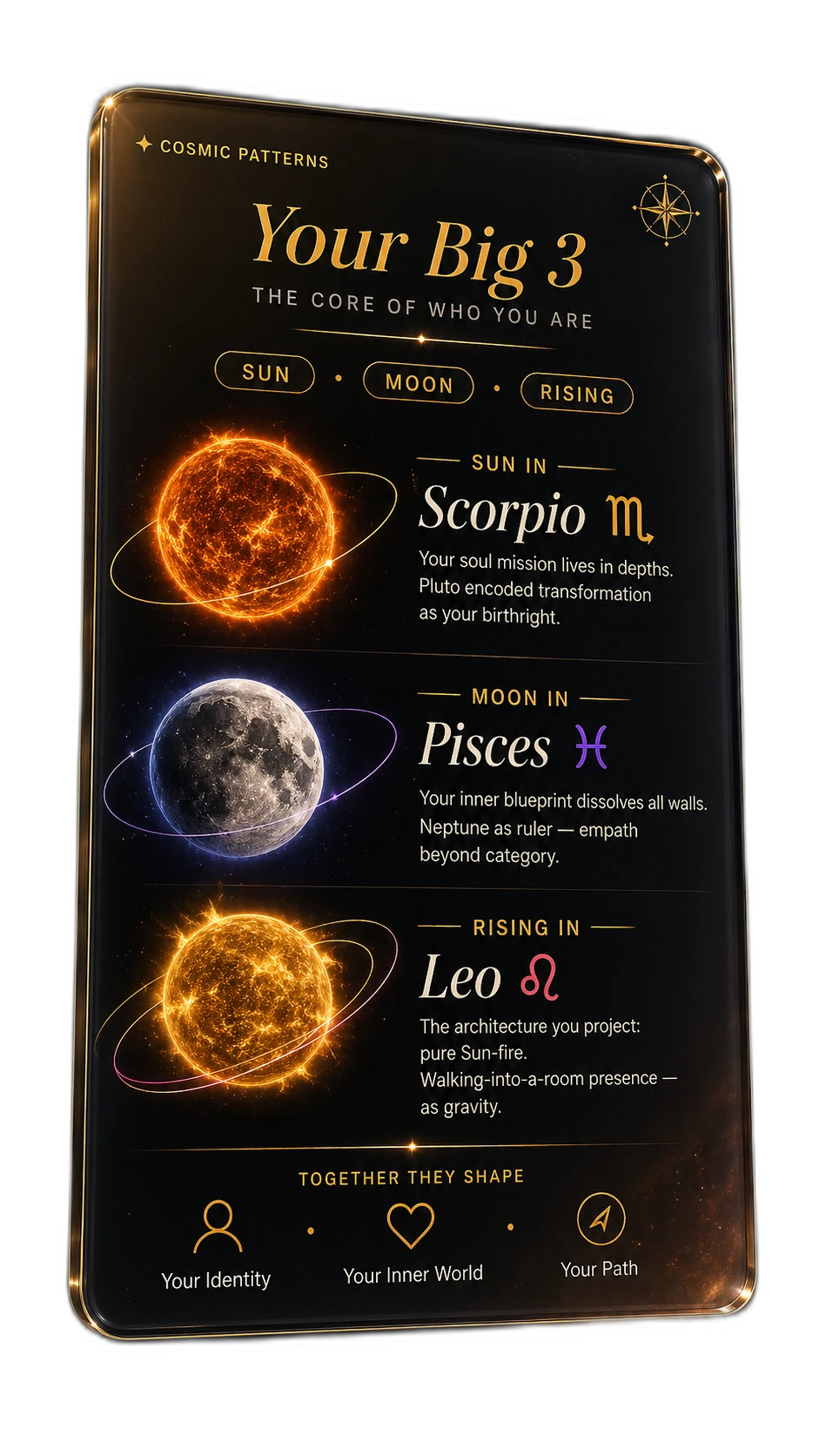
Three positions are enough to see the difference. One tells you what you reach for on purpose. One tells you what you reach for when nobody is watching, which is where most repetition actually lives. One tells you what other people reward you for, which is often neither of the first two and explains a great deal of misdirected effort. Your Big 3 is free, and it separates the luck from the pattern using your own data rather than a number that greets everybody.
We will not claim 777 activates anything in there, because it does not, and this article has kept numerology and astrology in their own lanes from the first line. The number agreed with you. The chart is the part that can disagree, which is the only reason it is useful.
The honest meaning of 777, kept whole
So what does 777 actually mean? In numerology's own words: you are on your path, go deeper, and what you learn there will one day want a voice. In psychology's own words: salience, the frequency illusion, and Jung's meaningful coincidence, your attention promoting exactly what your life is currently weighing. In the casino's words: jackpot, luck as a public event. And in the space where those readings meet, the version you can keep: the number is ordinary, and the noticing is not.
Luck is what happens to you. Knowledge is what happens in you. 777 is the rare number that carries both stories at once, and the moment it catches your eye is the moment the difference between them has started to matter. May the next 777 find you not waiting to be chosen by luck, but quietly certain that the invisible work has been real, and that the path you cannot show anyone has been carrying you the whole time.
You have just read what these tools can do. None of them has read you. Somewhere in all that comparing sits a quieter question, and it is not which app is best. It is what your own sky actually says.
Your complete birth chart reads all ten planets, the aspects your chart supports and, with your birth time, the houses where each one does its work. Not a feature list. A reading of the one chart no comparison can rank: yours. All of the sky, not one page of it.

Your Complete Birth Chart
Read your full birth chart$19$9 · Yours forever · No subscription
frequently asked
What does angel number 777 mean?
In modern numerology, 777 is the seeker’s number tripled: the 7 stands for introspection, knowledge, spirituality and retreat, and three sevens are read as amplified encouragement, something like: you are on your path, go deeper. Important context: this is a numerological tradition of meaning, not an astrological or scientific fact. Its real power lies in the moment of noticing, which says more about your current search than about the number itself.
Why do I keep seeing 777 everywhere?
Because your attention promotes patterns and your memory keeps the hits: you see hundreds of numbers a day, but only the repeating ones stay. The linguist Arnold Zwicky named this mechanism the frequency illusion in 2005. What remains worth taking seriously is the timing: phases in which 777 keeps finding you are usually phases in which you are quietly working on yourself and wishing for a sign that it counts.
Is 777 a lucky number?
Culturally, yes: 777 has been the classic jackpot row since slot machines spread from the 1890s onward, and with two dice the seven is the most likely sum, landing in 6 of 36 combinations. But luck is the outer reading of this number. The numerological reading points the opposite way, toward knowledge and depth, and a number on a receipt changes no odds anywhere.
What does 777 mean in love and relationships?
The angel number tradition often reads 777 in love as a call to deepen rather than to chase: understand yourself first, and the connection grows from there. Honestly told, a number can know neither you nor a partner. What the moment does show is where your attention lives right now, and if 777 keeps appearing while you think about someone, that tells you how much inner space the question of closeness currently takes.
Does 777 have an astrological meaning?
No. 777 is numerology and modern folk tradition; no planet, no zodiac sign and no degree is attached to it, and nothing happens in the sky when it appears. Astrology begins somewhere else entirely: with the sky of your birth moment, read as a personal pattern. If 777 has opened an inner question, your Sun, Moon, and Rising signs are where a personal answer can begin.
What should I do when I see 777?
Nothing is required. If you want to give the moment weight, treat it as a question instead of a prize: what have you quietly gotten better at that nobody has seen, and where are you waiting for outside permission for something you already know inside? One dated line in your notes is enough. Over a month, those lines become a record of a path that was real all along.
Cosmic Patterns
birth charts, Big 3, and the patterns you keep repeating.