Full Moon Names 2026: Dates, Signs, Degrees (Sep to Dec)
Four full moons remain in 2026: September 26 in Aries, October 26 in Taurus, November 24 in Gemini, and December 24 in Cancer. In the Farmer's Almanac naming lineage, these are the Harvest Moon, the Hunter's Moon, the Beaver Moon, and the Cold Moon. None of them is a blue moon. Every date, sign, and degree below is computed astronomy, every name is attributed folklore, and the honest line between those two layers is the one most full moon name pages never draw.
The remaining full moons of 2026: exact dates, signs, and degrees
- What happens: four full moons close out 2026, one in each calendar month from September through December. Each is an exact Sun-Moon opposition, the point of peak lunar illumination in the lunation cycle.
- When exactly (UTC): September 26 at 16:49, October 26 at 04:12, November 24 at 14:54, December 24 at 01:28.
- Signs and degrees: Moon at 3.63 degrees Aries, 2.77 degrees Taurus, 2.34 degrees Gemini, and 2.24 degrees Cancer, with the Sun standing directly opposite at nearly the same degree of Libra, Scorpio, Sagittarius, and Capricorn.
Set the traditional names beside the computed sky and the whole season comes into focus:
- September 26, 2026, 16:49 UTC: Full Moon at 3.63 degrees Aries. The Farmer's Almanac lineage calls this the Harvest Moon, the name it gives to the full moon nearest the autumn equinox.
- October 26, 2026, 04:12 UTC: Full Moon at 2.77 degrees Taurus. The Hunter's Moon in the almanac tradition, always the full moon that follows the Harvest Moon.
- November 24, 2026, 14:54 UTC: Full Moon at 2.34 degrees Gemini. The Beaver Moon, November's name in the almanac count.
- December 24, 2026, 01:28 UTC: Full Moon at 2.24 degrees Cancer. The Cold Moon, December's name, and in 2026 it turns exact in the first hours of Christmas Eve.
One detail worth pausing on, because the name pages never mention it: all four of these Moons reach fullness within the first four degrees of their signs, between 2.24 and 3.63. Each one goes full on ground its sign has only just entered. The season ahead is not a repeat of anything. It is four thresholds in a row.
Where the full moon names come from, and what they cannot tell you
The names belong to folklore, and it is worth saying so plainly. The Old Farmer's Almanac popularized a naming lineage drawn from colonial American and Native American seasonal usage: moons named for what the land was doing when they rose, harvests brought in, hunts begun, rivers hardening toward winter. In that tradition the Harvest Moon is defined by the equinox, not by a month: it is the full moon that rises closest to the September equinox, which is why the name sometimes falls in October in other years.
In 2026 the question settles itself. On September 26 the Sun stands at 3.62 degrees of Libra, only days past the equinox point at 0 degrees Libra, so the September moon carries the Harvest name with room to spare. And at the other end of the season, the Cold Moon turns exact with the Sun at 2.23 degrees Capricorn, just past the solstice point: the almanac's winter name and the astronomical winter door, arriving almost hand in hand.
Here is what the names cannot do: they cannot tell you what the moon means. The almanac names track the calendar, and the calendar repeats. The zodiac position does not. The Cold Moon is not always in Cancer; the Harvest Moon is not always in Aries. A name is the same every year, but the sky underneath it changes, and the meaning lives in the sky, not in the name. That is the difference between this guide and a folklore list: three honest layers, kept separate. The name is tradition. The date and degree are astronomy. The meaning is astrology, and we will only claim it where we can carry it.
What a full moon actually is, and why it feels like being seen
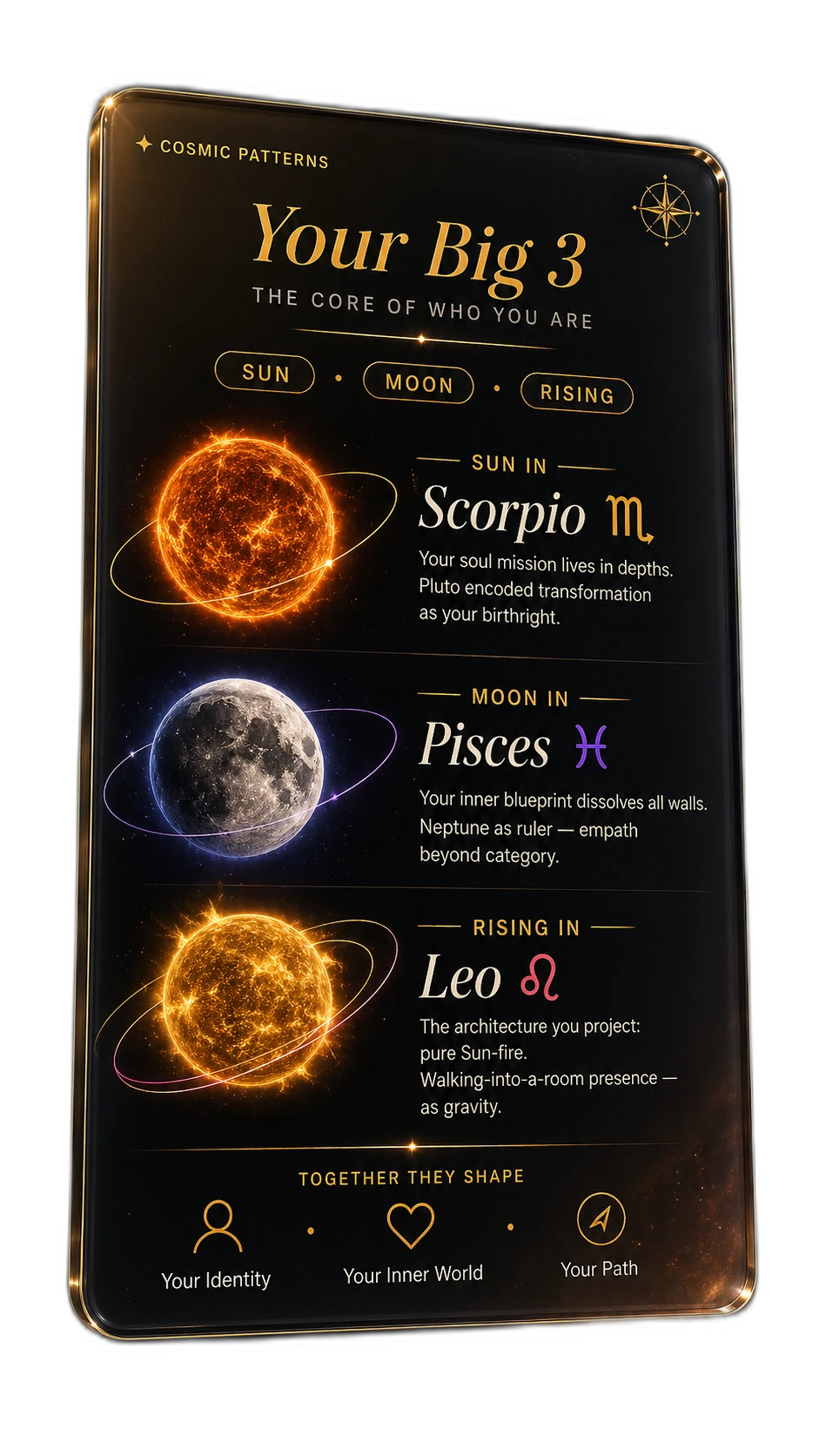
In the Western lunation cycle, a full Moon is the exact opposition of Sun and Moon, the point of peak lunar illumination; after the moment of exactness, the cycle turns from increasing to decreasing light. That is the astronomy. The psychology begins with what each body stands for. Modern psychological astrology reads the Moon as instinctive feeling, emotional memory, habitual response, care, and the conditions through which safety and belonging are felt. The Sun it reads as the organizing center of conscious identity, vitality, will, and purpose. At a full moon those two stand face to face across the whole sky, each at the same degree of opposite signs, and neither can pretend the other is not there.
Which is why a full moon does not invent your tension. It turns the light high enough that the arrangement you have been maintaining becomes difficult to misread. You have felt this without ever checking a calendar: the week the compromise you called temporary suddenly looked permanent, the night the thing you were not saying got loud. Illumination is not a verdict. It is the moment a choice can finally see what it is choosing. And there is a strange comfort in the scale of it: the same opposition of lights that finds you at your kitchen table has been rising over every human room for as long as anyone has watched the sky. What the light falls on is yours. The light itself never was.
The four moons, one by one: what each one opens
September 26: Full Moon at 3.63 degrees Aries, Sun at 3.62 degrees Libra. The Harvest Moon of 2026 stretches one axis tight: the Moon, your instinctive feeling life, in Aries, while the Sun, your conscious identity, moves through Libra. Under this light, ask where your need to be agreeable has been quietly overruling what you actually want. If a flash of impatience surfaces near this date, treat it as information before you treat it as a problem: peak illumination is exactly when a suppressed instinct becomes visible.
October 26: Full Moon at 2.77 degrees Taurus, Sun at 2.76 degrees Scorpio. The Hunter's Moon brings the feeling body into the conversation about safety. The Moon describes the conditions through which safety and belonging are felt, and with the Sun opposite in Scorpio, the question this light raises is which of your securities are real and which are just familiar. Notice what you are holding onto near this date, and whether you are holding it or gripping it.
November 24: Full Moon at 2.34 degrees Gemini, Sun at 2.34 degrees Sagittarius. Here the tradition of psychological astrology speaks precisely. Gemini expresses a planetary function through dialogue, comparison, connection, and mental movement between alternatives; Sagittarius through exploration, freedom, and the search for a larger meaning. The Beaver Moon lights the polarity between gathering distinctions and choosing an orientation: more information can postpone commitment, while a large story can dismiss the detail that would revise it. If you have spent this autumn researching a decision instead of making it, this is the full moon that will not let you call that research anymore.
December 24: Full Moon at 2.24 degrees Cancer, Sun at 2.23 degrees Capricorn. The Cold Moon goes full in the first hours of Christmas Eve, and the timing is almost too honest. The Moon, carrying care, emotional memory, and belonging, stands in Cancer while the Sun holds the Capricorn side: will, purpose, the structured life you have built. In the middle of the most family-saturated night of the year, this light asks what your achievements have cost your tenderness, and what your tenderness still wants from you. If something in you softens or aches around the table that night, that is not the season. That is the sky keeping an old appointment.
Supermoon and blue moon: the honest late-2026 answer
Two search terms attach themselves to every full moon list, so let us handle both without inventing anything.
A blue moon, in the most common modern usage, is the second full moon inside a single calendar month. An older counting, traced to the Maine Farmers' Almanac, names the third full moon in a season that holds four. By the monthly definition the late-2026 answer is verifiable from the data above: September, October, November, and December of 2026 each contain exactly one full moon, four moons in four months. There is no blue moon between September and December 2026. Any page telling you otherwise is not reading a calendar.
As for supermoons: the word is popular shorthand for a full moon that arrives near the Moon's closest approach to Earth, and honest claims about it require computed perigee distances. Our evidence base for this article computes lunation times, signs, and degrees, not perigee figures, so we will not print distance numbers we did not calculate. We would rather leave a number out than make one up. If that restraint reads as unusual for an astrology page, good. That is the point.
How to work with the last four moons of 2026
Every full moon in this list is the bright half of a cycle that begins in the dark. A new Moon is the Sun-Moon conjunction and the darkest point of the cycle; from it the Moon increases in light toward fullness. A new Moon opens a window to begin, and a full Moon turns the light up on what an arrangement has become. So pair them:
- September 11, new Moon at 18.44 degrees Virgo opens what the September 26 Aries full moon will illuminate.
- October 10, new Moon at 17.37 degrees Libra opens what the October 26 Taurus full moon will illuminate.
- November 9, new Moon at 16.90 degrees Scorpio opens what the November 24 Gemini full moon will illuminate.
- December 9, new Moon at 16.95 degrees Sagittarius opens what the December 24 Cancer full moon will illuminate.
The practice is simple enough to actually do. At each new moon, write one sentence about what you are beginning. At the full moon fifteen days later, read the sentence back under the brightest light of the month and notice what it has become. Where each of these moons lands for you personally depends on your own chart: the same full moon falls in a different life area counted from your sign, which is why one December Cold Moon finds one person at their desk and another in their oldest memory.
Four moons, four names, four thresholds, and above all of it the same two lights that have kept this appointment since before anyone thought to name them. The full moon names of 2026 were written by people watching the season. What the light finds when it rises is still written by you.
You have just read what these tools can do. None of them has read you. Somewhere in all that comparing sits a quieter question, and it is not which app is best. It is what your own sky actually says.
Your complete birth chart reads all ten planets, the aspects your chart supports and, with your birth time, the houses where each one does its work. Not a feature list. A reading of the one chart no comparison can rank: yours. All of the sky, not one page of it.

Your Complete Birth Chart
Read your full birth chart$19$9 · Yours forever · No subscription
frequently asked
What are the full moon names for the rest of 2026?
In the Farmer's Almanac naming tradition, the remaining 2026 full moons are the Harvest Moon on September 26 (3.63 degrees Aries), the Hunter's Moon on October 26 (2.77 degrees Taurus), the Beaver Moon on November 24 (2.34 degrees Gemini), and the Cold Moon on December 24 (2.24 degrees Cancer). The names come from seasonal folklore and repeat every year; the zodiac signs and degrees are computed astronomy and change from year to year.
Is there a blue moon between September and December 2026?
No. By the common modern definition, a blue moon is a second full moon inside one calendar month, and September, October, November, and December 2026 each contain exactly one full moon. Four moons in four months leaves no room for a blue moon in late 2026.
What sign is the Harvest Moon in 2026, and when exactly is it?
The 2026 Harvest Moon reaches fullness on September 26 at 16:49 UTC, with the Moon at 3.63 degrees Aries opposite the Sun at 3.62 degrees Libra. It earns the Harvest name in the almanac tradition because it is the full moon nearest the September equinox, with the Sun only days past 0 degrees Libra.
Are full moon names astrological?
No, and the distinction matters. The names trace to the Farmer's Almanac lineage of colonial American and Native American seasonal usage, so they follow the calendar, not the zodiac. The astrology lives in where the moon actually stands: the Cold Moon is not always in Cancer, but in 2026 it is, and that placement, not the name, carries the meaning.
What time is the Cold Moon in December 2026?
The Cold Moon turns exact on December 24, 2026 at 01:28 UTC, with the Moon at 2.24 degrees Cancer opposite the Sun at 2.23 degrees Capricorn. It is the last full moon of the year and falls in the first hours of Christmas Eve, just past the December solstice point.
Cosmic Patterns
birth charts, Big 3, and the patterns you keep repeating.