

How to Read Your Birth Chart: The Only Beginner's Guide You Need
The first time you look at your birth chart, it looks like someone threw a protractor at a zodiac wheel and screenshotted the result. Lines everywhere. Symbols you have never seen. Numbers that seem random. It is overwhelming.
But here is the useful secret: you do not need to understand all of it at once. A birth chart is a map, and like any map, you start with the biggest landmarks and zoom in from there.
This guide walks you through reading your chart from scratch. No astrology degree. No pretending you know what a "square aspect" is. Just the actual steps, in order.
What is a birth chart?
A birth chart (also called a natal chart) is a snapshot of the sky at the exact moment you were born. It maps where every planet, the Sun, and the Moon were positioned relative to the zodiac signs and the 12 houses of astrology.
Think of it as a description, not a prediction. It does not tell you what will happen. It tells you what you came wired with.
To generate one, you need:
- Birthday (month, day, year)
- Birth time (as exact as possible)
- Birth location (city and country)
The birth time is critical. Without it you cannot calculate your Rising sign or your house placements, which means you are missing the structural framework that organizes the entire chart.
What you are actually looking at: the four layers
Before any interpretation, get oriented. That intimidating wheel is only four layers stacked on top of each other, and every one of them answers a different question.
- The outer ring is the zodiac. Twelve signs, each exactly 30 degrees wide, wrapped around the edge. Think of it as the backdrop a planet performs against.
- The slices are the houses. Twelve sectors, numbered 1 to 12, each one an area of life: home, work, partnership, money.
- The symbols inside are the planets. Ten of them, each with a number beside it. That number is the degree, and it pins the planet to an exact spot.
- The lines crossing the middle are the aspects. Each one connects two planets that stand at a meaningful angle to each other.
Around the rim you will also spot four labelled points: AC, DC, MC and IC. Those are the angles, the cross that frames the whole chart, and the AC is your Rising sign.
That is the entire anatomy. Everything below is just learning to read one layer at a time.
The three questions that make any chart readable
Here is the key that turns a wall of symbols into sentences. Every single line of your chart answers the same three questions, always in this order:
- Which force? That is the planet. Who is speaking.
- In which style? That is the sign. How it speaks.
- In which area of life? That is the house. Where it lands.
Who, how, where. Learn those three and you can say any line of your chart out loud. "Venus in Taurus in the 4th house" becomes: my capacity for love and pleasure (who), expressed in a steady and sensory way (how), showing up mostly around home and family (where).
You do not need to memorize meanings to start. You need this sequence.
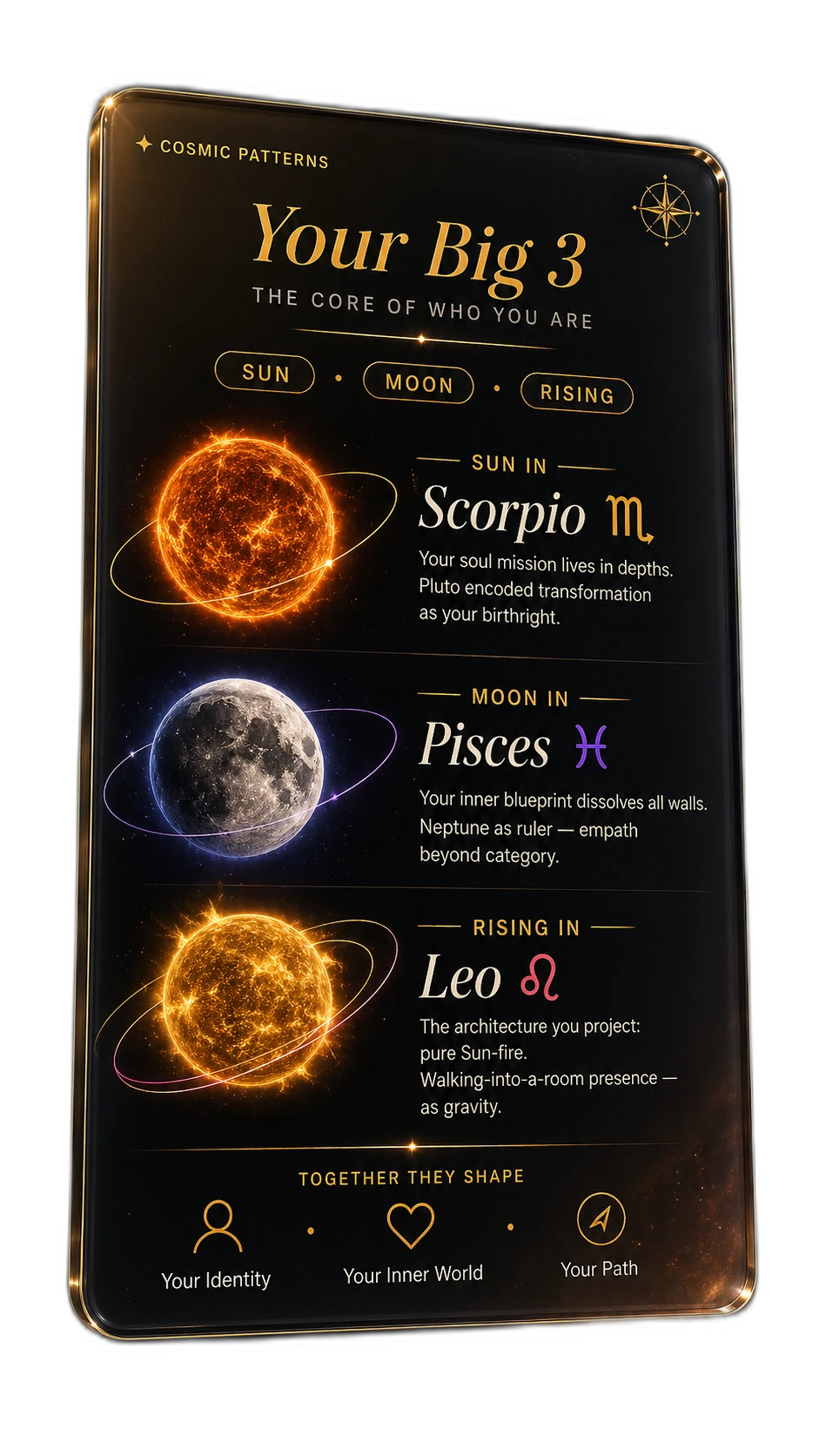
Step 1: Find your Big 3
Before anything else, locate your three most important placements:
- Sun sign: look for the ☉ symbol. Whatever sign it is in is your Sun sign.
- Moon sign: look for the ☽ symbol. This is your emotional core.
- Rising sign: the sign on the left-hand side of the chart wheel, marked "Ascendant" or "AC".
These three form your Big 3, the core identity stack most people never look past. If you are a beginner, understanding just these three already puts you ahead of most readers.
Start there rather than trying to hold ten planets at once. Three placements carry most of the picture, and the rest grows onto them naturally.
Step 2: Understand the planets
Your chart contains 10 celestial bodies (astrologers call them all "planets" even though the Sun and Moon technically are not):
The inner planets (Sun through Mars) move fast and describe your everyday personality. The outer planets (Uranus, Neptune, Pluto) move so slowly that you share them with everyone born around your time, which is why they read as generational. They become personal mainly where they touch one of your fast planets.
Deep dive: the ten planets and what each one runs in you
Step 3: Read the degrees
Next to every planet sits a number between 0 and 30. That is the degree, and it is the difference between a horoscope column and a chart.
Since the full circle is 360 degrees and there are 12 signs, each sign is exactly 30 degrees wide. The number tells you how far into its sign a planet had travelled at your moment of birth. "Sun in Pisces, 5.5" means early Pisces. "Ascendant in Leo, 20.9" means late Leo.
Why it matters: a sign is a category millions of people share. A sign plus a degree is a position that belongs to your specific minute. Degrees also measure the distance between planets, which is how aspects are found.
Deep dive: what the degrees in your birth chart mean
Step 4: Learn the 12 houses
The houses are the 12 sectors of your chart, each governing a different area of life. Your Rising sign determines which sign starts your 1st house, and the rest follow in order.
Do not try to memorize all 12. Start with whichever house holds the most planets, because that is where most of your energy is focused. A house with no planets in it is not a gap in your life, it simply means none of your ten planets took up residence there.
Deep dive: the 12 houses explained
Step 5: Find the four angles
Four labelled points sit on the rim of your chart, and together they form a cross that frames everything else.
- AC (Ascendant) on the left, the eastern horizon: your Rising sign, the door the world sees you through. It changes sign roughly every one to two hours, which makes it the most personal point in your chart and the reason your birth time matters so much.
- MC (Midheaven) at the top: career, public standing, reputation.
- DC (Descendant) on the right, opposite the AC: read through the 7th house of partnership.
- IC at the bottom, opposite the MC: read through the 4th house of home and roots.
Deep dive: the four angles of your chart
Step 6: Read the aspects
Aspects are the angles between planets. Those lines crossing the middle of your wheel are exactly that: two parts of you in conversation.
The five major aspects:
- Conjunction (0°): two planets sit together and act almost as one combined force.
- Sextile (60°): an open door. Cooperative potential that becomes available when you take it up.
- Square (90°): pressure and friction that builds real skill over time.
- Trine (120°): ease and natural talent, which you may enjoy or take for granted.
- Opposition (180°): two ends of an axis, asking to be balanced rather than won.
The closer an aspect sits to its exact angle, the louder that conversation runs. Squares and oppositions sound alarming but they are workshops, not verdicts. A chart made only of easy aspects often describes someone who was never pushed.
Deep dive: birth chart aspects explained
Step 7: Look for patterns
Once you have your planets, signs, houses, degrees and aspects, step back and look at the shape of the whole thing.
Element balance: count how many planets you have in each element.
- Fire (Aries, Leo, Sagittarius): vision, passion, quick ignition
- Earth (Taurus, Virgo, Capricorn): form, practicality, patient building
- Air (Gemini, Libra, Aquarius): thinking, language, exchange
- Water (Cancer, Scorpio, Pisces): feeling, memory, empathy
Modality balance: count planets by modality.
- Cardinal (Aries, Cancer, Libra, Capricorn): initiators
- Fixed (Taurus, Leo, Scorpio, Aquarius): sustainers
- Mutable (Gemini, Virgo, Sagittarius, Pisces): adapters
An element you barely have is not a deficiency. It is usually the one you grow into on purpose, later, and it often ends up more consciously yours than the one you were born fluent in.
Stelliums: three or more planets in the same sign or house. That area of life runs amplified.
Deep dive: elements and modalities
A small letter you may notice: the r
If a planet has a small "r" or "Rx" next to its degree, it was retrograde at your birth, meaning it appeared to move backwards from Earth's point of view. Nothing is wrong with your chart. It reads as an inward, reviewing tone for that planet, and it carries real meaning mainly for Mercury, Venus and Mars.
Deep dive: what the little r means in your birth chart
Step 8: Put it together
Now combine what you have learned:
- Start with your Big 3 for the overview
- Check which houses hold the most planets, because that is where life gets busy
- Read Mercury and Venus for how you think and how you love
- Check Mars for drive and how you handle conflict
- Note any squares or oppositions, since those are your growth edges
- Look for stelliums, meaning concentrated energy in one area
You do not need to understand everything at once. Your chart is something you will keep reading for years, discovering something new each time as your life gives you context for what the symbols mean.
Common mistakes beginners make
Reading only the Sun sign. Your Sun is one of ten placements. Your Big 3 alone gives you three times the picture.
Ignoring the houses. A planet's sign tells you how. The house tells you where. Both matter. Saturn in Capricorn in the 5th house is a very different life from Saturn in Capricorn in the 10th.
Treating hard aspects as doom. Squares and oppositions are not curses. They are the places that build character, and plenty of remarkable people have heavily aspected charts.
Comparing charts competitively. Your chart is not better or worse than anyone else's. It is a map of your wiring. Comparing charts is useful for synastry, which is relationship analysis, not for ranking.
Beyond the Big 3: your full birth chart
Your Big 3 is chapter one. Your full birth chart is the whole book: 10 planets across 12 houses, with aspects, elements, modalities and patterns that tell a story no Sun sign description ever could.
You have just read what these tools can do. None of them has read you. Somewhere in all that comparing sits a quieter question, and it is not which app is best. It is what your own sky actually says.
Your complete birth chart reads all ten planets, the aspects your chart supports and, with your birth time, the houses where each one does its work. Not a feature list. A reading of the one chart no comparison can rank: yours. All of the sky, not one page of it.

Your Complete Birth Chart
Read your full birth chart$19$9 · Yours forever · No subscription
frequently asked
What do I need to read my birth chart?
You need your birthday (month, day, year), exact birth time, and birth location (city and country). Without birth time, you can't calculate your Rising sign or house placements.
What is the most important placement in a birth chart?
Your Big 3 (Sun, Moon, Rising) are the three most important placements. After that, Mercury (communication), Venus (love/values), and Mars (drive/action) add significant detail.
What is a stellium in astrology?
A stellium is when three or more planets are clustered in the same zodiac sign or house. It creates concentrated energy in that area, making it a dominant theme in your life.
Do birth chart aspects determine your fate?
No. Aspects describe tendencies and patterns, not predetermined outcomes. Challenging aspects (squares, oppositions) indicate areas of growth, not doom. How you work with your chart is always up to you.
Cosmic Patterns
birth charts, Big 3, and the patterns you keep repeating.