

Synastry Explained: How Two Birth Charts Reveal Relationship Patterns
You googled "[your sign] and [their sign] compatibility." The article gave you a percentage. You felt either validated or doomed. And none of it was based on actual astrology.
Sun sign compatibility is the most popular and least useful form of astrological relationship analysis. It takes two people's most basic placements and pretends that's enough to assess a relationship. It's like evaluating a restaurant by looking at the sign outside.
Synastry is what astrologers actually use. And it's a completely different game.
What Is Synastry?
Synastry is the comparison of two complete birth charts to understand how two people's planetary energies interact. Instead of asking "are Aries and Scorpio compatible?" — synastry asks "how does YOUR Mars interact with THEIR Venus? How does YOUR Moon sit relative to THEIR Saturn?"
It's not about signs matching. It's about aspects — the geometric angles between one person's planets and the other's.
How Synastry Works
Take two birth charts. Overlay them. Every planet in Chart A forms angular relationships with every planet in Chart B. Those angles — conjunctions, trines, squares, oppositions — tell the story.
Key aspects in synastry:
Conjunction (0°): Your planet meets their planet in the same area of the zodiac. Fusion. Intensity. For better or worse, that energy is shared. Venus conjunct Venus? Shared aesthetic and values. Mars conjunct Mars? Either incredible chemistry or constant competition. Usually both.
Trine (120°): Easy flow between two planets. Natural compatibility in that area. Moon trine Moon? Emotional wavelengths are naturally in sync. Sun trine Jupiter? They expand you, you energize them.
Square (90°): Friction. Tension. Growth. Venus square Mars across charts creates undeniable attraction that also drives you crazy. Squares are why you can't stop thinking about someone AND can't stop arguing with them.
Opposition (180°): Polarity. Magnetic attraction between opposites. Sun opposite Moon? You complete each other in ways that are both beautiful and exhausting. Oppositions create awareness — you see in them what you can't see in yourself.
Sextile (60°): Gentle, supportive energy. Not as dramatic as trines but consistently harmonious. Good for long-term ease.
The 5 Most Important Synastry Aspects
Not all planet-to-planet connections carry equal weight. Here are the ones that matter most:
1. Moon-Moon Aspects
How your emotional natures interact. This is the "do we FEEL comfortable together?" aspect. Moon conjunct Moon? You process emotions the same way. Moon square Moon? Your emotional needs clash — one person needs space while the other needs closeness.
2. Venus-Mars Aspects
The chemistry indicator. Venus is attraction; Mars is desire. When one person's Venus contacts the other's Mars, there's physical and romantic chemistry. Conjunctions and oppositions create intense attraction. Squares create attraction mixed with frustration.
3. Sun-Moon Aspects
The "do we work as a unit?" connection. When one person's Sun (identity) aligns with the other's Moon (emotions), there's a deep recognition — like you fit together on a fundamental level. The Sun person feels seen; the Moon person feels safe.
4. Mercury-Mercury Aspects
Communication compatibility. Can you actually TALK to each other? Mercury conjunct or trine Mercury means conversations flow. Mercury square Mercury means you think differently — stimulating but occasionally maddening.
5. Saturn Aspects
The commitment indicators. Saturn is structure, responsibility, and time. When Saturn touches personal planets in synastry, it creates either stability or restriction — sometimes both. Saturn conjunct Venus can mean "this relationship endures" or "this relationship feels heavy." Often it means both over time.
What Synastry CAN'T Tell You
Synastry shows the POTENTIAL of a relationship — not the outcome. A chart with incredible synastry can fail if two people don't put in the work. A chart with challenging synastry can succeed if both people are committed to navigating the friction.
Synastry doesn't tell you:
- Whether you SHOULD be together (that's your decision, not the chart's)
- Whether the relationship will last (duration depends on choices, not aspects)
- Whether someone is "good" or "bad" for you (all aspects carry growth potential)
What synastry DOES tell you: where the connection is easy, where it requires effort, and what themes will keep showing up.
Beyond Sun Sign Compatibility
Sun sign compatibility articles assign percentages based on element compatibility: fire goes with fire/air, earth goes with earth/water. It's a framework — but it's incredibly simplified.
In real synastry, you might have a "terrible" Sun sign pairing (like Aries and Cancer) but incredible Moon, Venus, and Mars aspects that create a deeply compatible relationship. Or you might have a "perfect" Sun sign match (Leo and Sagittarius) but Saturn squares that make the relationship feel like a constant test.
The Sun sign is one variable in a chart with dozens. Knowing your full birth chart — and theirs — is the only way to get a real compatibility picture.
How to Get Your Synastry Read
You need:
- Both people's birth charts — birthday, birth time, and birth location for each person
- A synastry chart overlay — which maps one chart onto the other
- The aspect table — which lists every planet-to-planet aspect between the two charts
This is more complex than a single birth chart reading, but the insights are worth it. Synastry explains the dynamics you already feel — it gives language to the "why do we always argue about THIS" and "why do I feel so calm around them" experiences.
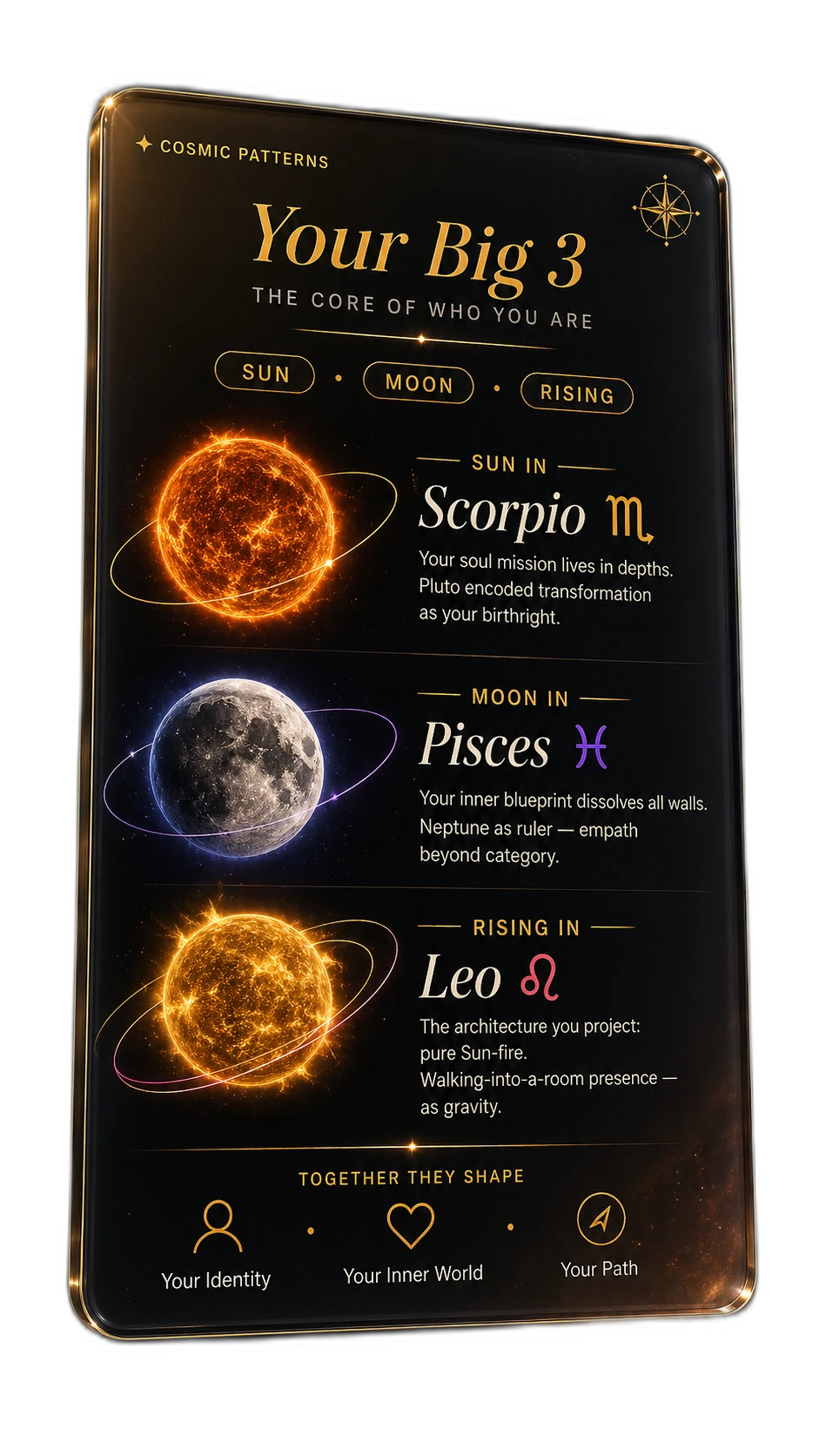
Start by knowing your own chart first. Find your Big 3 — free. Once you understand your own planetary wiring, you'll be able to make sense of how it interacts with someone else's.
You have just read what these tools can do. None of them has read you. Somewhere in all that comparing sits a quieter question, and it is not which app is best. It is what your own sky actually says.
Your complete birth chart reads all ten planets, the aspects your chart supports and, with your birth time, the houses where each one does its work. Not a feature list. A reading of the one chart no comparison can rank: yours. All of the sky, not one page of it.

Your Complete Birth Chart
Read your full birth chart$19$9 · Yours forever · No subscription
frequently asked
What is synastry in astrology?
Synastry is the comparison of two complete birth charts to understand relationship dynamics. It analyzes how one person's planets form geometric aspects with the other's, revealing areas of harmony, tension, attraction, and growth potential.
Is synastry more accurate than Sun sign compatibility?
Yes, significantly. Sun sign compatibility uses one variable per person; synastry analyzes all 10 planets and their interactions between two charts. It captures the full complexity of a relationship rather than reducing it to one-twelfth of each chart.
What is the most important synastry aspect?
Moon-Moon aspects (emotional compatibility) and Venus-Mars aspects (chemistry and attraction) are generally considered the most impactful. Sun-Moon contacts indicate deep recognition, and Saturn aspects show long-term potential.
Cosmic Patterns
birth charts, Big 3, and the patterns you keep repeating.