The Moon on the first-house axis
1stMoon in the 1st House: Your Face Gets There First
A house is not a body. It is a territory, counted from the moment and the place you were born.



The structural fact
The Moon in the first house means your emotional life happens at the surface: in your face, your body, your presentation, the first four seconds of a room. The Moon is the function of instinctive feeling, emotional memory and care; the first house is the territory of embodiment and the immediate way you meet the outside world. The gift is instant authenticity, because nothing about you is laminated. The price is that you have no emotional privacy, and other people's reactions to your moods become weather of their own.
Someone has told you to smile more. Someone else has asked what was wrong on an ordinary Wednesday when nothing was wrong, because your face was busy thinking and they read it as weather. By about the age of nine you had worked out that your face files reports you never authorized. You have been managing that ever since: in hallways, at tables, in the four seconds it takes to walk into a kitchen where people are already talking. Strangers have been adding captions to your face since school. Not every face needs a caption.
There is a second thing, and it is quieter: you do not have a lag. Most people feel something, hold it for a beat, decide what to do with it, and then let an edited version out through the door. Yours arrives on the outside at the same moment it arrives on the inside. Nobody handed you the pause. The stars are not in the habit of explaining themselves.
In astrology this pattern has a name. The Moon in the first house.
What the Moon does, and where the 1st house puts it
In a birth chart the Moon describes instinctive feeling: emotional memory, the habitual response, the way you give and receive care, and the conditions under which safety and belonging are actually felt. It is not the person you are trying to be, it is the layer that has already reacted by the time you notice it reacting. In most charts that layer does its work somewhere private. In yours it works at the front desk. That layer is still unfolding, years after you stopped noticing it at all.
The first house is the territory of embodiment and presentation: the immediate way you meet the outside world and mediate it, the body that walks in before the sentence does. It is the doorway and not the room behind it, what a kitchen registers in the first second, before anybody in it has decided anything about you. Whatever else is true of you, this is the part that goes first. The rest of it comes later, if it comes at all.
In natal interpretation the planet identifies the function and the house identifies the field of life in which that function operates. The Moon says what you need. The first house says where that need becomes visible, and the answer is your face, your hands, your voice in the first sentence of a phone call. Your needs live on your face. Feeling and presentation share a front door, and the world meets your inner weather in real time. There is no antechamber and there never was one. Whatever is happening in you is happening on you, at the same volume, on a Wednesday morning, in a corridor, with the person from accounts walking toward you. That is not a fault in the wiring. It is a placement, one point in a much larger constellation.
The gift, and what it quietly costs
People trust you fast, and most of them cannot tell you why. Here is why: nothing about you is laminated. There is no finish on the surface, no coating between what you feel and what shows, and other people register that in under a second even when they have no words for it. It reads as safety: in a room of managed faces, an unmanaged one is a small act of hospitality. Not every kind of trust has to be earned.
That is the gift, and it is not a small one. Instant authenticity is a currency other people spend years failing to counterfeit. You did not build it and you cannot switch it off, which is the first honest clue about the price. Some things are given rather than built, and the sky keeps no receipts.
The price sits in the same room as the gift, because it is the same mechanism. You have no emotional privacy. Every tide is public: the good ones, the small ugly ones, the three minutes of grief that arrived at the wrong moment in a supermarket queue. Other people react to your moods, and then their reactions become weather of their own, and now there are two systems in the kitchen instead of one. Your moods have an orbit, and the people who live with you learned it before they learned your middle name.
This is why you have learned to warn people. You say you are fine before anyone has asked, because you can see them reading you and you want to get ahead of the reading. You apologise for a face you did not choose. Somewhere in there a habit formed: manage the room's response to you before the room has one. It is tiring, it is invisible, and nobody has ever thanked you for it. Not every tide needs an apology.
When the mood takes the wheel
There is a version of this placement where the feeling stops being something you have and becomes something you are. Mood as identity. On a bad Tuesday you are not a person having a hard morning, you are a hard person, and you will say so out loud before lunch. The self gets handed over to whatever feeling is loudest in the room, and the loudest feeling in the room is usually yours. Something above you keeps turning, morning after morning, indifferent to the forecast.
It does not announce itself as a collapse, it sounds like honesty. It sounds like a sentence you have actually said out loud: I am only being real about where I am at. And the room adjusts, because the room always adjusts to you, which is the whole point of this house. What comes next is not decided by the morning.
The tell is simple and uncomfortable: ask who in your life has started checking your face before they say anything. Not because they are frightened of you. Because they have learned that the day's climate is set by whatever crossed your face at nine, and they would like the forecast before they open their mouth. That is the moment a feeling stops being information and starts being government. A mood is not a problem to be solved, and it is not a verdict either.
Transparent, and still standing
The mature form of this is not a poker face. Anybody who tells you to build one is asking you to give away the exact thing people trust you for. It is something harder and much quieter: transparent but anchored. Feelings visible, self intact beneath them. That part of you has not finished arriving.
In practice it looks like this: the feeling shows up on your face at the usual speed, because it always will. And underneath it, something does not move. You are still the one holding the cup, still the one who can say give me ten minutes, still the person who knows this will have a different shape by Thursday. There is a steadier version of this you have yet to meet.
The question that does the work is small enough to carry. Ask it in an ordinary week, in a corridor, in the second before you answer the phone with your whole face already committed: can you be seen mid-feeling without becoming the feeling? Not whether you can hide it. Whether you can be watched having it and still be there afterwards, the same person, holding the same cup. Some questions are asking to be understood rather than answered.
The other end of the axis
The first house does not stand alone. It sits on an axis with the seventh, and that axis relates embodied selfhood, identity and personal initiative to committed one-to-one encounter, partnership and the experience of the other. One end of that line is the face you arrive with. The other end is the person sitting across the table once the door has closed. That line does not need to be solved, only walked.
Read as a pair it explains something people with this placement notice long before they have words for it. Because your inside is already outside, partnership does not work the way the manuals describe it. There is no slow reveal, no third date where you finally let somebody in, because they were in on the walk from the car. What you actually negotiate is not access. It is what the other person does with weather they can read perfectly and did not cause. That negotiation is not finished with you.
Some people will treat your transparency as an invitation to manage you. Others will treat it as a relief and quietly stop performing themselves. You will learn to tell the two apart faster than you expect, usually inside ten minutes, usually by what their hands do when you say something honest. Both of you are standing beneath the same sky, and only one of you is showing the weather.
What this page cannot tell you
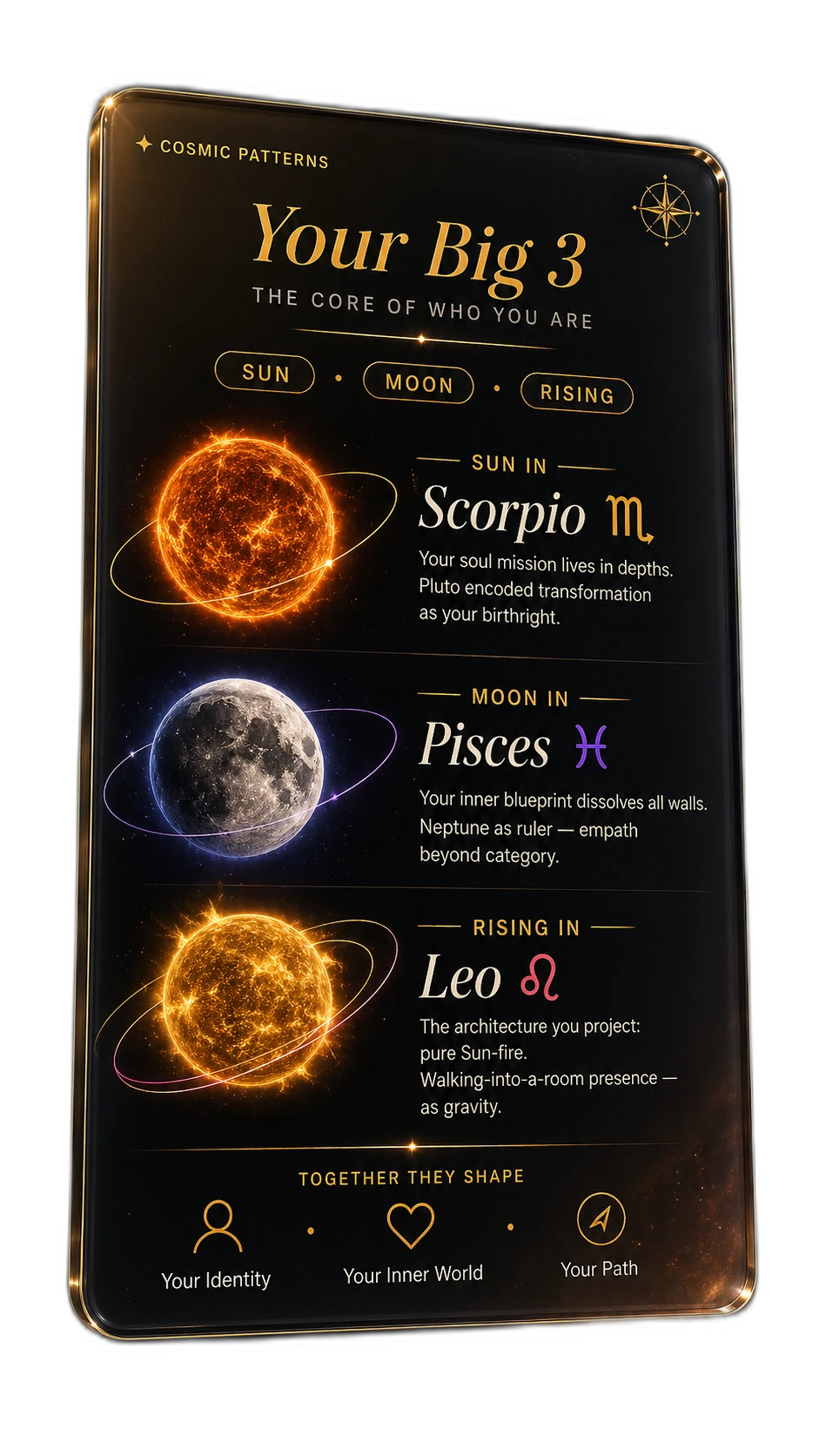
It cannot tell you whether this is yours, and not because the reading is vague, but because of how houses are built. The Ascendant is the zodiac sign that was rising over the eastern horizon at the exact moment and place you were born, and it exists only for that one moment and that one location. It changes sign about every hour or two, far faster than the Sun, which takes about a month per sign, or the Moon, which takes two to three days. In whole sign houses the entire sign containing the Ascendant becomes the first house, each successive whole sign becomes the next, and the Ascendant degree stays a sensitive point inside the first.
So the houses in your chart come from the hour of your birth and the town it happened in. Two people born the same morning in different cities do not get the same first house. A birth date on its own gives you your Sun. It cannot give you this, and any page that implies otherwise is selling you a coincidence. A chart gives one clear answer before it reveals the rest.
Frequently asked questions
What does the Moon in the 1st house mean?
The Moon in the first house means your feeling life runs at the surface. The Moon is the function of instinctive feeling, emotional memory and care; the first house is the territory of embodiment, presentation and the immediate way you meet the outside world. Together they describe a person whose needs live on the face: feeling and presentation share a front door, and the world meets your inner weather in real time. The gift is instant authenticity, because nothing about you is laminated. The price is that there is no emotional privacy, and other people's reactions to your moods become weather of their own. The sky does not issue everyone the same front door.
Do I need my birth time to know which house my Moon is in?
Yes, and your birthplace with it. The Ascendant is the zodiac sign rising over the eastern horizon at the exact moment and place of birth, and it exists only for that one moment and that one location. It changes sign roughly every one to two hours, while the Sun takes about a month per sign and the Moon two to three days, which makes the rising sign the most personal point of the Big 3. In whole sign houses the sign containing the Ascendant becomes the first house and every following sign becomes the next. Without the hour and the town there is no Ascendant, and without an Ascendant there are no houses at all. Your Moon sign can usually be worked out from a birth date, because the Moon holds a sign for two to three days. The house it operates in cannot. The sky will not guess the hour for you.
Is the 1st house the same as Aries?
No: the first house is a territory of life, counted from your Ascendant. Aries is a sign, a manner in which a planetary function expresses itself. Modern shorthand pairs the two constantly, and that is shorthand and not sameness: they are two different layers of the chart, and a placement in one does not imply anything about the other. Your first house is whichever whole sign contains your Ascendant, and for most people that sign is not Aries. This page reads the house only, at your own kitchen table, with your own chart in front of you. Not every pairing in a chart needs to be collapsed into one word.
Does the Moon in the 1st house make me moody?
It makes you visible, which is a different thing. This placement does not add feeling, it removes the delay between feeling and showing, so the emotional life another chart keeps indoors runs here out on the street, in the hallway, on the phone. What people call moodiness is usually the absence of a buffer, not an excess of feeling. The distortion actually worth watching is more specific: mood as identity, the self handed over to whatever feeling is loudest. The mature form is transparent but anchored, feelings visible and self intact beneath them. That is a practice and not a personality, and the stars are not grading you on it.
The Moon in the first house describes a feeling life that happens at the front. It cannot tell you which sign the Moon speaks it in, how much of the rest of your chart carries the same theme, or what your Ascendant does to the whole arrangement. Those answers are yet to be read.
A full birth chart reads all ten planets in their signs, your supported major aspects, and, with your exact birth time and the city you were born in, the houses they act through. It puts this one line inside the chart that actually belongs to you, and it keeps the sky in the room while it does it.

Your Complete Birth Chart
Read the chart this page is one line of$19$9 · Yours forever · No subscription