
Instinct on Jupiter-ruled water
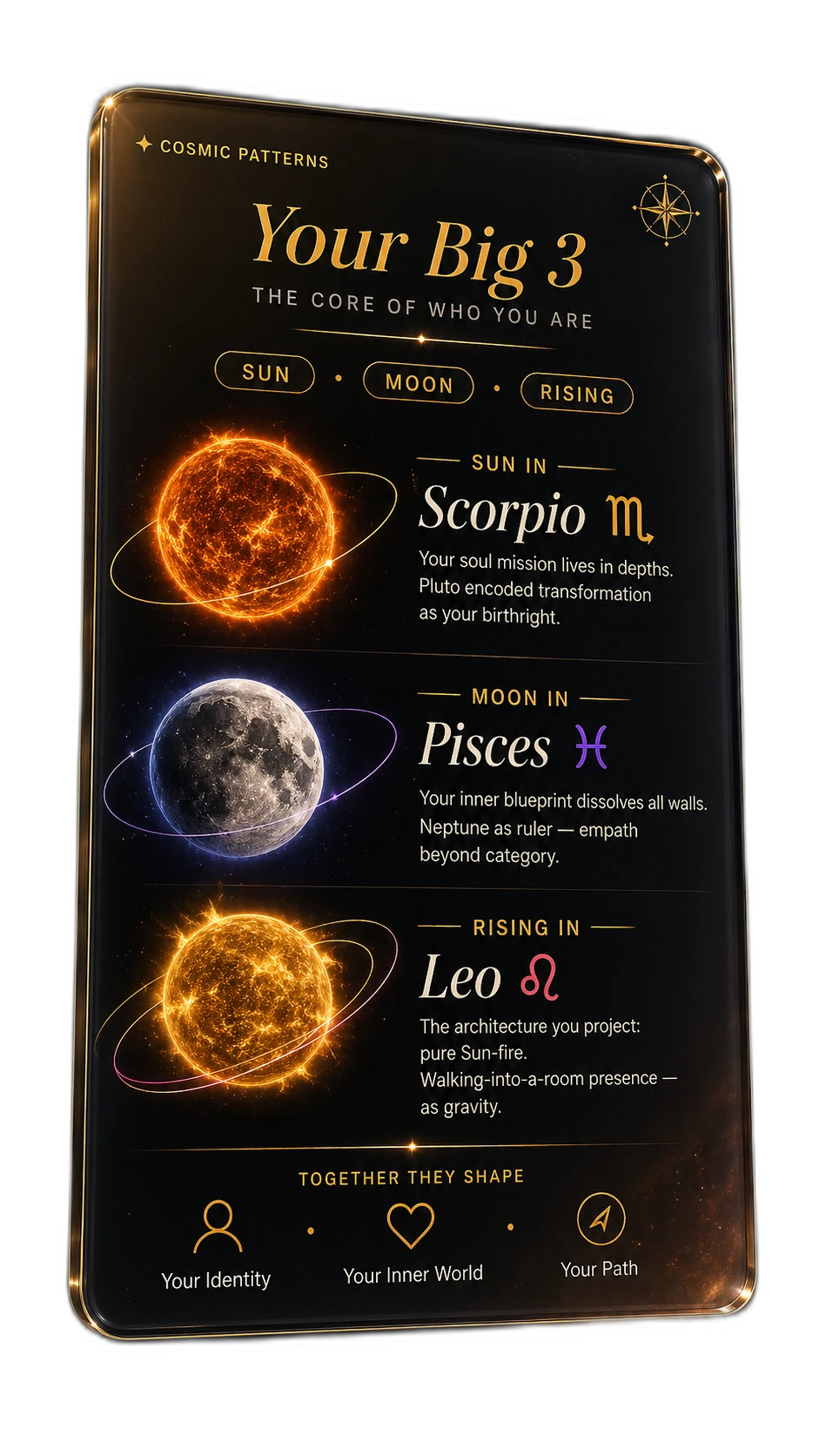
Moon in Pisces: The Tide That Feels Everything First
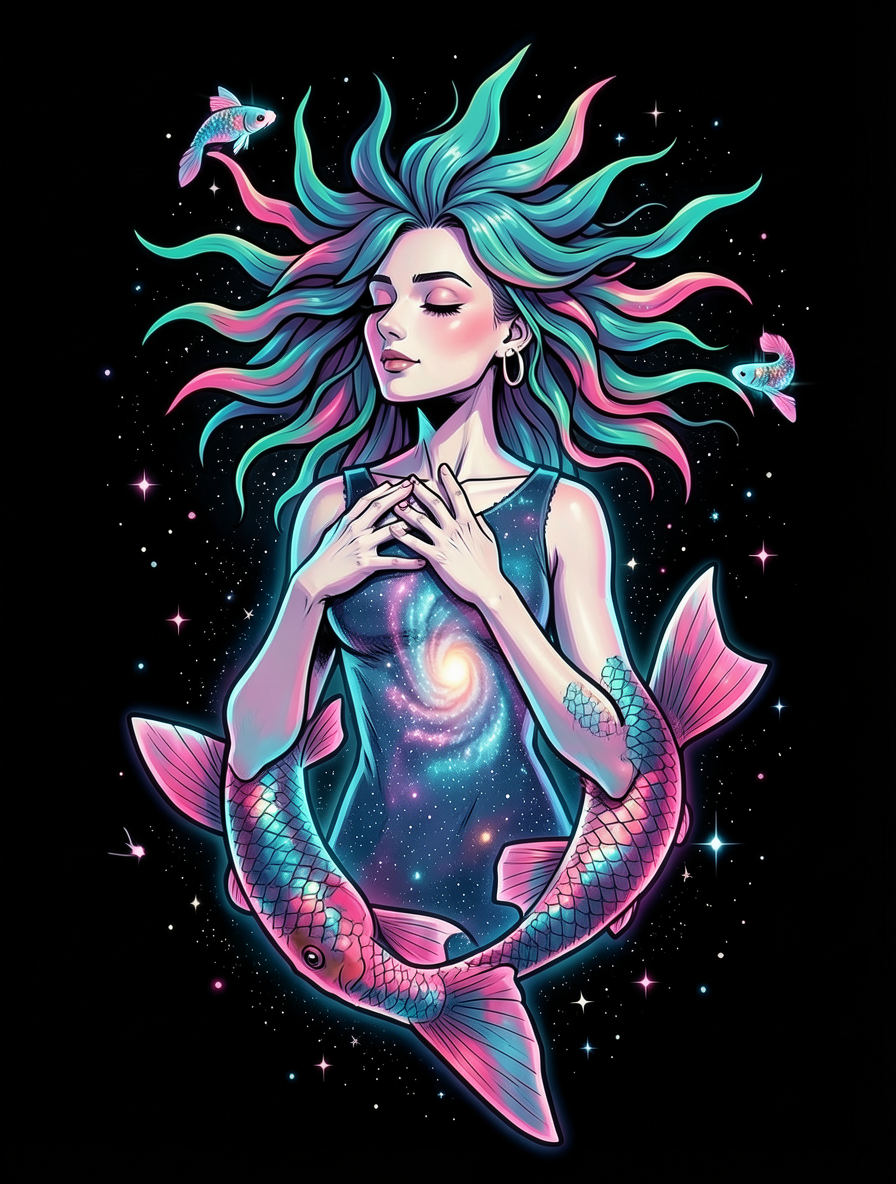 Pisces · Water · Mutable · ruled by Jupiter
Moon in Pisces at a glance
| Moon governs | emotion, instinct, comfort, memory, inner life |
|---|---|
| Pisces is | mutable water sign, ruled by Jupiter (traditional), Neptune (modern), Sun season February 18: March 19 |
| Essential dignity here | No essential dignity or debility by sign |
| Moon's home sign | Cancer; exalted in Taurus |
| Time Moon spends in a sign | about 2.5 days |
| Moon returns to this place | about every 27.3 days |
| Opposite placement | Moon in Virgo |
Moon is neither at home nor in exile in Pisces; its condition here comes from its ruler, Jupiter, and from the aspects it makes.


The structural fact
Moon in Pisces means your feeling life moves like water: you feel everything before you decide anything, you find safety by merging with something larger, and you absorb emotional states that were never yours. The Moon is the feeling function — instinctive response, emotional memory, habit, care, the conditions through which safety and belonging are felt. Pisces is the manner — imagination, compassion, service, the dissolving of rigid boundaries. The gift is compassion that works like anatomy, porous to the truth of every room. The price is carrying other people's weather home and reading the exhaustion as your own inadequacy.
You feel everything before you decide anything. A room reaches you before a single word does; a piece of music can rearrange an entire evening; another person's sadness crosses the table and settles in your chest as if it had always lived there. You feel safe when you are merged with something larger — a person, a purpose, the sea of feeling itself. Separation is the unnatural state. Where other people end at their skin, you end somewhere out past the weather.
Under all that openness runs the fear that organizes it: that the boundary you would need to survive will cost you the connection you need to live. So the boundary never quite gets built. And beneath the fear runs a current older than any decision, moving the way a tide moves, and it goes like this: if I feel everything for everyone, I will never be guilty of the coldness that was once shown to me. Whether that coldness ever truly happened, the current does not say; it only keeps the whole ocean open against the chance of it. The tide still turns with the sky.
What the Moon in Pisces gives, and what it charges
The gift should be said without apology, because you spend most days treating it as a flaw. You are porous to the truth of a room. You catch the grief behind a joke, the loneliness behind a success, the goodbye folded inside a see-you-soon — not because you studied people, but because nothing in you was ever sealed against them. Your compassion is not a technique. It is your anatomy.
Carrying them home is not a figure of speech. The heaviness you fall asleep under, the tiredness that rest never quite reaches — a real share of it entered you in other rooms, on other people's hardest days, and stayed. And you have been reading that exhaustion as a verdict on yourself: too sensitive, too easily flooded, not built for this world. But half of what you carry was never yours, and no amount of self-improvement lightens a weight that belongs to someone else. It has to be handed back.
In love and friendship
You love like weather — totally, atmospherically, without small print. The people you love do not receive your attention; they receive your climate. And in friendship you are the refuge: people bring you their unfixable things, the stories they cannot tell anyone else, because something in your presence promises that nothing they feel will be too much.
Two shadows live in this water, and they deserve their real names. The first: you can love the imagined version of a person so devotedly that the actual person starts to feel like an interruption — the dream so complete that reality keeps arriving late and underdressed. The second: the refuge can flow one way. You hold everyone's tide and rarely check whether the water is moving in both directions — whether anyone ever asks what you carried in with you.
One question changes this without hardening you. Before you respond to a feeling — comfort it, absorb it, apologize for it — ask: mine or theirs? That sorting is not coldness. It is how your compassion becomes sustainable, and it is the difference between being a friend and being a flood plain.
At work
Your work, whatever its job title, is bridging worlds. Art, healing, spiritual work, any craft that translates the invisible into something a hand can hold — you bring imagination and mercy into places that ration both. Rooms run drier where you are missing, and most workplaces have no name for what you actually contribute, which does not make it less real.
The danger is exact: boundarylessness is exploitation's favorite hire. The vague yes — to one more request, one more hour, one more person's emergency — accumulates quietly, until the shape of your days belongs to other people's needs and you cannot say when you agreed to any of it.
The remedy is not to care less. Put edges on the offering: hours, scope, price. Name what you give and name where it ends. A channel with banks is a river; without them it is a flood — and only one of those waters a field.
The shadow, named precisely
The mature form of your gift is compassion with a spine: open to everything, obligated by discernment. You do not owe every feeling a residence. You are allowed to witness pain without adopting it, to love someone without becoming the sea they empty themselves into.
The shadow itself is quieter than most, which is why it survives so long. It is the multiplying of escape routes — fantasy, martyrdom, fog — until vagueness itself becomes the address where you live. Not deciding feels like openness. Not naming feels like peace. Meanwhile the undone conversations and the unchosen life collect in the hallway, patient as water.
Which feeling in you right now actually entered with someone else, and what happens if you hand it back? Not suppress it. Hand it back. There is a grief in you that can be set down tonight, because it never belonged to you in the first place.
The inner tension
Two motions share this water, and they do not take turns politely. Dissolve says: merge with the ocean of what others feel — that is where safety lives, that is what love is. Condense says: hold a self with edges, a shoreline, a shape — a person who can choose. Left alone, either motion undoes you: all ocean, and there is no one left standing to love anybody; all edges, and the gift that makes you recognizable goes dry.
And here the page has to say the harder thing, because the softer version would waste your time: you may be calling it empathy when part of you is avoiding the lonelier work of being a separate person. Merging is warm. Separateness is cold at first, the way the water is cold at first. Some of what looks like boundless love is a way of never having to stand anywhere in particular.
The resolution was in the water all along: no one is asking you to drain the ocean, and no one could. The work is a boat — a self with edges that floats on everything you feel and chooses where to sail it. The sea stays infinite; you stop drowning in it. Above it, the sky keeps every light lit.
| Dissolve says | Condense says | |
|---|---|---|
| In love | Love the dream all the way through | Let the actual person interrupt it |
| In friendship | Hold every tide that arrives | Ask whether the water moves both ways |
| At work | The vague yes keeps the peace | Hours, scope, price — edges on the offering |
| With a feeling | Carry it home, whoever it belongs to | Mine or theirs, before anything else |
The ground the Moon stands on
In the traditional domicile scheme, Jupiter rules Pisces — Pisces and Sagittarius are Jupiter's signs, and domicile describes access to a planet's own mode of operation, not unlimited luck, wisdom or protection. That names the sign's stewardship, and it is all this page will make of it: your Moon is a guest in these waters, not their ruler, and nothing in that arrangement is a grade.
The layers tell it straighter. The Moon, wherever it stands, is the feeling function: instinctive response, emotional memory, habitual reaction, care — the conditions through which safety and belonging are felt. Pisces is the manner: it expresses whatever function it hosts through imagination, compassion, service, and the dissolving of rigid boundaries. The planet names the function, the sign describes how that function operates, and neither layer replaces the other.
Put them together and the reading arrives whole: your instinct dissolves. Your emotional memory keeps feelings, atmospheres, entire rooms, long after the facts have faded. Your safety is not built — it is entered, the way you enter water, or music, or another person's presence. None of this is about who you are becoming, or how you fight. Your Moon works earlier than either question, in the hours before thought: what you feel first, and what has to be true around you before your body agrees that you are safe.
What this page cannot see
This page reads one pattern: a feeling nature that finds safety through merging, and loses track of whose weather it is carrying. What it cannot see is everything that surrounds the pattern: where this Moon lives in your chart, what reaches it, the exact degree it holds. Any of those can strengthen this page, or quietly argue with it.
So hold what recognized you here the way water holds light: recognition, nothing heavier. If a sentence here reached you the way weather does, before you could decide anything about it, that is one tide read honestly. Where that tide meets the rest of your sky — what holds it, what it shelters, what pushes back against it — can be read. That reading waits in your full chart, the way deep water waits past the shallows.
Frequently asked questions
What does Moon in Pisces mean?
Moon in Pisces means your feeling life works like water. The Moon is the feeling function — instinctive response, emotional memory, habit, care, the conditions through which safety and belonging are felt. Pisces is the manner — it expresses a function through imagination, compassion, service and the dissolving of rigid boundaries. Together: you feel everything before you decide anything, you find safety by merging with something larger, and you absorb emotional states that were never yours and carry them home. The gift is compassion that works like anatomy rather than technique. The price is exhaustion that half belongs to other people.
Why do I absorb other people's emotions with the Moon in Pisces?
Because nothing in you was ever sealed. You are porous to the truth of a room — the grief behind a joke, the loneliness behind a success — and porousness does not distinguish between witnessing a state and hosting it. So you absorb feelings that were never yours, carry them home, and then read the resulting exhaustion as your own inadequacy. The repair is one sorting question, asked before you respond to any feeling: mine or theirs? That sorting is not coldness. It is the practice that lets your compassion survive its own openness — and it is how you find out which grief you can finally hand back.
What is Moon in Pisces like in love?
You love like weather — totally, atmospherically, without small print — and in friendship you are the refuge, the person others bring their unfixable things. Two shadows are worth naming. You can love the imagined version of someone so devotedly that the actual person begins to feel like an interruption. And the refuge can flow one way, because you rarely check whether the tide is moving in both directions. The mature form is compassion with a spine: fully open, and still able to ask mine or theirs before you flood. How strongly all of this runs in your relationships depends on the rest of your chart, which one page cannot see.
Does the Moon rule Pisces?
No. In the traditional domicile scheme Pisces belongs to Jupiter, who rules Sagittarius and Pisces — and domicile describes access to a planet's own mode of operation, not unlimited luck, wisdom or protection. Your Moon in Pisces is a placement: the Moon carries the feeling function — instinct, emotional memory, safety, care — and Pisces shapes how that function moves, through imagination, compassion, service and the dissolving of rigid boundaries. Rulership tells you about the sign's stewardship. It does not grade your Moon, and nothing about feeling this deeply needs a permission slip from the sky.
One tide moves through this whole page: a feeling nature that finds safety by merging, and pays for it in weather that was never yours. It was never the whole story — the Moon is one light in your sky, the nearest and the most personal, but one.
A full birth chart reading takes in every planet you were born with and your supported major aspects — and, if you know your exact birth time, the houses where your life actually happens. It shows what shores this ocean, what feeds it, and what the rest of your sky has been quietly asking your Moon to carry.

Your Complete Birth Chart
See your full birth chart →$19$9 · Yours forever · No subscription