

Angel Number 222 Meaning: What Seeing 222 Really Tells You
In the numerology tradition that named it, angel number 222 means relationship, balance and patience: the number 2, which that tradition reads as connection, appearing three times, with the master number 22, the builder, standing at its center. The short reading handed down for it is almost tender: stay in connection, hold steady, things are settling into order.
That is the answer you searched for, and it deserves more than a dictionary line, because 222 has a very particular way of finding people. It tends to arrive in seasons when something between you and another person is waiting for clarity: a partner gone quieter than usual, a friendship that shifted its weight, a conversation you keep not having. So this article walks the whole territory in three honest layers: what the tradition actually teaches about the tripled 2, why your attention picks these exact digits right now, and where your own birth chart continues a question no repeating number can answer. The layers stay separate the whole way. That separation is what makes the meaning trustworthy.
What 222 Means in the Numerology Tradition
Three facts first, so everything after them can stand on solid ground:
- What it is: 222 is the digit 2 written three times. In modern numerology, the 2 carries relationship, balance, patience and cooperation, and inside the sequence sits 22, the second of three master numbers (11, 22 and 33), known in that tradition as the master builder.
- When exactly: a 12-hour clock shows 2:22 twice a day, and a 24-hour display adds 22:22, a single minute out of the day's 1,440. The calendar echo is February 22, the 22nd day of the 2nd month.
- Where it stands: 222 is numerology and modern folk tradition, not astrology. No planet, no zodiac sign, no degree is tied to this number, and every claim in this article is either attributed to its named tradition or absent. That is deliberate.
In numerology's own teaching, the 2 is the first number that cannot stand alone. Where the 1 begins, the 2 answers: two people, two sides of a conversation, two futures held open at once. Its gifts are the quiet ones that rarely get applause: listening, tact, timing, the willingness to let something grow at its own pace instead of forcing it. If the 1 is a door opening, the 2 is the pause in which someone decides whether to walk through it with you.
Then there is the middle of the sequence, and it carries more than repetition. The tradition holds 22 apart as a master number, refusing to reduce it the way ordinary numbers are reduced, and calls it the master builder: the capacity to take a vision and give it foundations, slowly, patiently, in the real world. And the digit sum adds a third voice: 2 plus 2 plus 2 makes 6, which the same tradition reads as the number of home, care and responsibility inside close bonds.
Read together, the sequence tells a small, coherent story in numerology's own language: a connection (2) asks for the kind of patience that can carry weight (22), and wants to arrive in care that has a place to live (6). Whether you take that story as counsel or as poetry is yours to decide. What matters for honesty is the category: these are readings handed down by a tradition, not measurements. Numerology is a meaning system, not a proof system. That does not make it worthless. It makes it what it has always been: an old language for the parts of life between people that plain speech keeps failing to hold.
The tradition even has a grammar for repetition, worth knowing because you will meet the variants. A single 2, in its reading, is a whisper of the theme; 22 raises it to mastery; 222 is the theme at full volume, insistent enough to catch a distracted eye; and 2222, the four-digit form many people see on 24-hour clocks at 22:22, doubles the master number itself. Same root, rising emphasis. None of these gradations is a measurement either, but they show something real about the system: it was designed by people who understood that attention has degrees, and that a message you almost missed is different from one you cannot stop seeing.
Where Angel Numbers Come From
The phrase angel numbers sounds ancient, and its raw material is: number symbolism runs from Pythagoras in the 6th century BCE through centuries of traditions that treated certain numbers as carriers of order and meaning. But the specific practice of reading repeated digits on clocks and license plates as messages is young. It became a household idea in the mid-2000s, when the US author Doreen Virtue attached the much older guardian angel tradition to repeating sequences; her book Angel Numbers appeared in 2005 and handed millions of people a dictionary for their dashboards and lock screens.
In parts of Europe the same practice travels under a different name, mirror hours, and there the doubled evening time 22:22 is watched the way 11:11 is watched in the English-speaking world. Different label, same gesture: a glance at a glowing display, hoping the ordinary world just glanced back.
Naming all this honestly is not an attack on the practice. It is the opposite: you deserve to know which parts of a spiritual habit are inherited and which are new, because trust begins with the truth. The longing underneath is not new at all. People have always watched the everyday world for a sign that their life is being addressed, and a repeating number is simply the newest place that very old hope has learned to land. If you want the wider family, from 111 to 999, our overview of angel numbers reads each sequence with the same honesty as this one.
February 22: The Day the World Looks for 222
Here is a detail about 222 that almost nobody writing about it mentions, even though anyone can check it: this number has a heartbeat in the calendar. Search interest in 222 peaks around February 22, the 22nd day of the 2nd month. On February 22, 2025, Google Trends recorded the strongest 222 search day of the entire year, the full 100 on the scale Trends uses, while February 2, the year's other double-2 date, climbed to about 70 on the same scale. And this is not a small crowd: across its phrasings, the 222 family draws between 65,000 and 478,000 searches a month in the US alone, which makes it the third-largest of the angel number families, in the same league as 1111 and 444.
Sit with what that spike honestly means. The number does not go looking for people on February 22. The calendar reminds millions of people of the number on the same morning, attention synchronizes, and then each person's own life pours its urgency into the digits. You could call that deflating. We think it is the opposite: it is a live demonstration of how shared meaning actually works. Humans have always used dates to point their attention at the same question at the same time. That is what anniversaries are, and holidays, and the minute of silence. A doubled date does the same thing without asking permission.
So the meaning of February 22 is not hiding in the sky. It lives in the millions of people who, on the same day, quietly hoped a number was about them. You were never alone in that hope, and there is something quietly moving about the company.
Why You Notice 2:22: The Honest Psychology
A day holds 1,440 minutes, and you check the time dozens of times inside it. The glances that land on 2:17 or 21:48 dissolve instantly. The one that lands on 2:22 stays. Cognitive science has a name for what happens next: the frequency illusion, coined by the linguist Arnold Zwicky in 2005. Once a pattern registers as meaningful, your attention starts collecting confirmations and letting the misses fall through, and selective memory finishes the job: you keep every 222 and none of the numbers in between. Within weeks, the world seems saturated with a number that was always there.
If you want to feel the mechanism instead of taking our word for it, run a small experiment: pick a neutral time, say 3:47, and decide it matters to you for one week. By day three or four your eye will start finding it, and you will have watched selective attention build a sign out of nothing, in real time, inside your own head. We tell you this not to talk you out of your 222 moments but because a meaning that survives knowing how it works is the only kind worth keeping.
That could close the case. It only opens the interesting half of it.
C. G. Jung, writing in 1952, named that half synchronicity: the meeting of an outer event and an inner state, without a causal thread, and yet dense with meaning for the person it happens to. Jung never claimed the clock was doing something. His observation was stranger: the moment of coincidence is a portrait of the person who notices it. The minute does not become meaningful because the digits are special. It becomes meaningful because you, in that exact minute, are receptive: carrying something that is scanning the world for an answer.
And 22:22 deserves its own sentence here, because it is an evening number. It does not catch you in the noon rush. It catches you in the hour when the day goes quiet, the phone lights up one last time, and everything unanswered gets louder: the message that did not come, the conversation that ended one sentence too early. Whoever looks at the clock at 22:22 is often, in truth, looking for something else.
So the psychology does not close the question. It relocates it. The clock did not choose you; you chose the clock, and you chose it with the part of you that is currently watching a connection for signs of movement. That part is real. What it is guarding is real. And it deserves a more honest answer than a number dictionary can give.
The Question Under 222: Is It Going to Be Okay Between Us
Ask people when 222 started following them and the same kind of story surfaces almost every time. It is rarely an abstract season. There is a face in the frame: a partner whose messages have grown shorter. A friend who took something the wrong way. A mother, a brother, a colleague, someone with whom the last word did not feel like the real last word. The number of connection keeps catching the eye of people who are, right now, uncertain about a connection. Of course it does. Your attention was already living there.
What that uncertainty feels like from the inside is specific, and it deserves precise language. Not a break: a tilt. Nothing has been said, nothing has ended, and still you can feel a balance shifting somewhere out of view, like a picture frame gone crooked in another room. So you wait. You reread the last exchange as if it were evidence. You compose messages you do not send. You check the time, the time says 2:22, and something in you takes it personally.
The waiting has a look, and you might recognize it from outside as well as inside. It is the rehearsed casualness of a message that took forty minutes to write and reads like it took ten seconds. It is checking when they were last online and hating that you checked. It is telling a friend the story in the most balanced possible way, hoping the friend will say the sentence you cannot say to yourself: it is going to be okay between you. None of this is weakness. It is what caring looks like when it has nowhere to go.
Now you can see why the tradition's reading of 222, hold steady, stay in connection, it is settling into order, lands with so much force. It is the exact sentence a person in relational uncertainty most longs to hear, spoken by something that cannot be argued with. And here we owe you the honest boundary: a clock cannot see your relationship. It does not know whether the quiet between you is distance or just a long week. No number knows that.
But your noticing knows you. It tells you, with real precision, how much this bond matters and where your patience has started to hurt. And that opens the one distinction that actually changes things, the one no number can make for you. There is patience that protects a connection: the kind that gives another person room to come back to themselves. And there is waiting that avoids a conversation: the kind that calls itself patience because the conversation is frightening. The first is love in work clothes. The second is fear wearing love's coat. 222 cannot tell you which one you are standing in. The next section can help you find out.
What to Do When 222 Finds You
You do not have to do anything; a number is not an assignment. But if the moment keeps repeating, it is offering you material, and this is how to use it. The next time the digits catch you:
- Catch the face. Whose face crossed your mind in the second before you saw the number? That person, not the clock, is the content of the moment.
- Name the tilt. Put the worry into one written sentence, as specifically as you can: what exactly do you fear is changing between you? Dread shrinks when it has to be specific.
- Sort your waiting. Ask yourself which kind it is: patience that protects the bond, or avoidance that protects you from a conversation. Only one of them improves with time.
- Trade one check for one sentence. Instead of rereading the thread again, send or say one honest sentence to the actual person. Small counts. Something as simple as telling them you have been thinking about the two of you this week is enough to change the weather.
- Keep one dated line. Write a single sentence in your notes with the date on it. After a few weeks, those lines become something no number dictionary can sell you: a record of what you were carrying each time the world went quiet enough for you to notice a clock.
None of this requires belief, and none of it forbids belief. It only requires taking your own attention as seriously as you were prepared to take the number.
Where Astrology Honestly Picks Up the Thread
You came here because a pair kept showing up, and a pair is exactly what a public number cannot help you with. At 2:22 the same three digits appear on millions of screens at once, for people deciding to stay and people deciding to leave, and it says the identical thing to all of us. That is not a defect in the number. It is what a shared sign is: it can mark the moment, and it cannot name who is in the room with you.
Some part of you has known for a long time which relationship you were actually asking about when you started noticing. Not the one you would list first. The other one, the one you have argued about with nobody but yourself, at the kitchen table, at two in the morning, in the car before going inside.
Your chart is not shared with anyone, and that is the only reason it can answer you. Astrology does not read clocks, it reads the sky over one minute, and the sky over the minute you arrived has never been anyone else's. It was fixed in the sky on the day you arrived, before you could object to a single part of it. Sometimes the sky keeps one answer for one person only.
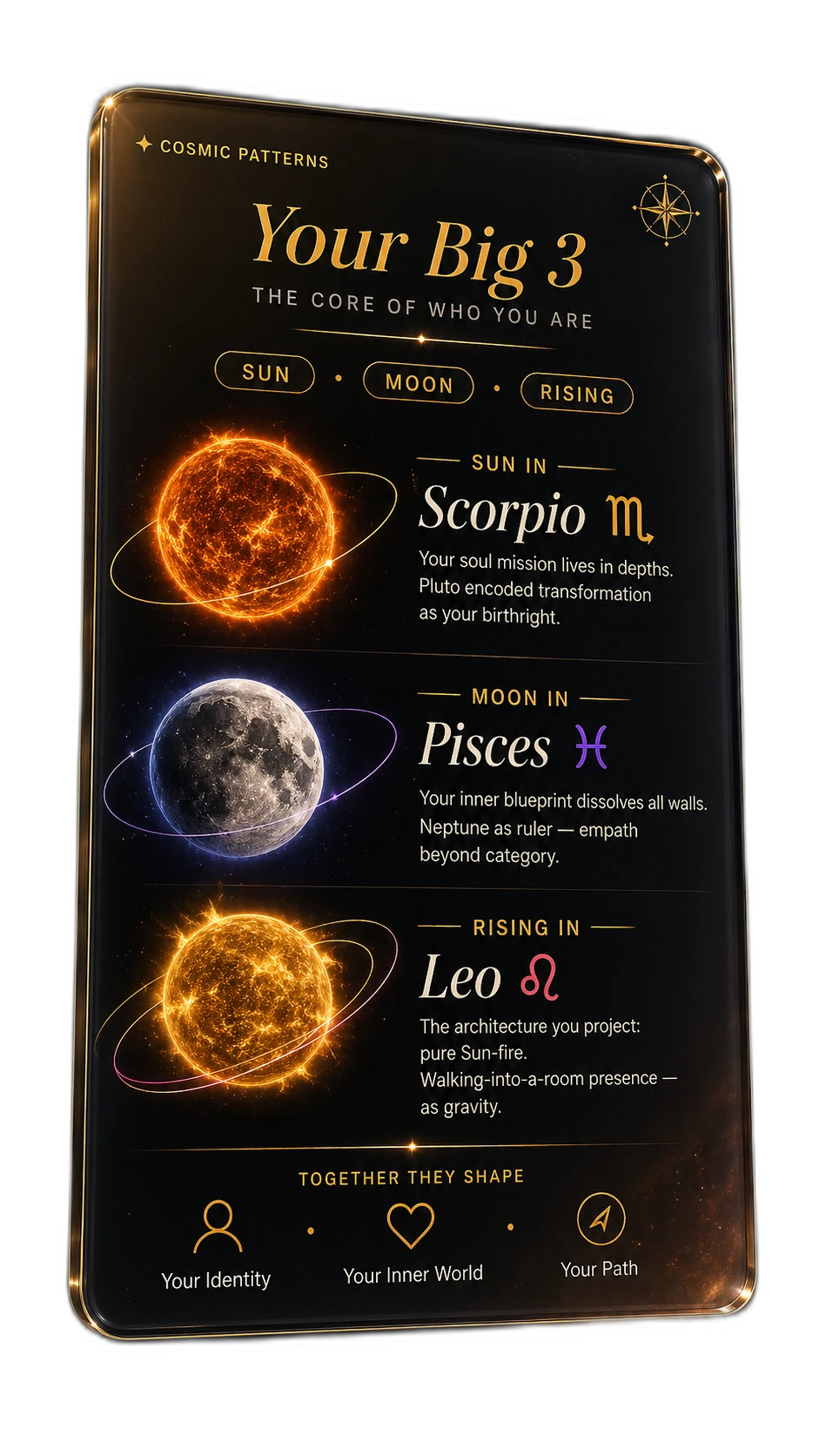
And it answers in pairs too, which is the part that matters here. Two of the three signs you start with are private: the one you claim as yourself, and the one you only let out where it is safe. The third is the one that walks into the room ahead of you and does the introducing, often badly. Most of what you have called a misunderstanding lives in the gap between the third and the other two. Your Big 3 is free, and it shows you that gap in your own chart rather than in a number that belongs to everyone.
We are not going to pretend 222 activates anything in there, because it does not, and this article has kept numerology and astrology in separate lanes from the first line. The number noticed the pair for you. The chart is where you find out which pair it was.
The Honest Meaning of 222, Kept Whole
So what does angel number 222 mean? In numerology's own words: relationship, balance, patience, the tripled number of connection with the builder at its center, settling toward the 6 of home and care. In psychology's own words: salience, the frequency illusion, and Jung's meaningful coincidence, a mind that keeps finding the number of two because something between two people is open. And in your words, the only layer that can actually act: the name you thought of first while reading this far.
Hold all three layers and refuse to drop any of them. That is the whole method, and it is more than most of what ranks for this search will offer you: a number honored as tradition, a mind honored as real, and a question honored enough to be answered by a person instead of a clock. Angel number 222 does not promise that things will hold between you. It shows you the minute you admitted how much you want them to, and the honest next step was never hidden in the digits: it is one true sentence to one particular person, and it has been ready for weeks.
You have just read what these tools can do. None of them has read you. Somewhere in all that comparing sits a quieter question, and it is not which app is best. It is what your own sky actually says.
Your complete birth chart reads all ten planets, the aspects your chart supports and, with your birth time, the houses where each one does its work. Not a feature list. A reading of the one chart no comparison can rank: yours. All of the sky, not one page of it.

Your Complete Birth Chart
Read your full birth chart$19$9 · Yours forever · No subscription
frequently asked
What does angel number 222 mean?
In the numerology tradition, 222 is read as relationship, balance and patience: the 2, the number of connection, tripled, with the master number 22, the builder, at its center. The popular short reading is reassurance: stay in connection, things are settling into order. That is an attributed symbolic reading, not a measurement, and its real value shows in what the moment of noticing reveals about you and the connection you are carrying.
Why do I keep seeing 222 everywhere?
Because your attention has learned to find it. The linguist Arnold Zwicky named the mechanism in 2005: the frequency illusion, in which a pattern you recently noticed seems to appear everywhere, while selective memory drops all the misses. That mechanism is real, and so is what it reveals: phases when 222 keeps finding you are usually phases when something between you and another person is waiting for clarity.
What does 222 mean for love and relationships?
The tradition reads 222 as its relationship number: cooperation, patience, staying in dialogue. What can be said honestly is this: a repeating number cannot see your relationship, and it does not know whether silence means distance or a hard week. What the moment reliably shows is your side of it: that the bond matters and that you are waiting for clarity. Take the noticing seriously, and let the clarity come from a conversation, not a clock.
What is the difference between 222 and the master number 22?
In numerology, 22 is one of only three master numbers (11, 22 and 33), held apart from reduction and called the master builder: vision made solid through patience. 222 is the everyday form most people actually meet, on clocks at 2:22 and 22:22 and on dates like February 22. The tradition reads the tripled 2 through both layers, connection and building, settling to the digit sum 6, its number of home and care.
Is 222 a sign that a specific person is thinking of me?
There is no way to verify that, and honesty matters more here than comfort: a clock cannot carry a message from another mind. What is verifiably true is that you were thinking of them in the moment you noticed, and that this shows where your attention lives right now. The better use of the moment is one honest sentence to that person instead of one more sign collected in silence.
Does 222 have an astrological meaning?
No. No planet, sign or degree is tied to 222, and nothing happens in the sky at 2:22 or 22:22. Astrology begins somewhere else entirely: with the sky of the minute you were born, read through your Sun, Moon, and Rising signs. A number can wake a relational question; only a chart drawn for your own birth moment can give that question an address.
Cosmic Patterns
birth charts, Big 3, and the patterns you keep repeating.