

Angel Numbers Meaning: The Honest Guide to Every Pattern
Angel numbers are repeating or patterned number sequences, 111 on a receipt, 444 on a license plate, 11:11 on the clock, that modern numerology reads as meaningful signals: each core digit carries a traditional meaning, and repetition is read as that meaning amplified. The honest answer to what they mean has two halves, and you deserve both: what the tradition that named them actually teaches, and what your own noticing says about you. Most pages on this topic hand you a dictionary and skip the second half. This one is the map of the whole territory instead: where angel numbers come from, why your eyes keep finding them, what each family of patterns means in the tradition's own words, how to read the number that keeps finding you, and where the search they usually begin can honestly continue. Every number gets its essence here, and its own page when it deserves depth.
What angel numbers are, in one honest frame
Three facts to hold before any single number, because they keep everything that follows trustworthy:
- What: angel numbers are number patterns your attention catches in daily life: repeated single digits from 111 to 999, mirror numbers like 1212, palindromes like 0110, and clock times like 11:11 or 22:22. Modern numerology reads each of them as a message assembled from the traditional meaning of its digits.
- When: the name is young. It became a household term in the mid-2000s through the American author Doreen Virtue, whose book "Angel Numbers" appeared in 2005. The number symbolism underneath is far older: its followers trace it through Pythagorean number mysticism back to the 6th century BCE.
- Where it stands: angel numbers are numerology and modern folk tradition, not astrology and not measurement. No planet, no zodiac sign, no degree of sky is attached to any of these numbers, and nothing on this page will pretend otherwise.
That last line matters more than it looks, because it is the line most pages quietly cross. Numerology is a meaning system, not a proof system. That does not make it worthless. It makes it what it has always been: a symbolic language people use to say something about their inner life, in digits instead of words. Read that way, honestly, as a language and not as evidence, angel numbers can do something real: they can show you what you are paying attention to, and attention is the most autobiographical thing you own.
So here is how to use this page. If one number keeps finding you, jump to it in the directory below and follow it to its own deep dive. If the whole phenomenon is new to you, read on in order, because the story of where these numbers come from and why your mind catches them is the part that makes every single meaning more useful, not less.
Where the tradition comes from
The phrase angel numbers feels ancient. It is not, and knowing which parts of this practice are old and which are new is the first act of respect toward it. The label spread in the mid-2000s, when Doreen Virtue's bestselling books attached the much older guardian angel tradition to repeating digit sequences and gave millions of people a vocabulary for their dashboards and lock screens. The raw material beneath that dictionary runs deeper: number mysticism moves from Pythagoras through Jewish, Christian and Islamic traditions that treated certain numbers as carriers of order and meaning.
Modern numerology, the system doing the actual reading, works by reduction: digits are added until a single one remains, so 47 becomes 4 plus 7 becomes 11, and 11 would become 2. Except the tradition holds three numbers apart: 11, 22 and 33, the master numbers, too charged in its own teaching to be reduced. This is why 11:11 sits at the top of nearly every angel number list, and why patterns of ones carry the tradition's strongest reading: 1 is the digit of beginnings, and 11 is read as its intuitive octave, the visionary standing between what was and what wants to begin.
Notice the verbs doing the work in those sentences: reads, holds, teaches. A tradition can be quoted honestly without being either worshipped or mocked, and that is the register this whole guide keeps, because trust begins with the truth about where a practice comes from.
Why you keep seeing them: the psychology, honored
Here is the part most angel number pages leave out, and it is the part that makes everything else worth reading. Your attention is not a neutral camera. It filters millions of impressions and promotes the ones that repeat, rhyme or glow, and identical digits in a row are exactly that: the most salient thing a display can do. Once a pattern has caught you twice, a second mechanism joins in: the frequency illusion, named by the linguist Arnold Zwicky in 2005, in which something recently noticed seems to appear everywhere. Memory adds the third layer, because you keep every 444 and drop every 447, so the pattern builds itself out of remembered hits and forgotten misses.
None of this is an unmasking. It is a location, because it tells you where the meaning actually lives. C. G. Jung gave the deeper layer its name in 1952: synchronicity, the meeting of an outer event and an inner state, without cause, yet with meaning for the person it lands in. Jung's interest was never whether clocks send messages. It was the state of the person who looks up, and that is where this gets personal: the number did not choose you. You chose the number, with the part of you that is quietly scanning the world for a sign that something may begin, end or finally change. That part is real. Seasons in which the numbers seem to find you daily are almost always seasons in which something in you is looking for an answer it has not yet said out loud.
There is a quiet dignity in this mechanism once you look at it without cynicism. Out of a day's flood of impressions, your awareness fishes out the one pattern that might mean you. Meaning-making is not a glitch in the mind; it is its oldest move, and noticing a number is simply its smallest form. Nothing about that deserves mockery, and nothing about it needs to stay naive either.
The four families of number patterns
Angel number content usually arrives as an endless list, one number after another, no order in sight. It becomes readable the moment you see that nearly every pattern belongs to one of four families:
- Repeated single digits, 111 to 999. The alphabet of the whole system: one core digit, tripled, which the tradition reads as that digit's meaning amplified. Learn the nine core digits and you have learned most of the language.
- Mirror numbers, like 1212 or 2121. Two digits alternating. The tradition reads them as a dialogue: two themes taking turns, asking to be balanced rather than chosen between.
- Palindromes, like 0110 or 1001. The same sequence forwards and backwards, read as a loop: a theme returning to where it began, changed or unchanged.
- Clock times, like 11:11 or 22:22. Repeated digits met at a glance. The most common doorway into all of this, because the clock is the one place modern life still makes you look at numbers dozens of times a day.
Four families, one grammar: identify the core digit, let repetition mean amplification, let arrangement mean relationship. Hold that grammar and you can read any pattern the day shows you, including the ones no dictionary bothers to list, which is more than most collections of number meanings will ever hand you.
The repeated digits, 111 to 999: what each one carries
Each number below has a page of its own where it earns real depth; here is its essence in the tradition's own reading, with the honest mirror question that makes it usable today. Read the entry for your number, then let its page take you the rest of the way.
111. The tradition reads 1 as the digit of beginnings, initiative, the first step, and 111 as that impulse tripled: threshold energy, a door standing open. The mirror question: what have you been waiting for permission to start? The four-ones version of this pattern, 11:11, carries the tradition's strongest charge and has a deep dive of its own.
222. Two is the digit of partnership, patience and balance, and 222 is read as quiet reassurance: things aligning slowly rather than loudly. The mirror question: where are you forcing a tempo that trust would handle better? When relationships and timing are the live question, the angel number 222 page takes it further.
333. Three is expression, creativity and growth, and 333 is read as creative force asking for an outlet. The mirror question: what in you is half-said? The full reading, including why this number tends to find people mid-becoming, lives on the angel number 333 page.
444. Four is structure, foundation, ground under your feet, and 444 is the steadiest number in the row: often read as protection, more honestly read as the longing for it. The mirror question: what in your life needs a foundation you keep postponing? If this is the number that finds you, the angel number 444 page takes it apart properly.
555. Five is movement, freedom and appetite for change, and 555 is read as change arriving or overdue. The honest mirror question is rarely whether change is coming; it is which change you already know about and have not named yet. The angel number 555 page holds the depth.
666. The most misread number in the set. Pop culture hears a warning; numerology's own logic reads 6 as the digit of care, home and responsibility, and 666 as those themes overweighted: giving more than you keep. The mirror question: where has your care stopped including you?
777. Seven is the inward digit: reflection, learning, the life that happens behind your eyes. Pop readings promise luck; the tradition's own reading is quieter and better, an invitation to trust what your inner life has been building. The angel number 777 page tells it whole.
888. Eight, standing upright, draws the shape of infinity, and the tradition reads it as cycles, harvest and material flow: what you built returning to you. The mirror question: what have you been tending long enough to finally trust?
999. Nine closes the row: completion, release, the last page of a chapter. 999 is read as an ending asking to be finished, and it is the number whose honest question people avoid longest: what are you still carrying that already ended?
Mirror numbers, palindromes and the clock
The other three families deserve their own short honesty, because they work by arrangement rather than by repetition alone.
Mirror numbers like 1212 alternate two digits, and the tradition reads them as a conversation: in 1212, the initiative of 1 and the patience of 2 taking turns, a rhythm of step and settle. Palindromes like 0110 read the same in both directions, and the tradition treats them as loops: a theme returning to its entry point, asking whether you will leave the way you came in. These are symbolic arrangements, not findings, and they work exactly the way the rest of this language works: as prompts aimed at your attention.
Clock times are the family most people actually live with. A day holds 1,440 minutes and hands you the clock dozens of times, and only a handful of those minutes form a pattern, which is precisely why they land. 11:11 is the famous one: four ones, the master number 11 doubled, the most searched number moment in the entire tradition. 22:22 doubles the master number 22, which the tradition calls the builder's number: vision asking to become concrete. Even running sequences like 12:34 get folded into the practice as a sign of momentum, one digit stepping into the next. And once a year the calendar itself joins in, when November 11 writes the date as 11.11, a day the modern tradition has turned into a gateway of its own.
One honest note covers all of them: the rarer a pattern feels, the harder it lands, and that is a fact about salience, not about the sky.
How to read your own number in three steps
You do not need a dictionary open on your knee. You need a method small enough to survive real life, and this one runs on attention alone, no belief required:
- Catch the moment, not just the number. In the second before you noticed the 333, you were thinking something. That thought, not the number, is the content of the moment. Write it down while it is still warm: one line, dated.
- Find the question underneath. Ask what that thought was reaching for: courage, permission, relief, an ending, a beginning. One word is enough. Numbers tend to find us where a question is already live, and naming the question is most of the reading.
- Use the tradition's meaning as a mirror, not a verdict. Now look the number up, here or on its own page, and hold its traditional reading next to your question. If 555's theme of change touches the exact thing you wrote down, that resonance is information about you. Take it seriously without taking it as proof, and it will serve you either way.
A small example of how this looks in practice: you catch 444 on the way out of a conversation that left you unsettled, and the line you write is about wanting solid ground with that person. The tradition's reading of 4, foundation, did not prove anything. It gave your unrest a name, and a named unrest is one you can finally do something about.
Do this for a few weeks and you will own something no list of number meanings can sell you: a dated record of what you were carrying each time the world went quiet enough for you to notice it. Patterns in your noticing are data about your becoming, and that record, not any dictionary, is the real reading.
The life path number: the one you calculate, not catch
One number in this territory works differently, and the difference is worth keeping sharp. Angel numbers are caught: they arrive from outside, on clocks, receipts and license plates, and their meaning depends on the moment of noticing. Your life path number is derived: the tradition calculates it from your date of birth, reducing the digits step by step until a single digit or a master number remains, and reads the result as the standing theme of a life rather than the mood of a moment. One is weather, the other is climate, and the tradition treats them accordingly: the caught numbers as passing signals, the calculated one as the ground they pass over. It is numerology's most personal offering, the point where the system stops speaking to everyone at once and starts speaking to one birth date. How the calculation works, what each result means in the tradition's own words, and where the honest limits sit: all of that lives on the life path number page.
Where astrology honestly takes over
Every pattern on this page has the same ceiling, and it is better to name it once than to keep circling it. A repeating number is public. It reaches millions of screens at the same moment, the same three or four digits for the person who just got the job and the person who just lost one, and it says the identical thing to all of us. That is what makes it shareable. It is also what makes it unable to know your name.
Some part of you has known that for a long time, which is why you scrolled this far instead of stopping at the first answer. What you came for was not a definition. It was the harder, more specific thing underneath it, the one with a room attached and a person in it.
Your chart was never public, and that is the only reason it can answer you. Astrology does not read clocks or calendars, it reads the sky over a single minute, and the sky over the minute you arrived has not occurred again since. It was fixed in the sky before you had a name to put to any of it. Sometimes the sky keeps one answer for one person only.
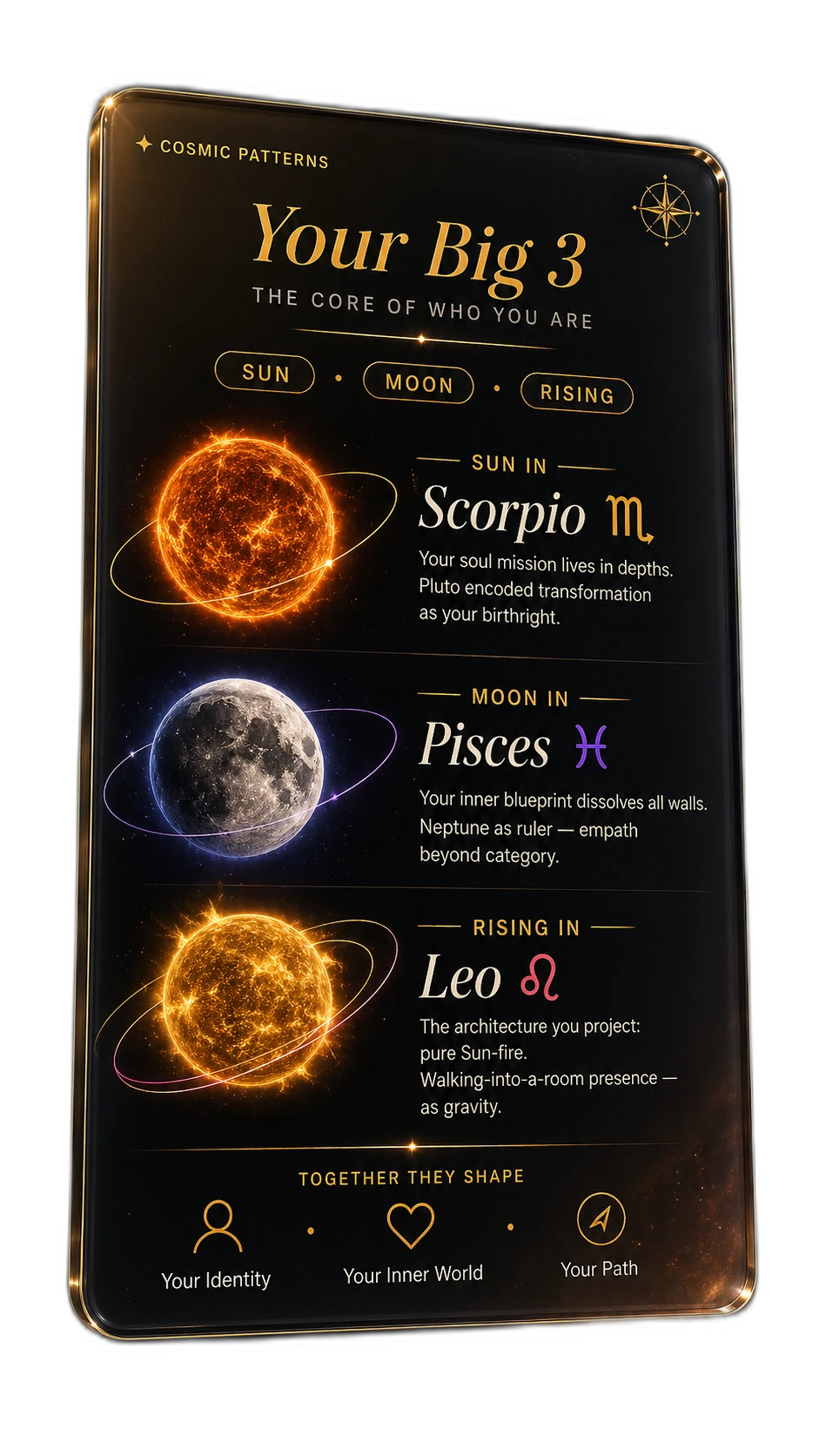
So here is the honest handover. These numbers can give you three things: a moment of attention, a vocabulary for it, and the relief of knowing other people see them too. They cannot give you the three that actually locate you: what you are reaching for, what you are protecting, and what the room concludes about you before you speak. Your Big 3 is free, and those three come from your birth date, with the time and place deciding how exact two of them can be.
We are not going to pretend any of these numbers activate anything in a chart, because none of them do, and this guide has kept numerology, psychology and astrology in their own lanes from the first line. The numbers were the knock. The chart is what is behind the door.
The honest meaning of angel numbers, kept whole
So what do angel numbers mean? In the tradition's own words: a symbolic language in which 1 begins, 2 balances, 4 grounds, 5 moves and 9 completes, with repetition as the volume dial. In psychology's words: salience, the frequency illusion and Jung's meaningful coincidence, a mind catching its own reflection in the world. And in your words, the layer that outranks both: whatever you were carrying in the moment you looked up.
Angel numbers are a meaning system, not a proof system, and that is not their weakness. It is their honest job description. The digits were never watching you. You were watching, and the pattern is the moment you caught yourself doing it. Take that seriously, because it is the truest thing on any page about numbers, and take it somewhere more personal than a sequence that belongs to the whole world.
You have just read what these tools can do. None of them has read you. Somewhere in all that comparing sits a quieter question, and it is not which app is best. It is what your own sky actually says.
Your complete birth chart reads all ten planets, the aspects your chart supports and, with your birth time, the houses where each one does its work. Not a feature list. A reading of the one chart no comparison can rank: yours. All of the sky, not one page of it.

Your Complete Birth Chart
Read your full birth chart$19$9 · Yours forever · No subscription
frequently asked
What do angel numbers mean?
In modern numerology, angel numbers are repeating number patterns, 111 to 999, mirrors like 1212, clock times like 11:11, read as messages assembled from the traditional meaning of their digits: 1 for beginnings, 4 for stability, 5 for change. That is an attributed symbolic reading, not a measurement. Their honest second meaning is personal: the moment you notice one says something real about what your attention is searching for.
Why do I keep seeing the same number everywhere?
Because attention promotes patterns and memory keeps score selectively. The linguist Arnold Zwicky named the mechanism in 2005: the frequency illusion, in which something recently noticed seems suddenly everywhere. You register every 444 and forget every 447. The more interesting question is why now: phases of heavy noticing are usually phases in which something in you is scanning for a sign that a change may begin.
Are angel numbers real?
The patterns are real, the noticing is real, and the tradition reading them is real and young: the label spread through Doreen Virtue's 2005 book, resting on number symbolism its followers trace back to Pythagoras. What angel numbers are not is evidence: no measurement connects a digit sequence to an outcome. They work as a meaning system, a language for inner states, and they keep their value exactly as long as they are held that way.
Which angel number is the most powerful?
The tradition gives special weight to its master numbers 11, 22 and 33, which is why 11:11 and 22:22 top most lists. But the honest answer is: the number that keeps finding you. Power, in a meaning system, is resonance, and the pattern your attention has chosen carries more information about your life than any ranking of digits ever could.
What is the difference between angel numbers and a life path number?
Angel numbers are caught in passing: they appear on clocks and receipts, and their meaning is tied to the moment of noticing. A life path number is calculated once, from your date of birth, by reducing its digits, and the tradition reads it as a life's standing theme rather than a moment's signal. One is weather, the other is climate, and both belong to numerology, not astrology.
Do angel numbers have anything to do with astrology?
No. No planet, zodiac sign or degree is attached to 111, 444 or 11:11, and nothing happens in the sky at those minutes. Astrology starts from different material: the sky of your birth moment, read through your Sun, Moon, and Rising signs. A number can wake a question; a birth chart is where that question gets a personal address.
Cosmic Patterns
birth charts, Big 3, and the patterns you keep repeating.