

Best Astrology Websites to Learn Your Birth Chart: Who Explains the System Well
The best astrology website to learn your birth chart is the one that explains the system in the right order and then shows you where it lands in your own chart. Cafe Astrology has the largest free library of natal interpretations on the web, written plainly. Astro.com is the reference: free charts drawn properly, an astrology wiki, and introductions that assume you can read. Astro-Seek gives you the chart and free interpretations side by side. Astrology Zone teaches the basics in the voice of a working astrologer. The Astrology Podcast is where the history and the reasoning live. CHANI teaches through a daily practice. And Cosmic Patterns takes the third road: every sign, every planet in every sign and every house placement gets its own page with a fact block, a reading and a FAQ, so you learn each piece where it sits in your chart.
This is a comparison of explainers, not calculators. For the tools that draw the chart, see the best free birth chart calculators; this page is about who teaches you what the chart means.
What "learning your birth chart" actually requires
A birth chart is 10 planets in 12 signs across 12 houses, tied together by aspects. That is 120 planet-in-sign combinations, 120 planet-in-house combinations and, for the seven traditional planets and the angles, several dozen aspect pairs. Nobody learns it as a list. You learn it in an order: first what each planet does, then how a sign colours it, then which house it lands in, then how the planets talk to each other.
A good explainer keeps that order, tells you which parts need a birth time (the Rising sign and the houses) and which do not (the Sun and most planets), and says when it is describing a tradition rather than a fact. A weak explainer gives you twelve paragraphs per sign and calls it a chart. The sites below are sorted by how well they teach, and by whether you can read the lesson against your own placements.
Cafe Astrology: the biggest free library of natal interpretations
What it offers: Birth Chart Interpretations is a full index of natal readings: planets in signs, planets in houses, aspects, and the angles, all free, all in plain paragraphs. The free report directory generates a report from your birth data so you can look each placement up as you read.
Best for: Learning by looking things up. If you know you have Venus in Scorpio and want a clear paragraph about it, this is the fastest route.
Trade-off: It is a library, not a course. Every placement gets equal weight, and the order in which you should read them is yours to find.
Astro.com: the reference site, with charts drawn properly
What it offers: Astrodienst's free chart is the chart most astrologers reach for, the Astrowiki is a real encyclopedia of terms, and the introduction to astrology explains the system without dumbing it down.
Best for: Someone who wants the vocabulary right from the start and a chart they can trust while they learn.
Trade-off: It is dense and it reads like a reference work. The site teaches you to read a chart; it does not hold your hand through your own.
Astro-Seek: chart and interpretations on one screen
What it offers: Free astrology interpretations sit next to the birth chart calculator, so the explanation of a placement and its position in your wheel are one click apart.
Best for: Learning while looking at your own chart, with adjustable settings so you can see what a house system or an orb changes.
Trade-off: The interpretations are short and generic by design. It shows you where things are; the why stays thin.
Astrology Zone: the basics, taught by a working astrologer
What it offers: Susan Miller's Learn Astrology pages walk through the signs, planets and houses in the voice of someone who has written monthly horoscopes for decades, alongside the monthly horoscopes themselves.
Best for: Readers who want the fundamentals explained warmly and who already follow the monthlies.
Trade-off: It teaches the general system, not your chart. Sun-sign material dominates, because that is what the site is built around.
The Astrology Podcast: the history and the reasoning
What it offers: The Astrology Podcast, also on YouTube, goes deep on techniques, history and interviews with practising astrologers. It is where you learn why the tradition assigns Mars to Aries and what a house actually is.
Best for: Anyone who wants to understand the system rather than memorise it, and who has hours rather than minutes.
Trade-off: It is long-form audio and video. You will not find your Venus placement in it; you will find out what Venus means.
CHANI: learning through a daily practice
What it offers: CHANI teaches through the app's daily readings and through the YouTube channel, in a voice that treats the chart as something to work with rather than a puzzle to solve. The free versus premium content page lists what stays free.
Best for: People who learn by repetition and want the lesson to arrive with the day.
Trade-off: The structure of the system stays in the background. You learn your chart by living it, not by studying it.
Cosmic Patterns: every placement on its own page, then your chart
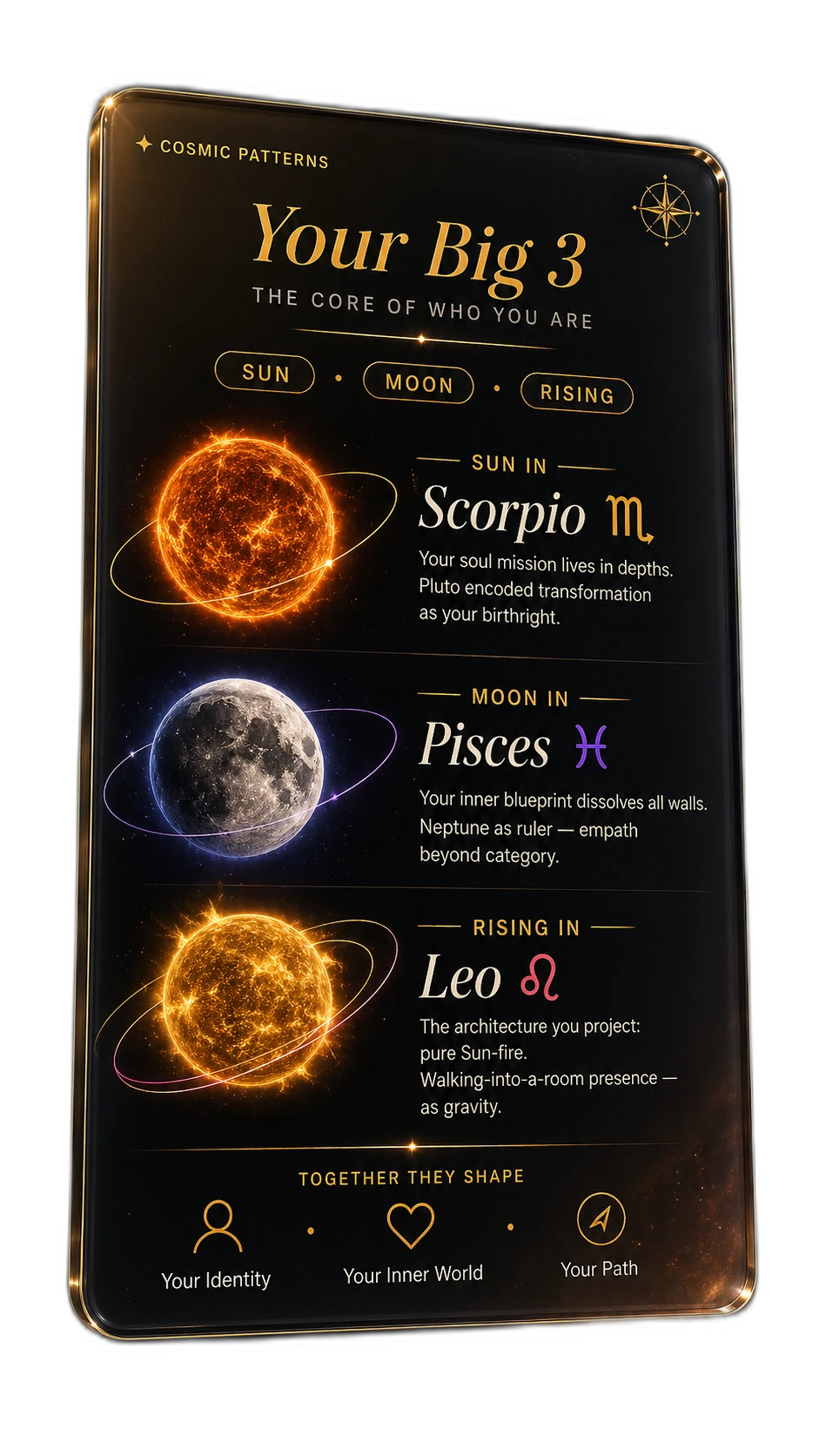
What it offers: The signs, planets in signs and planets in houses are each their own page: a fact block (dates, degrees, element, modality, ruler, dignity, how long the planet stays), a written reading, and a FAQ that answers the question people actually type. Sun, Moon, Mercury, Venus, Mars, Jupiter and Saturn through all 12 signs, the Moon, Venus and Saturn through all 12 houses, and every Sun and Moon combination. Start with your free Big 3 reading to know which pages are yours, or draw your whole wheel with the free chart calculator, planets, houses and aspect lines from date, birth time and place; the Birth Chart reads all of them together, $9, down from $19, yours forever.
Best for: Learning each piece where it sits in your chart, with the facts and the reading on one page, and a path from the free three placements to the whole chart.
Trade-off: The pages read, and the wheel is drawn in whole sign only; there is no house system to switch. If you want to learn in Placidus, keep Astro.com or Astro-Seek open beside it.
Quick Comparison
How to learn your chart in the right order
- Draw the chart once, properly. Astro.com or Astro-Seek, with your birth time if you have it. Screenshot it; you will come back to it constantly.
- Learn the planets before the signs. What Mars does is more important than what Mars in Libra does. The Astrology Podcast and Astro.com's introduction are best here.
- Read your own placements one at a time. Your Sun, then your Moon, then your Rising: the free Big 3 gives you those three exactly; then read each one on its page.
- Add the houses only with a birth time. Without one, the houses are guesses; with one, they are the part of the chart that is most specifically yours.
- Let one site be the library and one be the reading. Cafe Astrology or Astro.com for looking things up, one written reading for seeing how it all sits together.
Which one should you use?
If you want the largest free library, Cafe Astrology. If you want the reference and the chart in one place, Astro.com. If you want the wheel and short explanations side by side, Astro-Seek. If you want the basics warmly, Astrology Zone; the reasoning, The Astrology Podcast; the practice, CHANI.
If you want to learn each placement where it actually sits in your chart, start with the free Big 3 reading, then read your Sun, Moon and Rising on their own pages, and let the Birth Chart read the whole pattern together. Some part of you has been circling one placement for years; it is usually the one that explains the rest.
You have just read what these tools can do. None of them has read you. Somewhere in all that comparing sits a quieter question, and it is not which app is best. It is what your own sky actually says.
Your complete birth chart reads all ten planets, the aspects your chart supports and, with your birth time, the houses where each one does its work. Not a feature list. A reading of the one chart no comparison can rank: yours. All of the sky, not one page of it.

Your Complete Birth Chart
Read your full birth chart$19$9 · Yours forever · No subscription
frequently asked
What is the best website to learn astrology for free?
Cafe Astrology has the largest free library of natal interpretations, indexed by placement. Astro.com adds a free chart, an encyclopedia and introductions. Astro-Seek puts short interpretations beside the chart. Cosmic Patterns gives every sign, planet-in-sign and house placement its own page with facts, a reading and a FAQ, and the Big 3 reading is free.
In what order should I learn my birth chart?
Planets first, then signs, then houses, then aspects. Learn what each planet does before what it does in a sign, and add the houses only once you have a birth time, because the Rising sign and house cusps depend on it. Read your own placements one at a time rather than the whole chart at once.
Do I need my birth time to learn my chart?
For the Sun and most planets, no. For the Moon on a day it changes sign, the Rising sign and all twelve houses, yes. Without a time you can learn most of the planets in signs; the house layer stays a guess until you find the time.
Is a podcast a good way to learn astrology?
For the reasoning, yes. The Astrology Podcast explains where the techniques come from and how astrologers actually use them, which no placement library does. It will not tell you your own placements; pair it with a chart and a reading.
How is Cosmic Patterns different from a placement library?
Each placement page carries a fact block computed from the tradition, a written reading and a FAQ, and the pages link into your own chart: the free Big 3 reading tells you which three pages are yours, and the Birth Chart reads all of your placements together as one pattern.
Cosmic Patterns
birth charts, Big 3, and the patterns you keep repeating.