

Life Path Number Meaning: How to Calculate Yours, Honestly
Your life path number is the number modern numerology reads out of your date of birth: write the date in single digits, add them all, then keep reducing the sum until one digit remains, letting 11, 22 and 33 stand whole as master numbers if they appear. Born on August 10, 1992, you would add 8+1+0+1+9+9+2, reach 30, reduce it to 3, and the tradition would call you a life path 3.
That is the entire method. You can run it on the back of a receipt in under 2 minutes, and this article walks you through every step by hand, because no tool is required and none is being sold here. What most pages will not tell you is that there are three common ways to run this calculation, that they sometimes disagree, and that the disagreement is not a flaw someone needs to resolve for you. So this is the complete, honest version: the calculation, the traditional reading of every number from 1 to 33, the three conventions and where they part ways, and the quiet question underneath it all, which was never really about arithmetic.
What a life path number is, in numerology's own words
Three things to hold before you calculate anything:
- What: the life path number is the digit sum of your full birth date, reduced step by step until a single digit from 1 to 9 remains, unless the reduction lands on 11, 22 or 33, the three master numbers the tradition refuses to fold down.
- When: it has been fixed since the day you were born and it never changes. There is nothing to update, nothing to renew, and nothing to buy: pen, paper and 2 minutes are enough.
- Where it stands: the life path number is numerology, a symbolic tradition whose followers trace its lineage back to Pythagoras in the 6th century BCE. It is not astrology: no planet, no zodiac sign, no house and no degree stands behind this number, and nothing in this article will pretend otherwise.
Numerology works by reduction. Every number, however large, is folded toward a single digit: 36 becomes 3+6 and lands on 9, 29 becomes 2+9 and lands on 11, and 11 would become 2, except that the tradition holds it apart. In its own teaching, 11, 22 and 33 are too charged to be folded further, which is why they are called master numbers, and why any honest calculation has to watch for them along the way.
Within the wider system, the life path number holds a particular place. Numerology also derives numbers from the letters of your name, readings the tradition calls the expression number or the soul urge. The life path is the only core number that asks for no name at all: it wants nothing but the date, which is part of why it became the entry point for so many people. A date feels objective in a way a name does not, even when what is done with it is symbolic through and through.
In the tradition's reading, the life path number is the main road of a life. Not the events, but the gait: the way you tend to begin things, the way you carry them, the question you keep returning to no matter how the circumstances change around you.
Notice the verbs we keep using: reads, holds, calls. That is deliberate. Numerology is a meaning system, not a proof system. No measurement stands behind a life path number, and no study shows that people born on reducible dates live reducible lives. That does not make the tradition worthless. It makes it what it has always been: an old language for inner states, told in numbers, and it deserves to be quoted as exactly that. Meaning that has to pose as measurement usually ends up being neither.
One short, honest note on origins, because trust begins there. The method's defenders cite a lineage running back to Pythagoras and the number mysticism of the 6th century BCE, in which numbers carried qualities and not just quantities. The modern surge around it is far younger. Repeating digits became a household topic in the mid-2000s, when Doreen Virtue's bestselling books turned angel numbers into a global vocabulary and moments like 11:11 into daily rituals. The life path number rides that same modern wave, but it points somewhere more personal: not at a clock everyone shares, but at a date that is yours.
How to calculate your life path number by hand
Take your birth date and follow along, with August 10, 1992 as the worked example:
- Write the date in digits. August 10, 1992 becomes 8 for the month, 1 and 0 for the day, and 1, 9, 9, 2 for the year. Zeros add nothing, but writing them keeps you honest about skipping none of the places.
- Add everything. 8+1+0+1+9+9+2 = 30.
- Reduce the sum. 30 becomes 3+0 = 3. If the result had been two digits again, you would add once more, and again, until a single digit remains.
- Watch for master numbers. If any reduction step lands exactly on 11, 22 or 33, most schools stop there and keep it. 30 is not one of them, so this date folds down cleanly.
Result: life path 3.
There is a second common route to the same number. Instead of adding all digits in one line, you reduce each part of the date first and then add the parts. The month 8 stays 8. The day 10 becomes 1+0 = 1. The year 1992 becomes 1+9+9+2 = 21, and 21 becomes 2+1 = 3. Now add the three results: 8+1+3 = 12, and 1+2 = 3. Same door, different road.
Most birth dates behave exactly like this: whichever way you count, you arrive at the same number, and the whole question of method stays invisible. But not every date is so agreeable, and the exceptions deserve an honest section of their own, because they are where most sites quietly stop telling you the truth.
count it yourself
Your date, counted both ways.
Your birth date folds down to a single number. Two roads do that folding and they do not always meet, so you get both, with the arithmetic shown. The sky you were born under keeps its own count.
Give me the full date and both roads run.
Three ways to count, and what the difference really is
Across books, teachers and websites you will meet three conventions:
- The flat digit sum. Add every digit of the full date in one line, then reduce the total step by step.
- The block method. Reduce month, day and year separately, then add the three results and reduce once more.
- The master rule. On either road, stop reducing whenever a step lands exactly on 11, 22 or 33. Some schools apply this only to the final result, some at every stage, and some not at all.
Which convention you use is tradition, not truth. There is no experiment that could decide between them, because a life path number is not a measurement of anything: it is a reading, and readings have schools the way music has schools. The block method is the most widespread in modern books, the flat sum is older and simpler, and the master rule is applied with real inconsistency across the tradition's own literature. None of this is hidden knowledge. It is simply unprofitable to say.
Because you will also meet pages that insist only their method is the correct one, usually a scroll's distance from whatever they would like you to do next. That certainty is marketing. Read it as information about the seller, not about the number. The honest sentence about the conventions has existed all along, it just converts worse: numerology's schools count differently, the differences are part of the tradition's history, and no authority exists that could settle them, because underneath the counting there is nothing to measure.
Two birth dates where the methods disagree
June 16, 1980. The flat sum: 6+1+6+1+9+8+0 = 31, and 3+1 = 4. The block method: the month 6 stays 6, the day 16 becomes 1+6 = 7, the year 1980 becomes 1+9+8+0 = 18 and then 1+8 = 9. Add the parts: 6+7+9 = 22. With the master rule, that 22 stands, and this person is a life path 22. Without it, 2+2 = 4, and the two roads meet again. One date, and the honest answer is: 4 in one school, 22 in another.
March 7, 1994 turns the same seam the other way. The flat sum: 3+7+1+9+9+4 = 33, which the master rule keeps whole: life path 33, the rarest label the tradition has. The block method: the month 3 stays 3, the day 7 stays 7, the year 1994 becomes 1+9+9+4 = 23 and then 2+3 = 5, so 3+7+5 = 15, and 1+5 = 6. The same person is a 33 on one road and a 6 on the other, and no arithmetic error was made anywhere.
What should you do if your date splits like this? Calculate both ways. If they agree, you are done. If they part, read both numbers in the overview below and notice which description recognizes you, because in that moment something important has already happened: the number has stopped being a verdict and become a mirror held at two angles. That is not the system failing. That is the system showing you, more clearly than any sales page ever will, what kind of system it is.
Life path numbers 1 to 9: the traditional readings
Here is what the tradition reads into each number. Hold these the way you would hold lines of poetry: as descriptions to recognize yourself in, not sentences passed on you.
- 1, the beginner. Initiative, independence, the first step taken without asking permission. The 1's question: what can only I start?
- 2, the relator. Sensitivity, diplomacy, an ear for what lives between people. The 2's question: how do I stay myself inside a bond?
- 3, the voice. Expression, play, the gift of making inner life visible. The 3's question: will I say it, or only feel it?
- 4, the builder. Structure, patience, loyalty to the long way. The 4's question: what deserves my endurance?
- 5, the mover. Freedom, change, a standing refusal of cages. The 5's question: which freedom is worth what it asks of me?
- 6, the keeper. Care, responsibility, the instinct to hold people and places together. The 6's question: whom do I carry, and who carries me?
- 7, the diver. Depth, analysis, an inner room no one else enters. The 7's question: what is true beneath what merely works?
- 8, the steward. Ambition, effectiveness, the courage to want influence in the world. The 8's question: what is my strength for?
- 9, the closer. Compassion, overview, the art of ending things well. The 9's question: what am I ready to release?
Two honest observations about this table. First, it is deliberately wide. You will likely find yourself in three or four of these descriptions, and that is not your confusion, it is the genre: a description written for roughly a ninth of everyone ever born has to be roomy. Second, the width is not worthless. A wide mirror is still a mirror, and noticing which line you want to be true of you tells you something no narrow test can.
Master numbers 11, 22 and 33
The tradition holds three totals apart and reads them like this:
- 11: intuition raised. Sensitivity, illumination, a life tuned to thresholds and to beginnings other people miss.
- 22: the master builder. Vision joined to structure, the drive to leave something standing that outlasts its maker.
- 33: the master teacher. Care raised to devotion, a life that keeps arranging itself around others.
And here is the honest frame around them: master is the tradition's own label, not a rank among persons. A 33 is not a finer soul than a 4, and an 11 is not more awake than a 2. The arithmetic simply makes some totals rarer than others, and rarity is easy to sell as election. If your date reaches 22 on one road and 4 on another, you have not been promoted or demoted either way. You have met the seam of a human-made tradition, and you are allowed to find that seam interesting rather than disappointing. A tradition with visible seams is not weaker than one that hides them. It is just easier to trust.
Why "who am I" reaches for a number
Stay with the real event for a moment: a person, alone with a search bar, typing the question of their own identity into a calculation. That is what actually happens when someone looks up their life path number, it happens more every year, and mocking it would miss everything true in it.
A single number promises four things the open question cannot. Simplicity: one figure instead of an endless self-description that never feels finished. Belonging: a 7 has company all over the world, while an I stands alone. Permission: qualities framed as a path feel allowed, and half of what people call self-discovery is really the search for permission to be what they already are. And story: a life read as a road has a direction, even in the weeks when nothing feels like it is moving.
Perception joins in quietly. Once you learn your number, you begin to meet it: on receipts, door numbers, timestamps. The linguist Arnold Zwicky named this the frequency illusion in 2005: what has once become significant gets noticed everywhere afterward, while the misses drop silently out of memory. And when a found number lands in a searching moment, the word C. G. Jung offered in 1952 applies: synchronicity, an outer event meeting an inner state without cause and yet with felt meaning. Neither mechanism is an embarrassment. Both are your attention doing the oldest work attention has: keeping watch on your behalf.
We say all this not to talk you out of your number. We say it because trust begins with the truth: the pull of the life path number is real, and it comes from you, not from the arithmetic. The question of who you are is one of the oldest questions a human being owns, and asking it through a number is one of its smallest, most portable forms. A tradition that answers it deserves neither worship nor mockery. It deserves honest handling, which is what you are reading.
The number is the start. The date can do more.
Notice what you just did to get your life path number. You used your birth date. That single input is the reason this page can end somewhere better than most numerology pages do, because your birth date is also the first thing a chart asks for, and it does considerably more with it.
A life path number reduces your date to one digit. That is the method, and it is honest about what it is: a compression. Millions of people share your number, and the ones who share it include people whose lives look nothing like yours. Some part of you noticed that while reading the nine descriptions above, and kept reading anyway because one of them was close enough to be interesting and not close enough to be you.
Your birth date can do more than one digit, and that is not a claim about numerology being wrong. It is arithmetic. The same date, read as a position in the sky rather than as digits to add, gives a Sun sign reliably and in most cases a Moon sign too. It was fixed in the sky on the day you arrived, before you could object to any of it. Sometimes the sky keeps one answer for one person only.
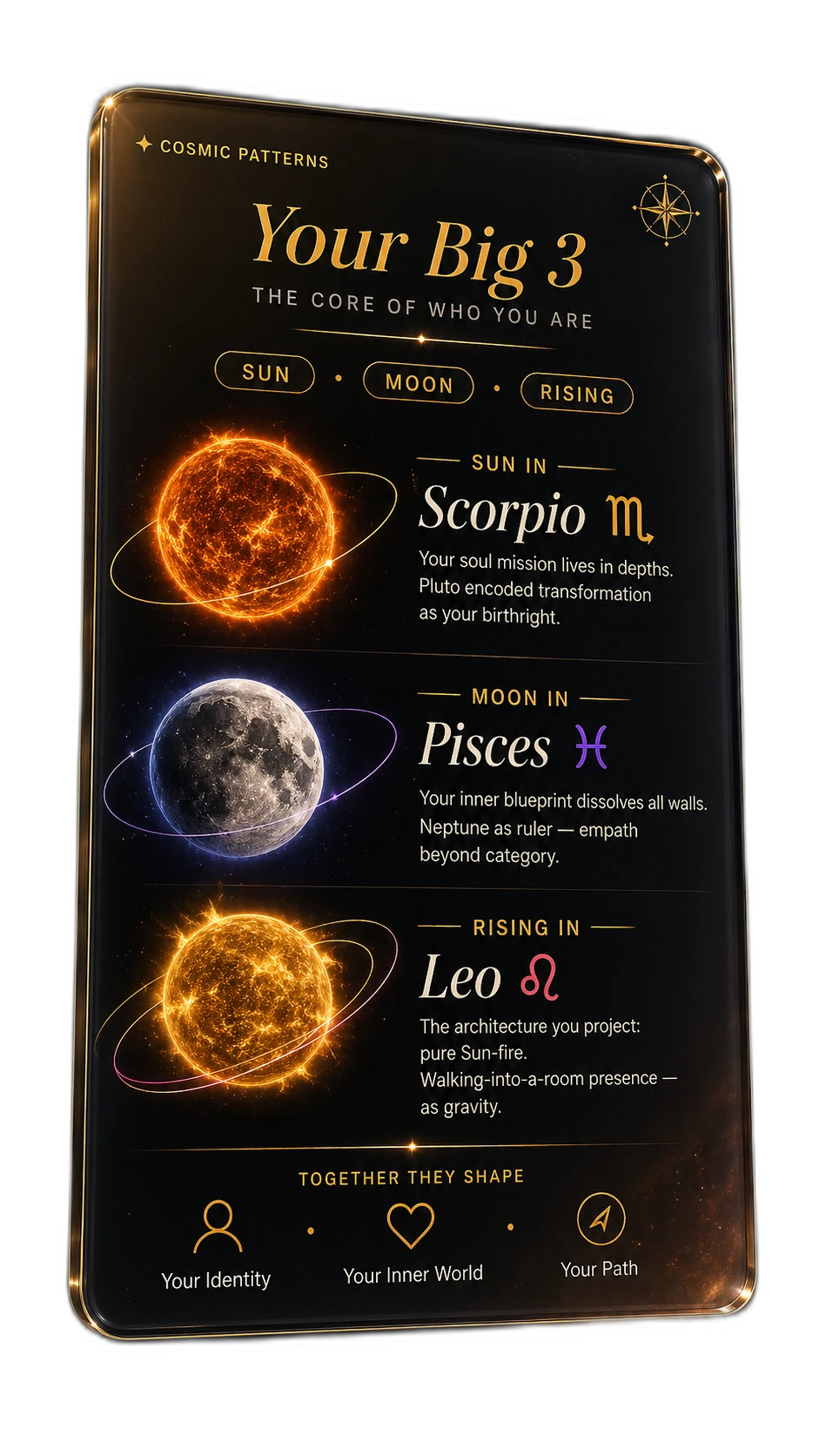
Add the hour and the place and the third position becomes exact: the one people meet first, which is the one that has been doing your introductions without consulting you. So the path is short. You already have the input. Your Big 3 is free and starts with the same date you just used, and it tells you which of the three needs the time and the place to be precise rather than approximate.
We are not going to claim your life path number appears anywhere in that chart, because it does not, and this article has kept numerology and astrology in their own lanes from the first line. Both start from your birth date. Only one of them keeps the whole of it.
A life path number, honestly read
So here is the whole answer, kept honest. Your life path number is a tradition's way of folding your birth date into one figure and reading a road in it: worked out by hand in 2 minutes, unchanged since your first day, proven by nothing and dependent on nothing. The three conventions are schools, not errors. The master numbers are labels, not ranks. The wide readings are mirrors, not measurements. And what remains once all of that is said was the real thing the whole time: you, taking your own beginning seriously enough to count it. A number can honor that question. It cannot finish it. Your birth date holds more than any digit sum of it, and the honest order is simple: the number is where the asking starts, not where it has to end.
You have just read what these tools can do. None of them has read you. Somewhere in all that comparing sits a quieter question, and it is not which app is best. It is what your own sky actually says.
Your complete birth chart reads all ten planets, the aspects your chart supports and, with your birth time, the houses where each one does its work. Not a feature list. A reading of the one chart no comparison can rank: yours. All of the sky, not one page of it.

Your Complete Birth Chart
Read your full birth chart$19$9 · Yours forever · No subscription
frequently asked
How do I calculate my life path number?
Write your birth date in single digits, add them all, and reduce the sum step by step until one digit remains, keeping 11, 22 or 33 whole if a step lands on them. Example: August 10, 1992 gives 8+1+0+1+9+9+2 = 30, and 3+0 = 3. You need pen, paper and about 2 minutes; no tool is required.
Which calculation method is the correct one?
None of them, and that is an honest answer, not an evasion. The flat digit sum, the block method and the master rule are conventions within a tradition, like schools within an art. Pages that declare exactly one method valid are selling certainty, not reporting it. Calculate both main ways; if they disagree, read both numbers and notice which one recognizes you.
What are master numbers 11, 22 and 33?
They are the three totals modern numerology refuses to reduce to a single digit, reading 11 as intuition raised, 22 as the master builder and 33 as the master teacher. The label is the tradition's own, and it marks rarity, not rank: a 33 is not a better person than a 4. Whether master numbers are kept at every step or only at the end differs between schools.
Can my life path number change?
No. It is calculated from your birth date, and that date is the one fact about you that never moves. What can change is the convention you calculate with: a date like June 16, 1980 is a 4 by the flat sum and a 22 by the block method with the master rule. If that happens to you, nothing is broken; two schools of one tradition are simply reading your date differently.
Is the life path number part of astrology?
No. The life path number is numerology, a symbolic reading of your birth date's digits; astrology reads the sky at the moment of your birth, and neither tradition proves the other. They touch at exactly one point: the date. Astrology begins with your Sun, Moon, and Rising signs, drawn from date, time and place, which is why it can tell apart people the same life path number cannot.
What if my life path number doesn't feel like me?
Take that seriously, because it is real information. The traditional readings are wide by design, and if yours still does not land, three honest options remain: check the other calculation convention, read the neighboring numbers, or accept that a system with 12 possible outcomes cannot hold every person. A description you have to force was never going to carry the question you brought to it.
Cosmic Patterns
birth charts, Big 3, and the patterns you keep repeating.