

Shadow Work in Astrology: Your Birth Chart as the Map
Shadow work is the practice of turning toward the parts of yourself you learned to exile: the anger, the need, the ambition, the desire that once cost you love or safety, so you buried them alive. In astrology, your birth chart shows where that buried material lives, most precisely through Pluto, Saturn, and the hard aspects to your Sun and Moon. Read this way, the chart stops being a personality label and becomes something far more useful: a map for integration.
That word, shadow, was not invented by astrologers. It belongs to C. G. Jung, and we will keep the two traditions honest with each other the whole way through: what psychology names, what astrology locates, and where the two meet in you.
What the Shadow Is: Jung's Idea, Told Honestly
- What it is: The shadow is C. G. Jung's name for everything real in you that your conscious identity refuses to own. He developed the concept across decades and gave it its fullest late treatment in Aion, published in 1951.
- Where it shows in a chart: In the modern psychological tradition of astrology, shadow themes concentrate around Pluto (intensity, compulsion, elimination and renewal) and Saturn (limits, responsibility, disciplined effort), and around the hard aspects, square and opposition, which bring two planets' shared theme under tension.
- Why it matters: In Jung's account, what stays unconscious does not stay quiet. It gets projected onto other people, and the opposition aspect in astrological method carries exactly that signature of projection.
Jung, born in 1875, watched the same pattern repeat in himself and his patients: the personality presents an approved version of itself, and everything that did not make the cut goes underground. In Psychology and Religion, published in 1938, he wrote that everyone carries a shadow, and the less it is embodied in a person's conscious life, the blacker and denser it becomes. Not gone. Denser.
The mechanism he trusted most is projection. What you refuse to see in yourself, you will meet in other people, usually carrying a charge of irritation or fascination that is out of proportion to the moment. The colleague whose ambition disgusts you. The friend whose neediness you cannot stand. In the Jungian reading, the intensity of your reaction is the tell: calm dislike is judgment, but heat is recognition.
None of this is astrology yet. It becomes astrology when you ask the map question: where, exactly, does my shadow live? That is the question a birth chart answers with uncomfortable precision.
How a Birth Chart Maps the Shadow
The method in the modern psychological tradition is clean: the planet identifies the function, the sign describes the manner in which that function operates. Neither layer replaces the other.
Four functions matter most for shadow work. Pluto describes intensity, power, compulsion, the stripping of experience to essentials, and processes of profound elimination and renewal. Saturn describes limits, consolidation, responsibility, time, and the mastery built by meeting real conditions. The Moon describes instinctive feeling, emotional memory, habitual response, and the conditions through which safety and belonging are felt. The Sun describes the organizing center of conscious identity: vitality, will, purpose.
Aspects are where these functions collide. An aspect between two planets combines both significations into one shared theme, and the type of aspect decides under what kind of tension that theme is reached. A square demands work and effort. An opposition sets up see-saw tension, and with it, the possibility of projection: the astrological method and the Jungian method describing the same event in two vocabularies. A conjunction fuses two functions into a single focused force.
So when Pluto or Saturn makes a hard aspect to your Sun or Moon, your shadow is not hiding in some abstract corner of the psyche. It is wired directly into your identity or your feeling life, set before your first breath, under a sky that keeps everything.
The Hard Moon and Sun Aspects: Where It Gets Personal
Moon square or opposite Saturn is need meeting the gatekeeper: feelings kept behind a checkpoint, care that had conditions, the heart that learned to file paperwork. With the hard aspects, need meets the closed door on schedule. Care felt scarce or conditional. Asking felt like humiliation. So duty became feeling's stand-in: you show love by handling things, because handling things was the love you were shown. The shadow here is not coldness. It is the exiled softness underneath the competence. Mastered, this becomes the emotional maturity aspect: the one who re-parents themselves and then, quietly, half their circle.
Moon square or opposite Pluto is need and the underworld: feelings at total depth, attachment with survival stakes. In the hard aspects, need gets entangled with control. Abandonment is guarded against by grip. Feelings are tested rather than told. The beloved gets quietly investigated. You do not ask whether you are loved: you run experiments. The shadow is the raw need itself, so total it was hidden even from you. Mastered, this becomes profound emotional power: the one who can hold anyone's darkness because their own is mapped.
Sun square or opposite Pluto is the self and the underworld: identity forged through death and rebirth, power as personal fate. The hard aspects set the self against its own depths. Control battles. Power struggles that keep finding you through authorities and intimates. Periodic identity demolitions, where a version of you that took years to build comes down in a single season. Mastered, this becomes regenerative authority: the one who has died enough times to lead calmly.
If one of these found you, you already know it did. There is a particular stillness that arrives when a sentence names the thing you have never said out loud. That stillness is the true beginning of shadow work: not a technique, just the moment the hidden material realizes it has been seen. And notice what it means that a chart could hold this at all: your most private architecture was never actually private. It was written overhead, held in plain view beneath the whole sky, waiting for you to look up.
When a Whole Placement Carries the Underworld: Pluto in Scorpio, Saturn in Capricorn
Sometimes the shadow is not a single aspect but the climate of a placement.
Pluto in Scorpio puts the planet of depth into the sign that expresses everything through intensity, secrecy, loyalty, and engagement with crisis, loss and renewal. The result is a generation formed at maximum depth: sexuality, death and the deepest wounds confronted without anesthesia, transformation as native climate. The shadow theme of this placement is precise and merciless: intensity as baseline, wounds explored until exploration becomes residence. The depth-native's shadow is not avoidance. It is staying in the excavation so long that the digging becomes the home.
Here is where we will be more honest with you than most astrology writing: a generational placement describes a collective climate, not your personal psychology, unless your chart makes it personal through contact with the Sun or Moon, a personal planet, an angle, or an emphasized house placement. If everyone you grew up with has Pluto in Scorpio too, that is not a cosmic coincidence about you. It is a cohort. The personal question is whether the underworld touches your luminaries.
Saturn in Capricorn is discipline at home: ambition, structure and time itself as native tools, and responsibility that arrived before you had a choice. The engine underneath is rarely ambition alone. It is a quiet equation: if I am the most responsible person in every room, no room can fall on me. The shadow is duty as identity, the crown grown into the skull, the self scheduled out of its own life. And the question that opens it is not gentle: who is the person the responsibilities were supposed to be for? The tension this placement carries is exact: carry it all, and also set it down and still exist. You may call it duty when part of you no longer knows who you are unburdened. The work is to keep the mastery and remember the mountain was optional.
Three Movements of Integration: The Method
Shadow work has no certified protocol, and anyone selling you one is selling packaging. But the Jungian tradition, and the practice built on it since, converges on three movements. A chart makes each one dramatically more precise.
- Catch the projection. For seven days, write down every person who irritates or fascinates you beyond reason. Not everyone you dislike: only the ones who produce heat. Then ask the Jungian question: what quality in them am I not allowed to have? Your chart tells you what to expect. With a Pluto opposition, power and control will wear other people's faces. With Saturn hard aspects, judgment and authority will keep finding you from outside.
- Trace the exile home. Take one recurring heat-source and ask when that quality first cost you something. Moon-Saturn: who taught me that asking was humiliating? Moon-Pluto: what am I testing, and what would happen if I simply asked? Sun-Pluto: which version of myself am I afraid to let die? Saturn in Capricorn: what did I want before I wanted to be reliable? Write the answers by hand. The shadow predates your typing speed.
- Give the banned movement a legal channel. Integration is not a mood, it is repetition in small acts. The Saturn-in-Capricorn version: delegate one duty and use the hour for something that produces nothing. The Moon-Pluto version: tell one person one feeling before you have verified it is safe. The Moon-Saturn version: ask for one small thing you could easily provide yourself. Small is the point. The exile does not trust grand gestures.
Three movements, repeated, for as long as it takes. The Jungian tradition regards integration as the work of a lifetime, not a weekend. That is not discouraging news. It means you are not behind.
A Map, Not a Label
Most astrology content treats a hard aspect like a diagnosis: you have Moon-Pluto, therefore you are controlling. That is a label, and labels are just the shadow's next hiding place, one layer more sophisticated. A map works differently. It does not tell you what you are. It tells you where to look, what the buried material is made of, and which door it will use when it comes back up. The chart does not judge the shadow. It locates it. Somewhere above you, right now, the sky that recorded your first breath is still moving: indifferent to your performance, endlessly patient with your becoming.
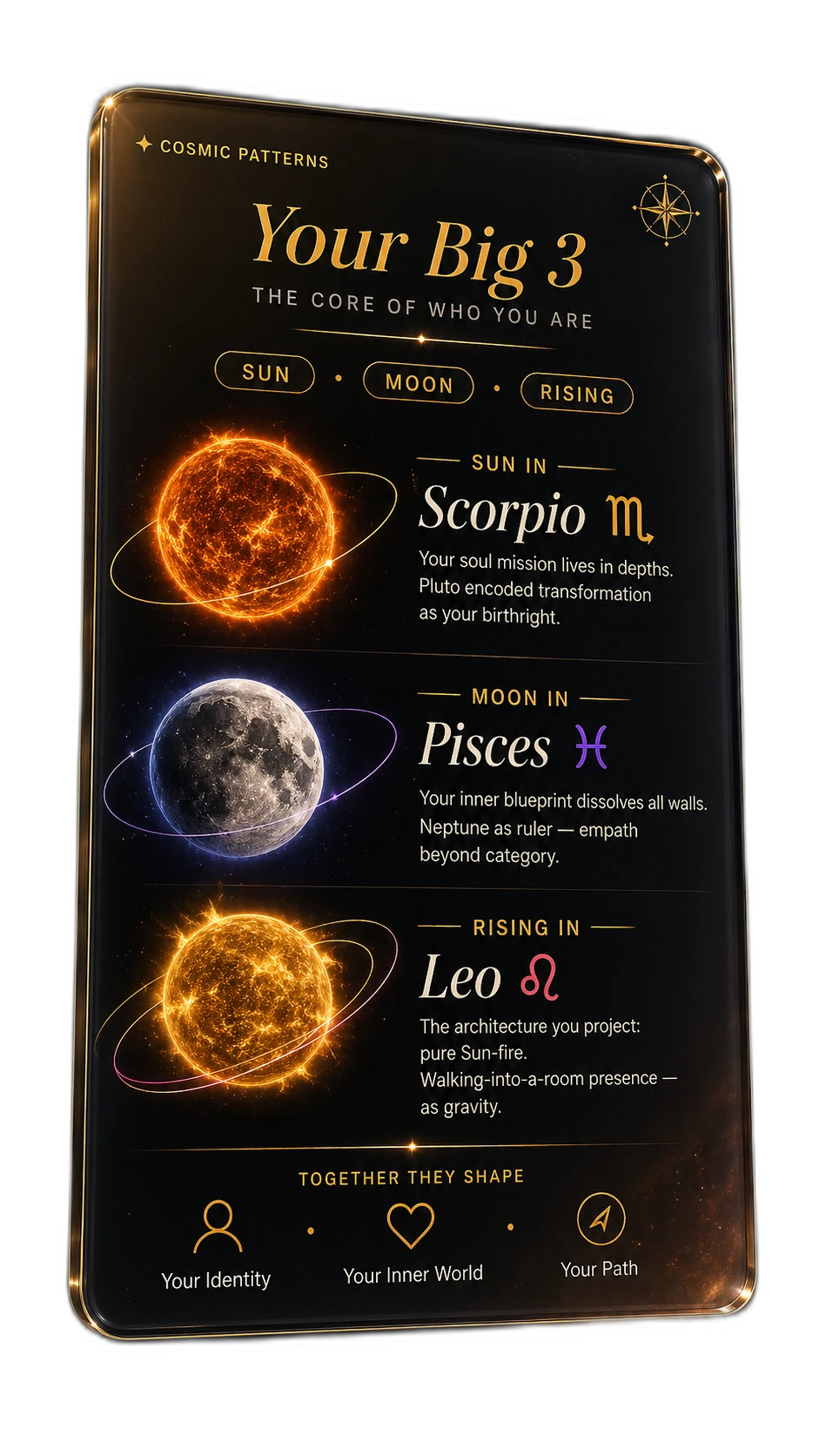
Everything in this article works at the level of the archetype: real, but general. Your actual shadow map is specific. It depends on which planets make hard aspects in your own chart, in which signs, in which houses. Your Sun, Moon, and Rising signs are the doorway into that map, and a complete birth chart ($9, down from $19, one time, yours forever) draws the full architecture of your sky: 10 planets by sign and degree. your strongest aspects. your patterns.
Shadow work through astrology is not the search for what is wrong with you. It is the discovery, written in your own birth chart, of what you had to hide to be loved, and the slow, deliberate act of welcoming it home.
You have just read what these tools can do. None of them has read you. Somewhere in all that comparing sits a quieter question, and it is not which app is best. It is what your own sky actually says.
Your complete birth chart reads all ten planets, the aspects your chart supports and, with your birth time, the houses where each one does its work. Not a feature list. A reading of the one chart no comparison can rank: yours. All of the sky, not one page of it.

Your Complete Birth Chart
Read your full birth chart$19$9 · Yours forever · No subscription
frequently asked
What placements show the shadow in a birth chart?
In the modern psychological tradition, the clearest shadow markers are hard aspects (square and opposition) from Pluto or Saturn to your Sun or Moon, because they set intensity or limitation directly against your identity and your feeling life. Placements like Saturn in Capricorn can also carry a shadow climate of their own: duty as identity, the self scheduled out of its own life. Generational placements such as Pluto in Scorpio only become personal shadow material when they contact your luminaries, personal planets, angles, or an emphasized house.
Is shadow work dangerous?
Shadow work is uncomfortable by design, because it asks you to feel things you once exiled for good reasons, but discomfort is not danger. The sane approach is pacing: small acts, one projection at a time, rather than forcing everything open in a weekend. If what surfaces feels overwhelming or connects to deep old wounds, doing this work alongside a qualified therapist is wisdom, not weakness.
How do I start shadow work with my birth chart?
Start with three movements. First, spend seven days noting every person who produces heat in you, irritation or fascination beyond reason, and ask what quality in them you are not allowed to have. Second, trace that quality back to when it first cost you something. Third, give the banned movement one small legal channel in your week. Knowing your chart, beginning with your Sun, Moon, and Rising signs, tells you which themes to expect before they surface.
What did Carl Jung actually say about the shadow?
Jung described the shadow as the unlived, refused side of the personality, and in Psychology and Religion (1938) he wrote that everyone carries one, and the less it is embodied in conscious life, the blacker and denser it becomes. He gave the concept its fullest late treatment in Aion (1951). His key mechanism is projection: what we refuse to see in ourselves, we meet in other people, charged with outsized emotion.
Can astrology replace therapy for shadow work?
No, and it does not claim to. The chart is a map: it shows where shadow themes concentrate and what they are made of, which can save you years of guessing. The actual integration is lived work, done in your relationships and habits, and for heavy material it belongs in the hands of a professional. Map and territory, both necessary, never interchangeable.
Cosmic Patterns
birth charts, Big 3, and the patterns you keep repeating.