


Venus Retrograde: The Cycle You Can Work With
Venus retrograde is a review phase, not an emergency: for a stretch of weeks, Venus appears to move backward through a span of zodiac degrees it has already crossed, and everything Venus governs (attraction, relationship, value, taste) comes back for a second look. The astronomical record has tracked this rhythm for millennia: it returns roughly every 18 months and lasts about 40 days. Nothing about that is dangerous. It is the sky slowing down over the exact territory you were about to rush past.
What Venus retrograde actually is
- What happens: Venus appears to reverse direction and re-walk a span of degrees it already covered. Every natal point inside that degree range, and its aspect degrees in other signs, gets sensitized by the repeated crossings.
- When exactly: as an astronomical rhythm, roughly every 18 months, for about 40 days at a time. Each cycle has its own published station dates; any current ephemeris lists them.
- Which signs: no single sign owns it. Each retrograde falls in a different part of the zodiac, so each one reviews a different dialect of love. Venus in Libra weighs; Venus in Taurus holds.
Start with the mechanic that retires most of the fear. A transit is the current position of a planet in the sky relating back to a chart, and it activates what a placement already promises rather than creating it. Read that again slowly: a retrograde cannot install a pattern you do not carry. It can only turn up the volume on one you do. And volume, whatever it feels like in the moment, is information.
Venus is a personal planet, and personal-planet transits are brief, frequent and usually light: momentary triggers rather than life chapters. A fast trigger matters most when it crosses an already loaded configuration in your chart, where it can knock over the first domino of a larger sequence. That is why the same retrograde is a shrug for one person and a season of reckoning for another. The difference was never the sky's mood. The difference is what the sky happens to be standing on in your chart.
The station: where the sky slows to a stop
Twice per cycle, Venus stations: once to turn retrograde, once to turn direct. A station is the visible pause before the turn, and it is the sharpest moment of the whole loop. When a planet stations close to an exact contact with a natal placement, the transit is both intensified and prolonged. The planet sits on that degree longer than usual, like an exclamation mark on the contact.
In lived time, a station week has a texture you will recognize. Small daily machinery that ran on autopilot suddenly wants to be steered by hand. Words go out and come back with question marks. A plan you confirmed twice quietly moves itself, and for a week your calendar is a negotiation instead of a map. The week asks for drafts, not decisions, and that is not a failure of the week. It is the assignment.
One honest boundary belongs here, because honesty is the point of this whole guide. An exact transit can land as an outer event or purely as an inner state: a mood, a preoccupation. Its magnitude ranges from major to trivial, and sometimes its effect only becomes visible in retrospect. Expecting every station to deliver a dramatic scene is a beginner's error. Some stations pass through a life without leaving a mark you can point to. The sky answers on its own schedule, not yours.
Three passes over the same ground
Here is the part of the cycle that most retrograde copy skips, and it is the part that changes everything. A retrograde loop makes a planet cross the same span of degrees three times. Once at speed. Once backward. Once to make it stick. This stretches a transit far beyond its normal length: Mars, which normally spends about six weeks in a sign, can spend around seven months in one sign because of its retrograde loop. Venus runs the same mechanics on its own shorter clock.
While retrograde, the planet literally re-walks degrees it already covered, and that is lived as review: returning to something that seemed finished, revising a decision, going back over recent territory in that life area. With Venus, the life area is love, worth and what you value. So the review sounds like this: you reread a message three times before sending it, and the reply that comes back still answers a different question than the one you asked. The thing you were certain you wanted on Monday is still sitting in the cart on Thursday, and you keep not clicking. The person, the invoice or the conversation you thought was closed writes back, politely, as if it had been waiting for this exact week. You solve the same small problem twice, and only the second solution holds.
None of that is the sky malfunctioning. Repetition is how a pattern becomes audible. The first pass, you lived it at speed. The backward pass, you hear it. The third pass, you decide what to do with what you heard. Unfinished business gets a return address, and a pattern you can hear is a pattern you can finally answer. That is the entire difference between a retrograde read as danger and a retrograde read as a cycle: danger asks you to brace, a cycle asks you to listen.
Venus in Libra and Venus in Taurus: two dialects of one planet
Venus describes attraction, relationship, value and taste: the ways common ground, harmony, beauty and fairness are sought. The planet names the function; the sign describes the manner in which that function operates, and neither layer replaces the other. That is why no two Venus retrogrades sound alike. Each one replays a different dialect of the same planet.
When the dialect is Libra, Venus works through weighing perspectives, diplomacy and the search for a fair balance. This is the Venus that is gifted at love itself: attentive, aesthetic, fluent in the other person, the presence around which relationships become more civilized versions of themselves. Its price is precise: the peace is bought with your unsaid half. A review phase in this dialect makes the unsaid half audible. The true preference. The real no. The disharmony you kept swallowing to keep the room beautiful. Love that requires your absence is not love yet, and a retrograde is often the first time that sentence becomes hearable.
When the dialect is Taurus, Venus works through steadiness, embodiment, deliberation and gradual accumulation. This Venus loves like gravity: steady, sensual, unconditional in practice rather than proclamation, and people heal inside its constancy. Its price is just as precise: holding becomes gripping, and the beloved, the comfort zone and the aesthetic all get preserved past their living state. A review phase in this dialect asks one question on repeat: what are you keeping that stopped being alive, and what would the space hold instead? Chosen is sweeter than kept.
These dialects are not retrograde phenomena. They run through every pairing you care about, every ordinary week, in how you text, argue, hold on and let go. If you want to see how your dialect meets another person's, our free Cosmic Compatibility covers 78 sign pairings · free on our site, with 5 deep sections per pair, built to help you find out where you click and where it gets hard.
The eight-year rose
There is a larger shape above all of this, and it belongs to astronomical tradition rather than to astrology's interpretive layer, so let us name it honestly as that. Sky-watchers going back to the Babylonian record observed that Venus's retrogrades repeat in a stable pattern: five retrograde loops in eight years, falling in nearly the same five zones of the zodiac each time. Plotted from Earth across those eight years, the loops trace a five-petaled figure often called the rose, or pentagram, of Venus. After roughly eight years, a Venus retrograde returns to almost the same part of the sky where it stood before.
Astrologers who work with this cycle like to ask a quiet question with it: what was being reviewed in your love life roughly eight years ago? Not as prophecy, as rhyme. The review you are standing in now is one petal of a figure the sky has been drawing since before anyone had a word for love. You are not inside chaos. You are inside geometry that keeps returning to check on you.
How to work with a Venus retrograde
- Name the dates. Look up the current cycle's station retrograde and station direct dates before you interpret anything. Personal-class loops are measured in weeks, not eras; the repeat is short and survivable, and knowing the exit date changes how the middle feels.
- Let drafts count as work. The proofread was on the schedule before you were. Write the message, hold the send.
- Trust the second pass. What you catch on the second pass stays caught. That is what the second pass is for, so revisiting is not relapse.
- If the review sounds like Libra: introduce one disharmony on purpose. The true preference, the real no, said at close range with all your grace intact.
- If the review sounds like Taurus: loosen one grip voluntarily. Let the loved thing be free on purpose and watch what returns by choice.
- Refuse to force meaning onto every echo. An exact transit can land as nothing more than a mood, and some retrogrades pass at the magnitude of a shrug. Reading every old name that lights up your phone as destiny is how a review phase curdles into a fear phase.
The station will pass. The loop will close. Venus will walk forward over the same degrees a third time, and something that used to run you on autopilot will have become something you can hear coming. That is the entire offer of this cycle, and it is enough: Venus retrograde is not the sky breaking your relationships, it is the sky playing them back, slowly enough for you to finally hear yourself in them.
You have compared the tools that promise to read two people. What none of them can tell you is what your two charts do when they meet: where they pull, where they hold, where one of you has been waiting a long time for the other to notice.
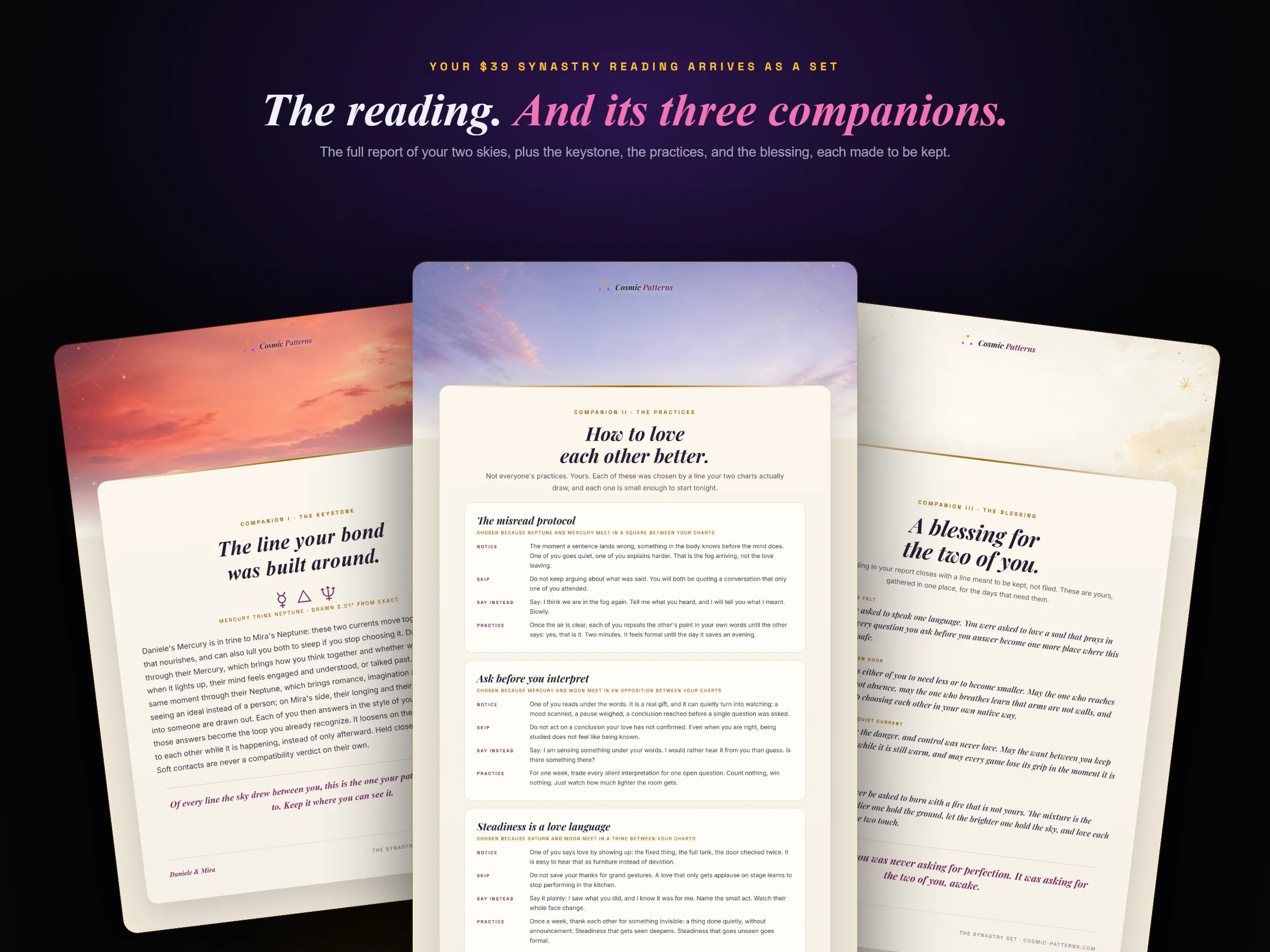
Your Synastry Report reads the top five cross-aspects between your two birth charts, written out in full. Not a percentage. The pattern between you, named. Two charts under the same sky, read where they touch.
Synastry Report
Read your Synastry Report$39$19 · Yours forever · No subscription
frequently asked
How often does Venus go retrograde, and how long does it last?
In the astronomical record, Venus turns retrograde roughly every 18 months and stays retrograde for about 40 days. Each cycle has its own published station dates, and any current ephemeris or astro calendar lists the exact ones. The rhythm is regular enough that Babylonian sky-watchers were already tracking it.
Is Venus retrograde bad for relationships?
No. A transit activates what a placement already promises rather than creating it, so a retrograde cannot put a problem into your relationship that was not already there in some form. What it does is repeat the theme until it becomes audible, and many retrogrades pass as an inner mood rather than an outer event. A review is only dangerous if you refuse to listen to it.
What does it mean when Venus stations retrograde or direct?
A station is the moment Venus appears to stand still before changing direction. If that stillness happens close to an exact contact with something in your birth chart, the transit is intensified and prolonged: Venus sits on that degree longer than usual, like an exclamation mark on the contact. Station weeks favor drafts over final decisions.
Why do old partners and old conversations come back during Venus retrograde?
While retrograde, a planet re-walks degrees it already covered, and astrologers read that as review: returning to something that seemed finished, revising a decision. With Venus, the reviewed territory is love and value, so conversations you thought were closed tend to reopen. The useful question is not whether it is a sign, but what the pattern sounds like on the second pass.
What is the 8-year Venus cycle?
Astronomical tradition records that Venus completes five retrograde loops every eight years, falling in nearly the same five zones of the zodiac each time. Plotted from Earth, those loops trace a five-petaled figure known as the rose, or pentagram, of Venus, and after roughly eight years a retrograde returns to nearly the same part of the sky. Astrologers use that rhythm to ask what love was reviewing in your life about eight years ago.
Cosmic Patterns
birth charts, Big 3, and the patterns you keep repeating.