

Astrology Compatibility Test by Birth Date: What a Real Test Needs From You
An astrology compatibility test by birth date can mean three very different things. The lightest version reads two Sun signs and matches them from a table. The middle version calculates both charts from the dates, compares the planets, and stays silent about the Moon on changing days and the houses always. The full version asks for birth times and places as well and reads the whole pattern between two charts. Astro-Seek offers a date-only love calculator and a full synastry calculator side by side. Cafe Astrology separates its date-only routes from its comparison with birth times. Astro.com's AstroClick Partner needs both times because it builds a composite chart. Cosmic Patterns starts with two birthdays, shows a free first pattern, and reads the full synastry once you add the times.
This guide sorts the tests by what they actually use, so that you know which kind of answer you are holding.
The three levels of a compatibility test
Level one: Sun signs. Two birthdays, two signs, one paragraph from a twelve-by-twelve table. It is fast, it is fun, and it compares one placement of ten. Our own free sign pairings sit at this level on purpose: 78 pairings written to be read, never presented as a chart comparison.
Level two: two charts from dates. The test calculates both charts from the birth dates and compares the planets. The Sun, Mercury, Venus, Mars and the outer planets are placed well from a date alone. The Moon moves roughly one sign every two and a half days, so on a changing day one Moon is uncertain. Anything about houses is a guess at this level, because the houses need a time.
Level three: two charts with times and places. The test now knows both Moons, both Rising signs and the house overlay, where each person's planets fall in the other's houses. This is the level astrologers mean by synastry, and it is the only level at which a sentence about houses is a finding rather than a placeholder.
A test that prints house paragraphs without asking for times is operating at level two and reporting at level three. That is the thing to watch for.
What changes when you add a birth time
The Rising sign moves through the whole zodiac every day, roughly one sign every two hours. The houses turn with it. Add both birth times and two things happen: each chart gets its Rising sign and house cusps, and the overlay between the charts appears. Their Saturn in your seventh house is a different sentence from their Saturn in your second, and neither exists without the times.
Add the birthplaces as well, because the same clock time in two cities points at different degrees of the sky. A test that shows you the resolved place and the timezone it used is letting you check its work. A test that does not is asking you to trust it.
The tools, by level
Astro-Seek: a date-only calculator and a full one, honestly separated
The love compatibility calculator by date of birth works from two dates and says so. The synastry chart online calculator is the level-three tool: both charts on one wheel with the cross-aspects listed and settings you can change. Keeping the two apart is the honest design.
Cafe Astrology: date-only routes beside the comparison with birth times
The free report directory lists the shorter, date-based comparisons, and Compatibility: With Birth Times is the level-three form. The synastry explainer is the page to read before you pick a route.
Astro.com AstroClick Partner: a composite chart, which needs times
AstroClick Partner builds the midpoint chart of two people and lets you click through it. It is a different technique from synastry, and because it depends on both charts' angles, it belongs at level three. A useful second lens, not a first test.
Cosmic Patterns: two birthdays to start, the full pattern when you add the times
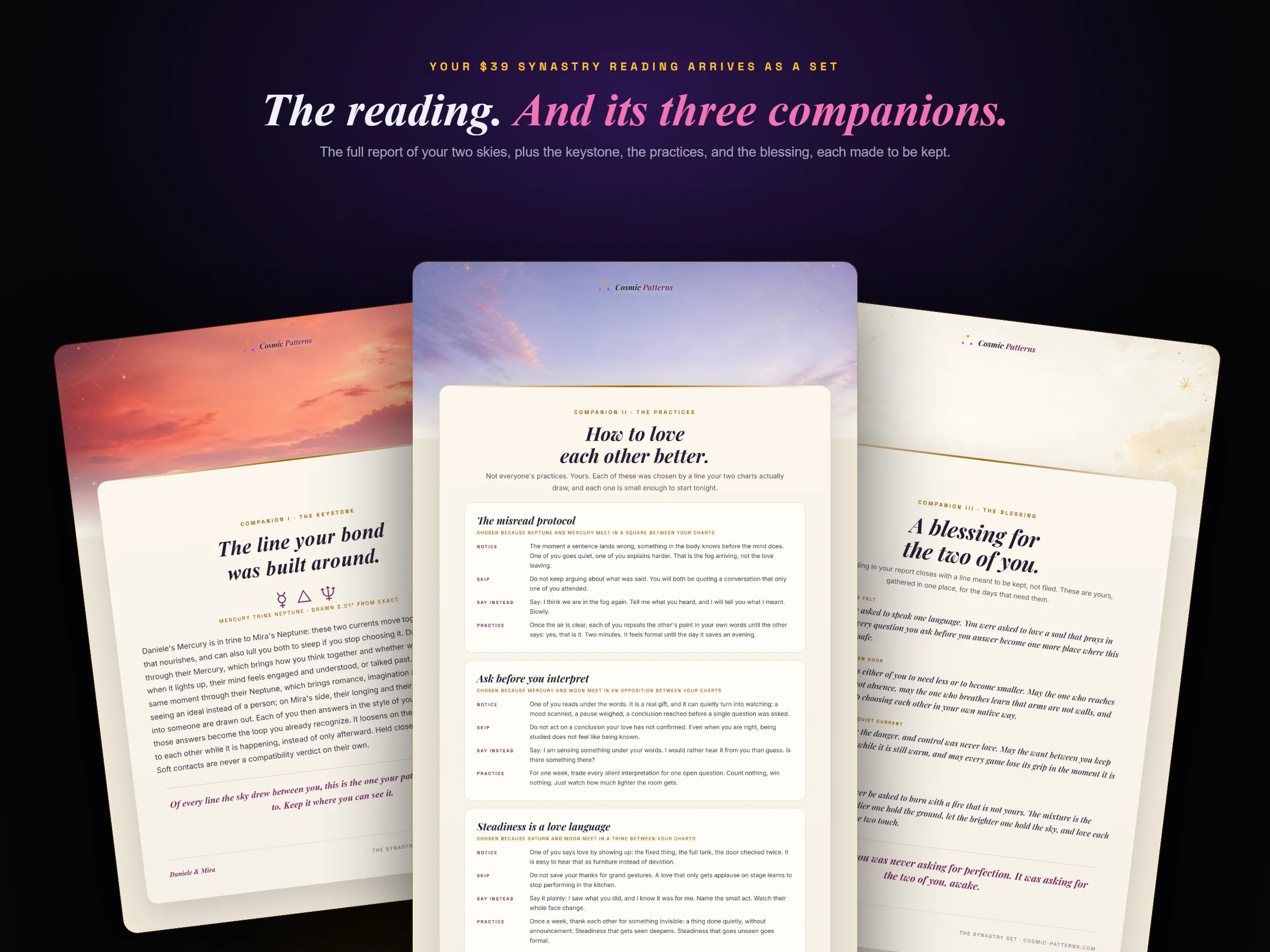
Synastry begins at level two on purpose: enter two birthdays and see a free first pattern on the page, how your Suns meet, how the two Moons hold each other, what Venus asks between you, what Saturn weighs. The Synastry Report is level three: your exact cross-aspects with the top five read in depth, the composite chart and the house overlays, with three companion pieces to keep. Birth times and places are optional, and adding them is what makes the house layer exact; the report says which sentences depend on them.
This is not a score. It is the pattern between you, written so both of you recognise it. $19, down from $39 one-time, yours forever, no subscription.
Quick Comparison
How to take a compatibility test honestly
- Find both birth times first. A birth certificate, a hospital record or a baby book beats a family memory. "Around nine in the evening" is still a lead, because it narrows the Rising sign to one or two candidates.
- Enter the same data everywhere. Two tests disagreeing is almost always two different inputs. Same time, same spelling of the city.
- Check which level you are reading. If the result talks about houses and you never entered a time, it assumed noon. Treat those paragraphs as guesses.
- Read the pattern, not the number. Any test that prints a percentage has compressed a hundred aspects into one figure it made up. The honest output names where the charts support and strain each other.
- Take the same test twice, with and without times. What changes is exactly what the time was worth.
Which test should you take?
If you want a fast, light answer, a Sun-sign pairing is fine, as long as you know it is one placement of ten. If you know both birth times and want to see everything, Astro-Seek's synastry calculator or Cafe Astrology's comparison with birth times are the honest level-three tools, and Astro.com's composite is the second lens after them.
If you want the pattern between the two of you in words you would both recognise, start with two birthdays at Cosmic Patterns Synastry. The first pattern is free. Add the times when you have them, and the full report reads the rest. Some part of you already knows the shape of it; a real test only shows you what that shape is made of.
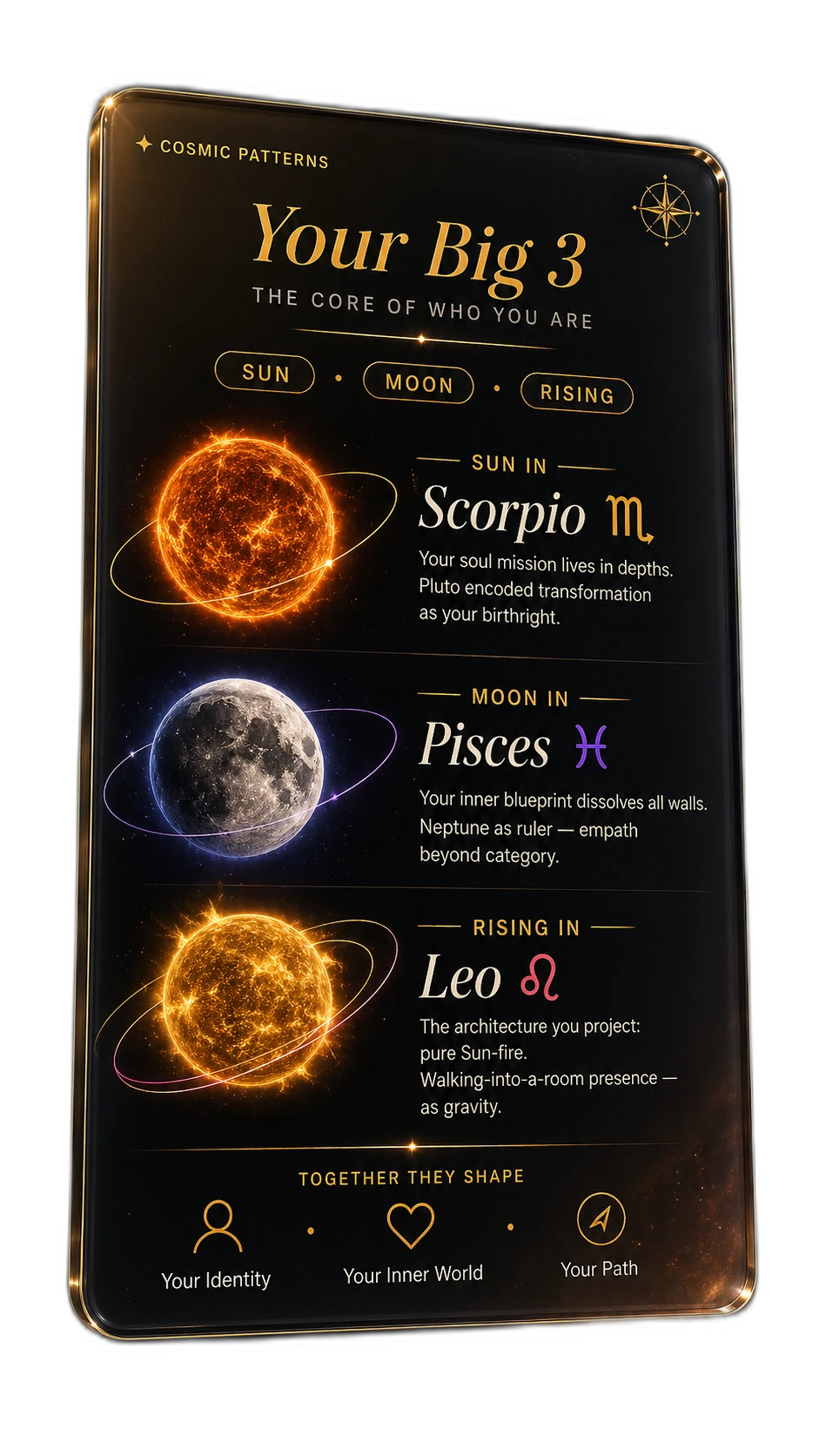
If you are still learning your own placements, the free Big 3 reading starts there, and if one of you has no birth time at all, how to find your Big 3 without a birth time covers what can honestly be read. For the tools in more depth, see the best synastry calculators.
You have compared the tools that promise to read two people. What none of them can tell you is what your two charts do when they meet: where they pull, where they hold, where one of you has been waiting a long time for the other to notice.
Your Synastry Report reads the top five cross-aspects between your two birth charts, written out in full. Not a percentage. The pattern between you, named. Two charts under the same sky, read where they touch.
Synastry Report
Read your Synastry Report$39$19 · Yours forever · No subscription
frequently asked
Can you test astrology compatibility with just birth dates?
Partly. Two birth dates place the Sun and most planets in both charts and let a test compare them. They do not fix the Moon on a changing day, the Rising signs or the houses, which need both birth times and birthplaces. A date-only test is real for the planets and silent, or guessing, about the rest.
Which astrology compatibility test is the most accurate?
The one that uses the most real data and says what it did not have. Astro-Seek's synastry calculator and Cafe Astrology's comparison with birth times both read two full charts when you give them the times. Cosmic Patterns Synastry starts from two birthdays and reads the full pattern once times and places are added. Accuracy is about inputs, not brands.
Is a Sun-sign compatibility test the same as synastry?
No. A Sun-sign test compares one placement of ten from a twelve-by-twelve table. Synastry compares two full charts through their cross-aspects and, with birth times, the house overlay. Cosmic Patterns keeps its free sign pairings at the Sun-sign level on purpose and reads synastry separately.
Why do two compatibility tests give different results?
Almost always because of the inputs: a birth time typed as 9:00 on one site and 9:30 on another, a city resolved to a different timezone, or one tool applying daylight saving and the other not. The Rising sign moves about a degree every four minutes, so small differences cross sign boundaries. Enter the same data everywhere and compare the resolved place and timezone each tool shows.
What does the Cosmic Patterns Synastry Report include?
A free first pattern from two birthdays on the page, then the full report: your exact cross-aspects with the top five read in depth, the composite chart and the house overlays, plus three companion pieces to keep. One-time, yours forever, no subscription, no score.
Cosmic Patterns
birth charts, Big 3, and the patterns you keep repeating.