

Best Synastry Calculators: Free Two-Chart Tools Compared, and What They Cannot Tell You
The best synastry calculator depends on whether you want to see the grid or read the pattern. Astro-Seek draws the most complete free synastry chart, both wheels on one screen with every cross-aspect listed and settings you can change. Cafe Astrology compares two charts with birth times in a single form and keeps the result readable. Astro.com's AstroClick Partner is a composite tool, a different technique altogether, and worth understanding before you mistake it for synastry. The Pattern reads relationships inside an app. Cosmic Patterns starts with two birthdays for free, shows you a first pattern, and then turns the strongest cross-chart aspects into a written reading of what happens between you.
Five tools, one question: what does it feel like when these two charts meet? A calculator answers with positions. A reading answers with language. This comparison is about which tool gives you which, and what each of them needs from you before it can be honest.
What a synastry calculator actually does
Synastry lays one birth chart over another. The planets of the first chart are compared with the planets of the second, and wherever two of them stand at a working angle, a cross-aspect is recorded. With ten planets on each side, that is up to a hundred pairings, and a calculator's first job is to list them and sort them by strength. The tightest aspects, those within a few degrees of exact, carry the most weight.
That much works from two birth dates. The rest depends on birth times. The Moon changes sign roughly every two and a half days, so a birthday alone can leave one Moon uncertain. The Rising sign and the houses change roughly every two hours, and the house overlay, where your planets fall in the other person's houses, needs both times and both birthplaces. A calculator that prints a full house overlay without asking for the times has assumed noon twice and told you nothing about it.
There is also a smaller cousin that gets sold under the same name. A Sun-sign compatibility check compares one placement of ten and calls it a match. It is a fine starting point and a poor synastry chart. We keep our own free sign pairings in that first category on purpose: 78 pairings, written to be read, never presented as a chart comparison.
Astro-Seek: the fullest free synastry chart
What it offers: The synastry chart online calculator draws both charts on one wheel, lists the cross-aspects, and lets you change the house system and the orbs. Their synastry aspect interpretations sit on a separate page, one entry per aspect. For the day one of you has no birth time, the love compatibility calculator by date of birth works from dates alone and says so.
Best for: Seeing everything. If you want the aspect grid, the degrees and the settings, and you are willing to read a dense screen, nothing free goes further.
Trade-off: The grid is the product. You get sixty lines of positions and a lookup page for each of them, and the job of deciding which three matter is yours. It is a workbench, not a reading of the two of you.
Cafe Astrology: two charts with birth times in one form
What it offers: Compatibility: With Birth Times takes both sets of birth data in one form and returns a synastry report, aspect by aspect, written out as readable paragraphs. Their synastry explainer is the page to read first if the word is new to you, and the free report directory lists the shorter, date-only routes beside it.
Best for: A quick, readable comparison when you both know your birth times and want interpretation rather than a grid.
Trade-off: The report is generated one aspect at a time. Each paragraph is fair, and none of them is weighed against the others, so the aspect that quietly runs your relationship gets the same space as the one that barely registers. If one birth time is missing, pick the date-only route and accept that the house layer is gone.
Astro.com AstroClick Partner: a composite chart, not synastry
What it offers: AstroClick Partner builds a composite chart, the midpoint chart of two people, and lets you click through its planets and houses for short interpretations. For written relationship reports, Astrodienst keeps a separate Relationship Horoscopes shop.
Best for: A second lens after synastry. A composite treats the relationship as a third thing with its own chart, which is a genuinely different question from how your Moon meets their Saturn.
Trade-off: It is not a synastry calculator, and Astro.com does not claim it is. If you came for the cross-aspects between two charts, this tool answers a question you did not ask. Use it after, not instead.
The Pattern: relationships inside an app
What it offers: The Pattern reads personality and connection from birth data, and its Bonds feature is the relationship layer, written as guidance rather than shown as a chart.
Best for: Someone who wants the relationship reading to keep talking, inside an app they already open, with the other person's profile added to their own.
Trade-off: There is no grid to check, no orb to adjust and no page you keep. The reading lives in the app, on the app's terms, and the exact features change with the version.
Cosmic Patterns: the first pattern free, the full reading one step away
What it offers: Synastry begins with two birthdays and no account. You see a first pattern on the page: how your Sun meets theirs, how the two Moons hold each other, what Venus asks between you, what Saturn weighs. That preview is free and it is already a reading, not a grid.
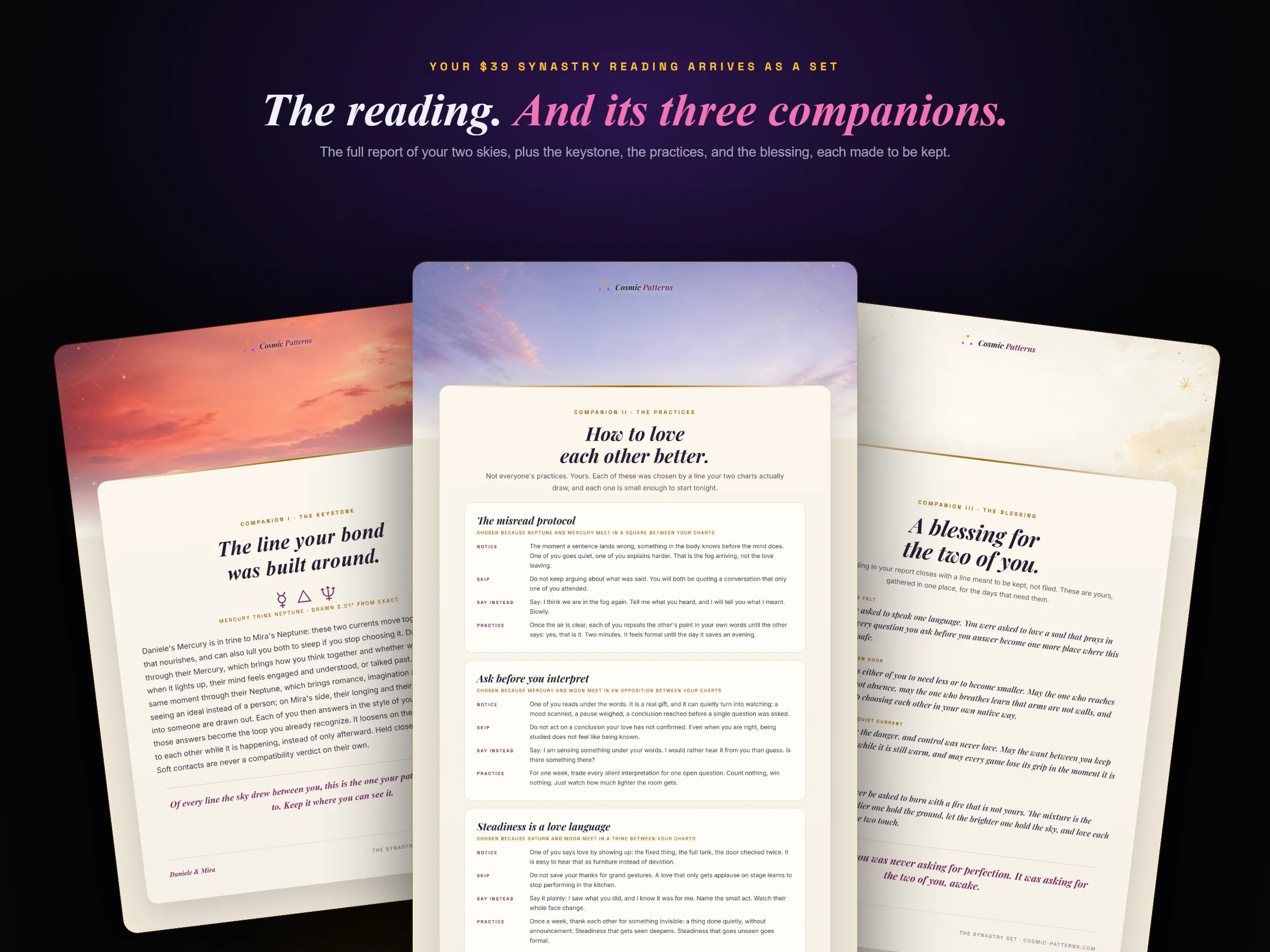
The Synastry Report is the full version: your exact cross-aspects with the top five read in depth, the composite chart and the house overlays, and three companion pieces to keep. It names the pull, the trigger, the loop that keeps repeating, the soft place where the guard comes down, and the honest question the two of you circle. This is not a score. It is the pattern between you, written so that both of you recognise it. $19, down from $39 one-time, yours forever, no subscription.
Best for: Reading the relationship rather than inspecting it. If you have ever reread a text to find the tone, or felt the shift in the room before either of you named it, this is the tool that puts words on that.
Trade-off: It is a written reading, not a live consultation, and it does not promise an outcome. Both birth dates are required; birth times and places are optional, and adding them is what makes the house layer exact. If you want to adjust orbs yourself, Astro-Seek is the better workbench. Some part of you already knows which of the two of you reaches first. The report tells you why.
Quick Comparison
How to read a synastry grid without drowning
If you take the free route and land on a screen full of aspects, read it in this order.
- Sun to Sun, Moon to Moon. Two Suns say how your directions meet; two Moons say whether your needs can share a room. This is the axis everything else sits on.
- Moon to Saturn, in both directions. Saturn on someone's Moon is weight: steadiness for some pairs, pressure for others. It is the aspect most people feel before they can name it.
- Venus and Mars across the charts. Venus is how each of you gives affection, Mars is how each of you reaches. Where they cross, attraction has a shape.
- The tightest aspects first. An aspect within 3 degrees of exact outranks one at 8. Calculators list them all; your attention should not.
- House overlays only if you have both times. Where their planets fall in your houses says where they show up in your life. Without exact times, skip this layer rather than trust a noon guess.
That order turns a hundred lines into five decisions. It is also, in short, what the Cosmic Patterns report does for you, with the language written out.
Which one should you use?
If you want the whole grid and you know both birth times, start with Astro-Seek and adjust the settings until the two charts sit the way you expect. If you want a fast, readable report from one form, Cafe Astrology does that well. If you are curious what the relationship looks like as a chart of its own, Astro.com's composite tool is the right second step, not the first. If you want the relationship inside an app you already use, The Pattern's Bonds are built for that.
If you want to know what actually happens between the two of you, in words you would recognise, start with two birthdays at Cosmic Patterns Synastry. The first pattern is free. The full report is the door behind it.
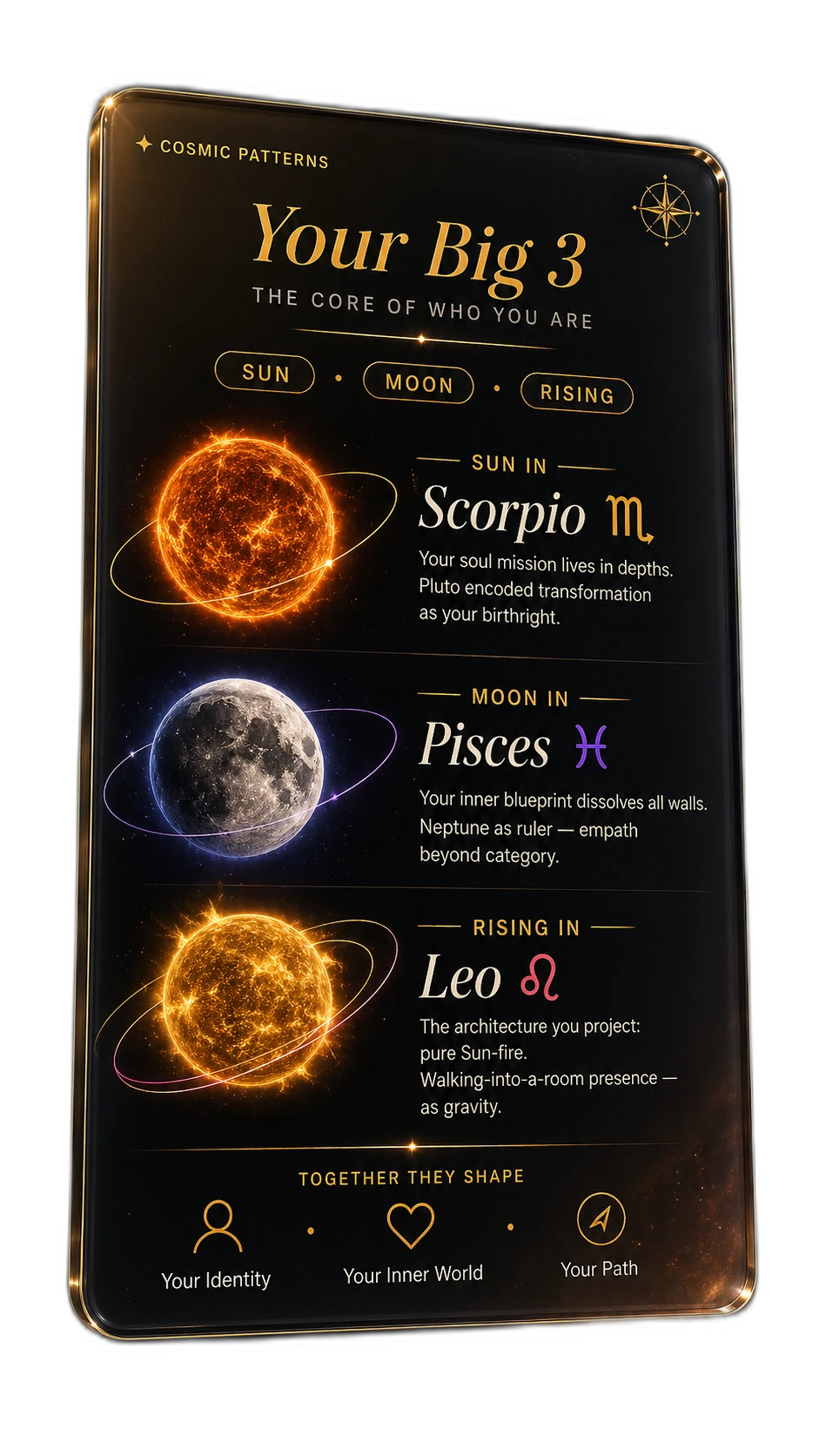
Whichever you choose, use real birth times where you have them and be honest where you do not. A synastry chart with one invented time is a story about someone who was never born at that minute. If you are still finding your own placements, the free Big 3 reading is where that starts, and synastry explained covers the concept before you compare two charts. For the broader field of relationship readings and their prices, see the best synastry sites.
You have compared the tools that promise to read two people. What none of them can tell you is what your two charts do when they meet: where they pull, where they hold, where one of you has been waiting a long time for the other to notice.
Your Synastry Report reads the top five cross-aspects between your two birth charts, written out in full. Not a percentage. The pattern between you, named. Two charts under the same sky, read where they touch.
Synastry Report
Read your Synastry Report$39$19 · Yours forever · No subscription
frequently asked
What is a synastry calculator?
A synastry calculator lays one birth chart over another and lists the cross-aspects: the angles between the planets of two people. Most free tools show the aspect grid and short interpretations for each aspect. Cosmic Patterns adds a written reading of the pattern those aspects make together, starting from two birthdays for free.
Do you need both birth times for synastry?
For the planets and most cross-aspects, two birth dates are enough. For the Moon on a changing day, the Rising signs and the house overlay, you need both birth times and both birthplaces. A calculator that fills in a full house overlay without asking for the times has assumed noon for both of you.
Is a composite chart the same as synastry?
No. Synastry compares two charts with each other. A composite chart takes the midpoints between the two charts and treats the relationship as a third chart of its own. Astro.com's AstroClick Partner is a composite tool. Both are useful; they answer different questions.
Can a synastry calculator tell whether we are compatible?
It can show where the two charts support and strain each other. It cannot turn that into a single verdict, and any tool that prints a percentage is compressing a hundred aspects into a number it made up. The honest output is a pattern: where the pull is, where the trigger is, what loop repeats, and what the two of you can do with that.
What does the Cosmic Patterns Synastry Report include?
A first pattern from two birthdays, free on the page. The full report reads your exact cross-aspects with the top five in depth, the composite chart and the house overlays, and comes with three companion pieces to keep. It is a one-time reading, yours forever, with no subscription and no score.
Cosmic Patterns
birth charts, Big 3, and the patterns you keep repeating.