

Best Compatibility Apps for Couples: Which Astrology Apps Actually Read Two Charts
The best compatibility app for a couple is the one that reads two charts against each other, not the one that describes each of you well. Co-Star does the daily, social version: connections with friends who also use the app, chart-based updates, a compatibility layer inside the feed. The Pattern goes deeper into the psychology and adds Bonds, its relationship feature, written as guidance rather than shown as a chart. TimePassages is the serious chart app with relationship and composite tools for people who want to study the connection themselves. Cosmic Patterns is not an app at all: two birthdays on a web page give you a first pattern for free, and the Synastry Report turns the strongest cross-chart aspects into a reading you keep.
Four very different answers to the same evening question: what is it about the two of us? This comparison sorts them by what they actually compute, what they ask of your partner, and what is left in your hands when you close the app.
What a compatibility app can and cannot do
Two people, two birth charts, one relationship. A real compatibility reading compares the planets of one chart with the planets of the other, finds the cross-aspects, and reads the pattern they make. That takes both birth dates, and for the Moon, the Rising signs and the houses it takes both birth times and birthplaces as well. The Moon changes sign roughly every two and a half days, the Rising sign roughly every two hours. A profile built from a date alone is a fair picture of the Sun and most of the planets, and a guess about the rest.
Apps add two things a web reading does not have: a daily rhythm, and the other person's presence. That is real value. It is also where the honest limits sit. An app can only compare charts it holds, which usually means your partner has to install it and enter their own data. And an app reads on its own schedule: a daily note about the two of you is not the same as a considered reading of the whole pattern, and both have their place.
If you only want the broad sign-to-sign version, our free sign pairings cover all 78 combinations without an app. They are written to be read, and they are sign-level by design, not a chart comparison.
Co-Star: the daily, social version
What it offers: Co-Star is built around a natal chart, daily chart-based updates and connections with friends who also use the app, with compatibility features inside that social layer. The FAQ explains the basics of how the app works. It is the app people already have on their phone, which is its strongest argument.
Best for: Couples who want astrology as part of a daily check-in, and friend groups who compare charts for fun. If your partner is already on Co-Star, the compatibility view is one tap away.
Trade-off: The reading is only as complete as the birth data both of you entered, and the format is a feed, not a report. You get the day's note about the two of you, not a page that lays out the whole pattern between your charts. For the wider Co-Star picture, see Co-Star vs Cosmic Patterns.
The Pattern: psychology first, Bonds for two
What it offers: The Pattern reads personality from birth data in long, psychologically precise paragraphs, and its Bonds feature applies the same style to a connection between two people. The astrology stays behind the curtain: you get the conclusions, not the chart.
Best for: Couples who want to be described rather than taught. If one of you rolls their eyes at planets but nods at "you withdraw when you feel managed," The Pattern speaks that language.
Trade-off: There is no chart to check, no aspect to point at, and nothing you keep outside the app. When the reading lands, you cannot see why it landed. We compared the two approaches in The Pattern vs Cosmic Patterns.
TimePassages: the chart app for studying the connection
What it offers: TimePassages mobile documents compatibility and composite chart tools alongside natal interpretation and transits. It is astrology software in app form: real wheels, real aspect lists, settings you control.
Best for: A couple where at least one person wants to learn. If you would rather see the Moon-to-Saturn aspect with its exact degree than be told about it, this is the app.
Trade-off: It reads placements and aspects, not the relationship as a whole, and the account and edition decide which relationship functions you get. Check the current account options before you assume a feature is included.
Cosmic Patterns: not an app, a reading you keep
What it offers: Synastry starts with two birthdays on a web page. No install, no account for either of you. You see a first pattern immediately: how your Suns meet, how the two Moons hold each other, what Venus asks between you, what Saturn weighs. That preview is free.
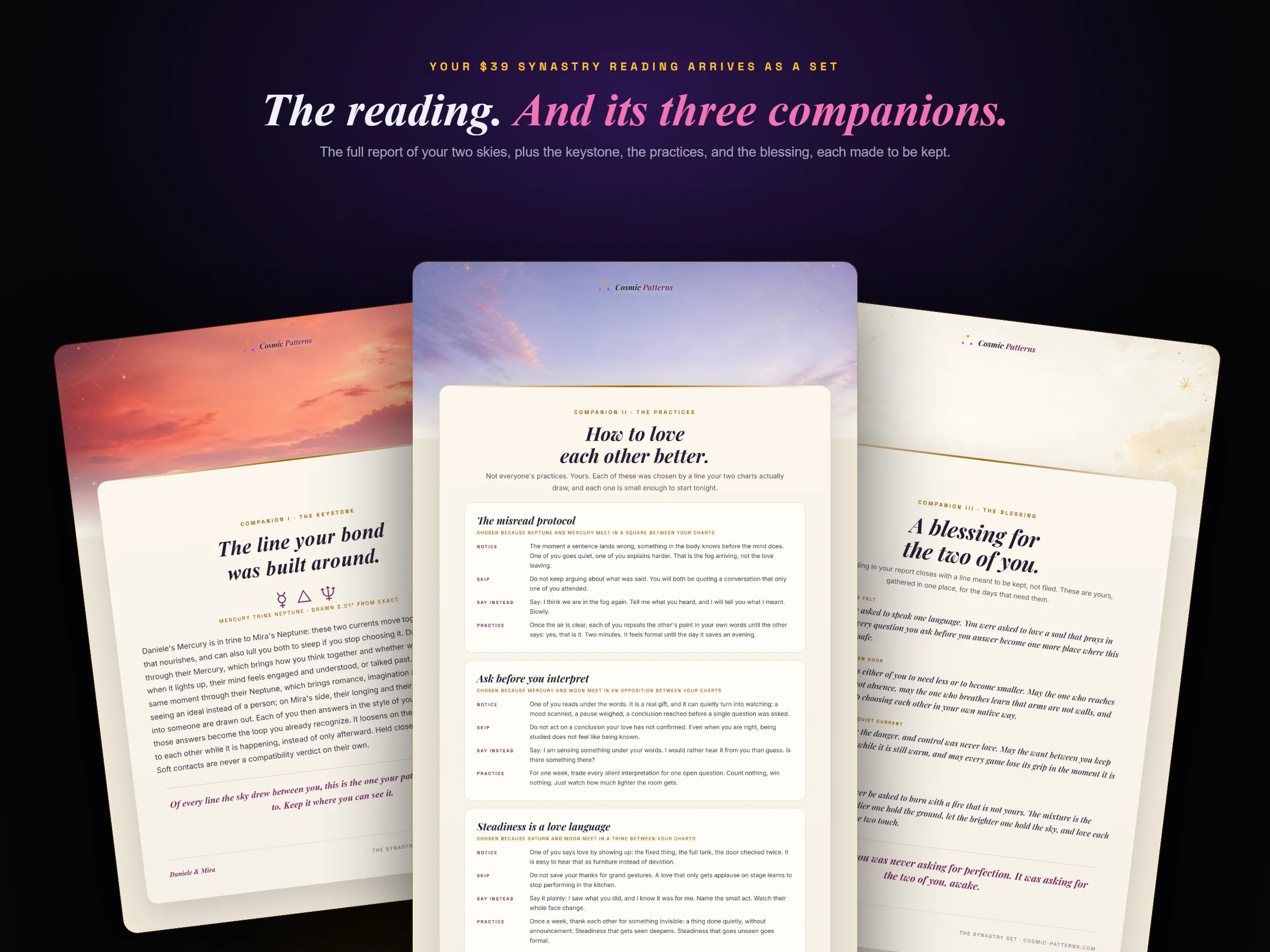
The Synastry Report is the full reading: your exact cross-aspects with the top five read in depth, the composite chart and the house overlays, and three companion pieces you keep. It names the pull, the trigger, the loop that keeps repeating, the soft place where the guard comes down, and the honest question you circle. This is not a score. It is the pattern between you, written so both of you recognise it. $19, down from $39 one-time, yours forever, no subscription.
Best for: A couple who wants one considered reading rather than a daily feed, and who wants both people to read the same words. Your partner never has to install anything; you enter both birthdays.
Trade-off: It is not a daily companion and not a live consultation. Birth times and places are optional, and adding them is what makes the house layer exact. If you want the aspect grid to adjust yourself, TimePassages or a free synastry calculator is the better workbench.
Quick Comparison
Before you pick an app together
- Agree on what you want: a daily note, a description, a chart to study, or one reading you both keep. Most disappointments start with an app doing a different job than the one you had in mind.
- Get both birth times if you can. A birth certificate or a hospital record beats a family memory. Without them, any app is guessing your Moons on changing days and your houses always.
- Enter the same data everywhere. Two apps disagreeing is almost always two different inputs, not two different astrologies.
- Read the compatibility view as a pattern, not a verdict. No app knows the two of you. The good ones show where the charts support and strain each other and leave the verdict to you.
- Notice which reading you reread. That is the one doing the work.
Which one should you use?
If you both already use Co-Star, use it: the compatibility view is there and the daily habit carries it. If you want to be described with uncomfortable accuracy and do not care how, The Pattern's Bonds will do that. If one of you wants to learn the chart, TimePassages gives you the tools.
If what you want is the pattern between you in words you would both recognise, and you want it without asking your partner to install anything, start with two birthdays at Cosmic Patterns Synastry. The first pattern is free, and the full report is one step behind it. Some part of you already knows which of you reaches first and which of you waits; the report tells you why that is the shape of it.
If you are still learning your own placements, start with the free Big 3 reading, and read synastry explained before you compare two charts. For written relationship readings beyond apps, see the best synastry sites.
You have compared the tools that promise to read two people. What none of them can tell you is what your two charts do when they meet: where they pull, where they hold, where one of you has been waiting a long time for the other to notice.
Your Synastry Report reads the top five cross-aspects between your two birth charts, written out in full. Not a percentage. The pattern between you, named. Two charts under the same sky, read where they touch.
Synastry Report
Read your Synastry Report$39$19 · Yours forever · No subscription
frequently asked
Which astrology app is best for couples?
It depends on the job. Co-Star is best if you both already use it and want a daily, social compatibility view. The Pattern is best if you want psychological description of the connection without the chart. TimePassages is best if one of you wants to study the relationship charts. Cosmic Patterns is best if you want one written reading of the pattern between you that you both keep, without installing anything.
Does my partner need to download the app too?
For Co-Star and The Pattern, yes: both people need profiles in the app for the compatibility features. TimePassages lets you enter both charts yourself. Cosmic Patterns Synastry needs only two birthdays entered on one page; your partner does not need an account.
Do compatibility apps need birth times?
For the Sun and most planets, birth dates are enough. For the Moon on a changing day, the Rising signs and the house overlay between your charts, both birth times and birthplaces are needed. An app that never asks for times is reading a partial chart and rarely says so.
Can an app tell us if we are compatible?
It can show where two charts support and strain each other. It cannot turn that into a single verdict, and a percentage is a hundred aspects compressed into a number the app made up. The honest output is a pattern: the pull, the trigger, the loop, and what the two of you can do with it.
What does the Cosmic Patterns Synastry Report include?
A first pattern from two birthdays, free on the page. The full report reads your exact cross-aspects with the top five in depth, the composite chart and the house overlays, with three companion pieces to keep. One-time, yours forever, no subscription, no score.
Cosmic Patterns
birth charts, Big 3, and the patterns you keep repeating.