

Best Explanations of the 12 Houses in Astrology: Who Teaches Them Well, and Where to Read Yours
The houses are the part of a birth chart that most explainers handle worst, because they are the part that needs a birth time, a house system and a reason. The best explanations of the 12 houses say all three things out loud. Cafe Astrology's natal index covers planets in houses one placement at a time. Astro.com's Astrowiki defines the houses and the systems that divide them. Astro-Seek lets you switch house systems and watch what moves. The Astrology Podcast explains where the houses come from and why astrologers disagree about them. Astrology University teaches them as a course. And Cosmic Patterns draws your 12 houses free in its chart calculator and gives the Moon, Venus and Saturn in each of them their own page, with the facts of the house on top and a reading underneath.
This comparison is about who explains the houses well, not who draws them. It ends with where to read your own.
Why the houses are the hard part
Signs describe how a planet acts. Houses describe where in your life it acts: the 1st house is the self and the body, the 4th is home and roots, the 7th is partnership, the 10th is career and the public role. There are 12 of them, they start at the Rising sign, and the Rising sign moves through the whole zodiac every 24 hours, about one degree every four minutes. Get the birth time wrong by half an hour and several planets can change house.
Then there is the question no beginner is warned about: which house system. Placidus divides the sky by time and is the default on most sites; whole sign gives each sign one full house and is the older method. The two agree on the Rising sign and often disagree on where a planet sits. An explanation of the houses that does not tell you which system it assumes is describing a chart you may not have.
Cafe Astrology: every planet in every house, plainly
What it offers: The Birth Chart Interpretations index includes planets in houses alongside planets in signs, written as plain paragraphs, free. The free report calculates your houses so you can look yours up.
Best for: Reading what Venus in the 11th house means without a lecture first.
Trade-off: It is a lookup, not an explanation of what a house is or which system it uses. You can read every house without ever learning why the 7th is about partnership.
Astro.com: definitions and the systems behind them
What it offers: The Astrowiki defines the houses, the angles and the house systems as an encyclopedia does, and the free chart lets you choose the system your chart is drawn in.
Best for: Learning what a house cusp is, what Placidus and whole sign mean, and drawing your chart in the system you want to learn in.
Trade-off: Reference prose. It defines; it does not read your 4th house for you.
Astro-Seek: switch the system and watch what moves
What it offers: The birth chart calculator draws your houses and lets you change the house system in a setting, with free interpretations beside it.
Best for: Understanding, by doing, why the houses depend on time and system: change one setting and watch a planet cross a cusp.
Trade-off: The interpretations are short. The tool teaches the mechanics; the meaning stays thin.
The Astrology Podcast: where the houses come from
What it offers: The Astrology Podcast, also on YouTube, covers techniques and their history in long-form episodes and interviews, the kind of material where the houses are explained from their origins rather than from a table of keywords.
Best for: Anyone who wants to know why the houses mean what they mean, and why astrologers argue about the systems.
Trade-off: Hours, not minutes, and nothing about your chart specifically.
Astrology University: the houses as a course
What it offers: Astrology University is an online astrology school with structured classes, the route for someone who wants the houses taught in sequence by teachers rather than pieced together from pages.
Best for: Learners who want structure, assignments and a teacher's order.
Trade-off: Paid, scheduled, and more than most people need to read their own chart.
Cosmic Patterns: the facts of the house on top, the reading underneath
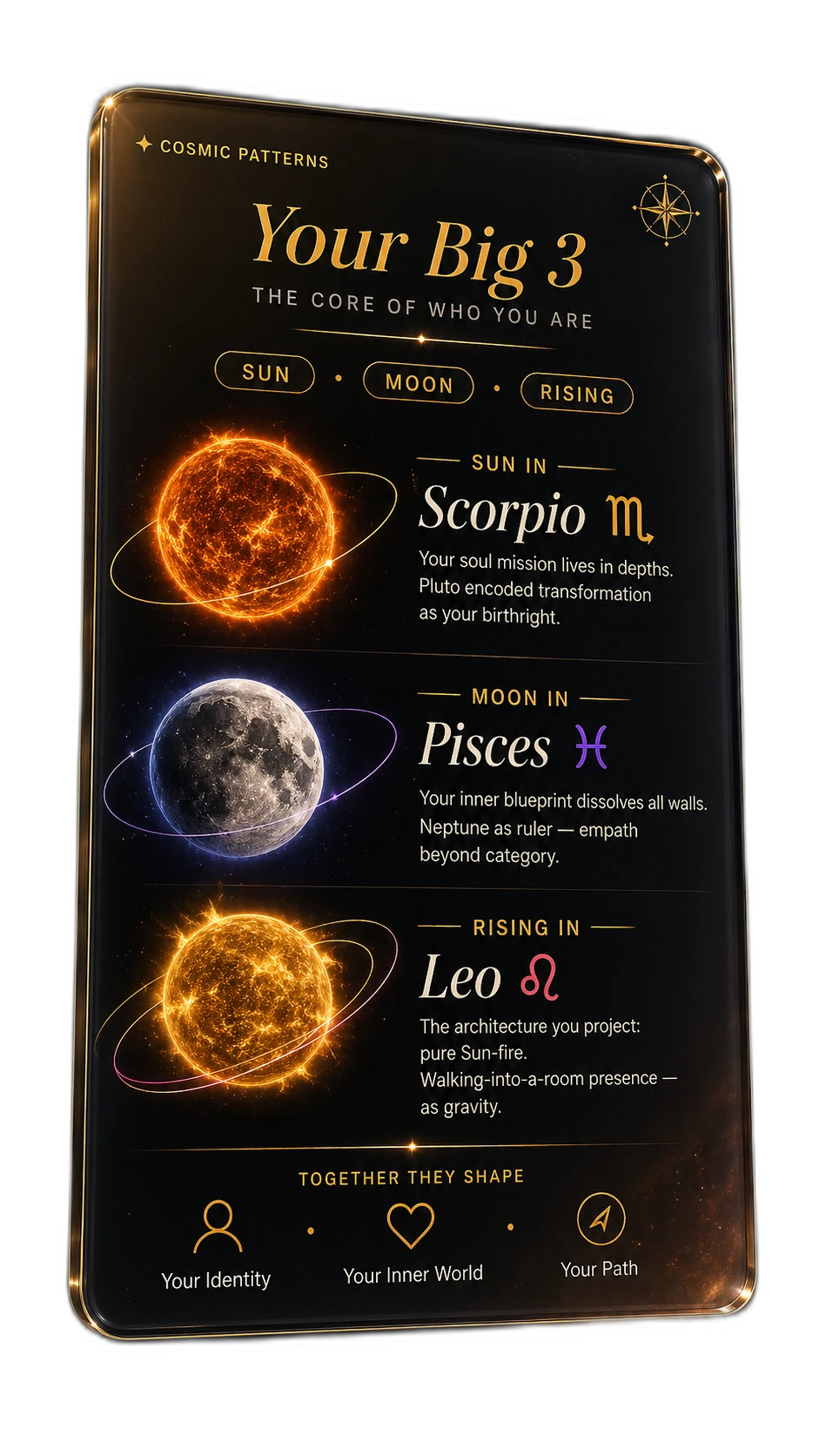
What it offers: The houses section gives the Moon, Venus and Saturn in each of the 12 houses their own page: 36 pages, each with the house's facts (what the house governs, its natural sign, which angle it starts from), a written reading of that placement, and a FAQ. Every page says which house system it assumes and why the birth time matters. The free chart calculator draws your wheel from date, birth time and place: all 12 house cusps in whole sign, every planet with its house number, and the aspect lines between them, free and on the page. The free Big 3 reading tells you your Rising sign, which is the first house cusp; the Birth Chart reads every planet in every house together, $9, down from $19, yours forever.
Best for: Reading the three planets that shape home, love and duty in the house where each of them actually sits.
Trade-off: Three planets through the houses so far, not ten. The calculator draws the houses in whole sign only; if you want to switch to Placidus and watch what moves, Astro-Seek is the workbench for that. Draw the chart here, see which house each planet sits in, then read the house here.
Quick Comparison
How to learn the houses without getting lost
- Find your birth time first. Certificate, hospital record, baby book. Without it, every house explanation is hypothetical.
- Pick one house system and stay in it while you learn. Placidus is the common default; whole sign is simpler. Switching mid-learning is how people end up convinced they have two different charts. Placidus vs whole sign houses shows what moves between them and why.
- Start from the angles. The 1st, 4th, 7th and 10th houses are the frame. Learn those four, and the other eight fall into place between them.
- Read one planet through its house, not one house through every planet. Where your Moon sits tells you more than a list of everything in the 5th.
- Then read the whole. A house means most when you see which planets are in it and which are empty; that is a chart reading, not a lookup.
Which one should you use?
For the definitions, Astro.com's Astrowiki. For a lookup of any planet in any house, Cafe Astrology. For feeling the mechanics, Astro-Seek. For the reasoning, The Astrology Podcast. For a structured course, Astrology University.
For reading your own Moon, Venus or Saturn in the house where it sits, with the house's facts on the same page, draw your wheel first with the free chart calculator, which shows all 12 houses and which planet sits in each, then start at the houses; the free Big 3 reading gives you your Rising sign and with it the door to the whole house layer. The Birth Chart reads all of it together. Somewhere in that layer is the room of your life you have been circling for years; it is usually the one with the most planets in it.
You have just read what these tools can do. None of them has read you. Somewhere in all that comparing sits a quieter question, and it is not which app is best. It is what your own sky actually says.
Your complete birth chart reads all ten planets, the aspects your chart supports and, with your birth time, the houses where each one does its work. Not a feature list. A reading of the one chart no comparison can rank: yours. All of the sky, not one page of it.

Your Complete Birth Chart
Read your full birth chart$19$9 · Yours forever · No subscription
frequently asked
What are the 12 houses in astrology?
Twelve divisions of the birth chart that describe areas of life: the 1st house is the self and the body, the 2nd money and worth, the 3rd words and the near world, the 4th home and roots, the 5th play and romance, the 6th work and health, the 7th partnership, the 8th intimacy and shared resources, the 9th belief and the far horizon, the 10th career and the public role, the 11th friends and the future, the 12th solitude and the unseen. They begin at the Rising sign.
Why do I need my birth time for the houses?
Because the houses start at the Rising sign, and the Rising sign moves through the whole zodiac every 24 hours, about one degree every four minutes. Half an hour of error can move several planets into a different house. The Sun and most planets do not need the time; the houses do.
Placidus or whole sign: which house system should I learn with?
Either, as long as you stay in one while you learn. Placidus is the default on most sites and divides the sky by time; whole sign gives each sign one full house and is the older method. They agree on the Rising sign and often disagree on where a planet sits, which is why an explanation should always name its system.
Which site explains the houses best?
For definitions and the systems, Astro.com's Astrowiki. For a lookup of any planet in any house, Cafe Astrology. For the reasoning and history, The Astrology Podcast. For reading your own Moon, Venus or Saturn in its house with the facts on the same page, the Cosmic Patterns house pages.
What do the Cosmic Patterns house pages include?
Thirty-six pages: the Moon, Venus and Saturn in each of the 12 houses, each with the house's facts, a written reading of the placement and a FAQ, and each naming the house system it assumes. The free chart calculator on the Birth Chart page draws your wheel with all 12 houses in whole sign, so you can see which house each planet sits in before you read it. The free Big 3 reading gives you your Rising sign, the first house cusp; the Birth Chart reads every planet in every house together.
Cosmic Patterns
birth charts, Big 3, and the patterns you keep repeating.