

Placidus vs Whole Sign Houses: Why Your Planets Change House Between Calculators
Placidus and whole sign are the two house systems you will actually meet, and the reason your Moon sits in the 4th house on one site and the 5th on another. Both use the same planets, the same Ascendant and the same Midheaven. They differ in one decision: how the sky between those angles is cut into 12 houses. Whole sign gives each zodiac sign one full house, starting from the sign your Ascendant is in. Placidus divides the time it takes each degree to rise and sets the house cusps where that time falls into thirds. Astro-Seek draws Placidus by default and lets you switch. Cosmic Patterns draws whole sign, in the free chart calculator and in the written Birth Chart alike.
This is not a fight you have to pick a side in. It is a setting you should know, because it decides which room of your life a planet is standing in.
What every house system agrees on
Four points are the same in every system: the Ascendant (the degree rising in the east at your birth), the Descendant opposite it, the Midheaven (MC) and the Imum Coeli (IC) beneath your feet. The 12 houses are counted counter-clockwise from the Ascendant. All of that needs your birth time: the Ascendant moves about 1 degree every 4 minutes and covers the whole zodiac in 24 hours. Astro.com's Astrowiki puts the shared ground in one sentence: no matter which system is used, the axes stay the same. Everything below is about the space between the axes.
Whole sign houses: one sign, one house
The sign your Ascendant is in becomes your whole 1st house, from its first degree to its last. The next sign is your 2nd house, and so on around the wheel. Every house is exactly 30 degrees, house lines and sign lines are the same lines, and no sign is ever skipped or split. The Astrowiki calls it the most ancient house system of all; it is the frame of Hellenistic astrology, and the one Chris Brennan makes the case for in The Astrology Podcast, episode 52.
Two things follow. First, the Ascendant degree sits somewhere inside the 1st house rather than at its edge; if you were born with 28 degrees of Leo rising, all of Leo is still your 1st house. Second, the Midheaven is not nailed to the 10th house cusp. It floats: it can fall in the 9th, 10th or 11th whole sign house, and wherever it lands it carries the topics of career and reputation into that house.
Best for: Reading houses that hold still. A birth time that is off by 20 minutes changes nothing in whole sign until the Ascendant crosses into the next sign.
Trade-off: The MC and the 10th house cusp are two different things here, which takes getting used to if you learned on Placidus.
Placidus houses: the sky cut by time
Placidus de Titis (1603 to 1668) built a system that divides each quadrant by time. It measures how long a degree of the zodiac takes to rise from the IC to the Ascendant and from the Ascendant to the MC, and puts the house cusps where that time falls into thirds. Houses come out unequal: opposite houses match in size, neighbours do not, and near the horizon a house can swallow an entire sign (an intercepted sign) while another house is barely 20 degrees wide.
It is the most commonly used system, and the default on most calculators, including Astro-Seek. It has one hard limit: the arithmetic breaks inside the polar circles, north or south of about 66.5 degrees, where some degrees of the zodiac never rise or set.
Best for: Matching the chart most apps and most modern books assume, and keeping the MC on the 10th house cusp.
Trade-off: Every cusp moves with every minute of birth time. A 20-minute error moves all 12 cusps, not just the Ascendant.
The others you will see in a menu
Equal houses start at the exact Ascendant degree and cut 12 slices of 30 degrees from there; the MC floats as it does in whole sign. Porphyry takes each quadrant between the angles and splits it into three equal parts; it is the simplest of the quadrant systems. Koch, propagated by Walter Koch (1895 to 1970), is time-based like Placidus but measured from the birthplace's latitude, and it shares the polar limit. Regiomontanus and Campanus project great circles of the celestial sphere onto the zodiac; both are older than Placidus and both survive mostly in traditional and horary work. Astro-Seek lists 12 of these in one menu. You do not need most of them. You need to know which one your chart is drawn in.
Quick Comparison
Which calculator draws which system
Astro-Seek draws Placidus by default and lists 12 systems in one menu, whole sign among them. Astro.com lets you pick the system in the chart drawing; Placidus is the common choice. Cosmic Patterns draws whole sign, one system, no menu, and the written Birth Chart reads the same houses the free wheel shows: the wheel is free, the full chart is read for $9. The two sites are compared head to head in Astro.com vs Astro-Seek.
Why your Moon changes house between calculators
Take a Moon at 2 degrees of Cancer with 25 degrees of Gemini rising. In whole sign, Gemini is the 1st house and Cancer is the 2nd, so the Moon is a 2nd house Moon. In Placidus, the 1st house starts at 25 Gemini and runs well into Cancer, so the same Moon is a 1st house Moon. Nobody miscalculated. One system asks which sign the Moon shares with your rising sign; the other asks how far past the horizon it had climbed. Both are true statements about the same sky. What changes is the question, and with it the room of life the Moon is read into.
Which one should you use?
Pick one and stay in it while you learn; switching mid-way is how people end up believing they have two charts. If you want the houses that most apps, most modern books and most readings you will find online assume, use Placidus and keep your birth time exact. If you want houses that hold still, that read the whole sign as one room, and that connect you to the oldest layer of the tradition, use whole sign. There is no agreement among astrologers about which is right (the Astrowiki says so in as many words), and no proof for either; what there is, is a difference in what each system is asking.
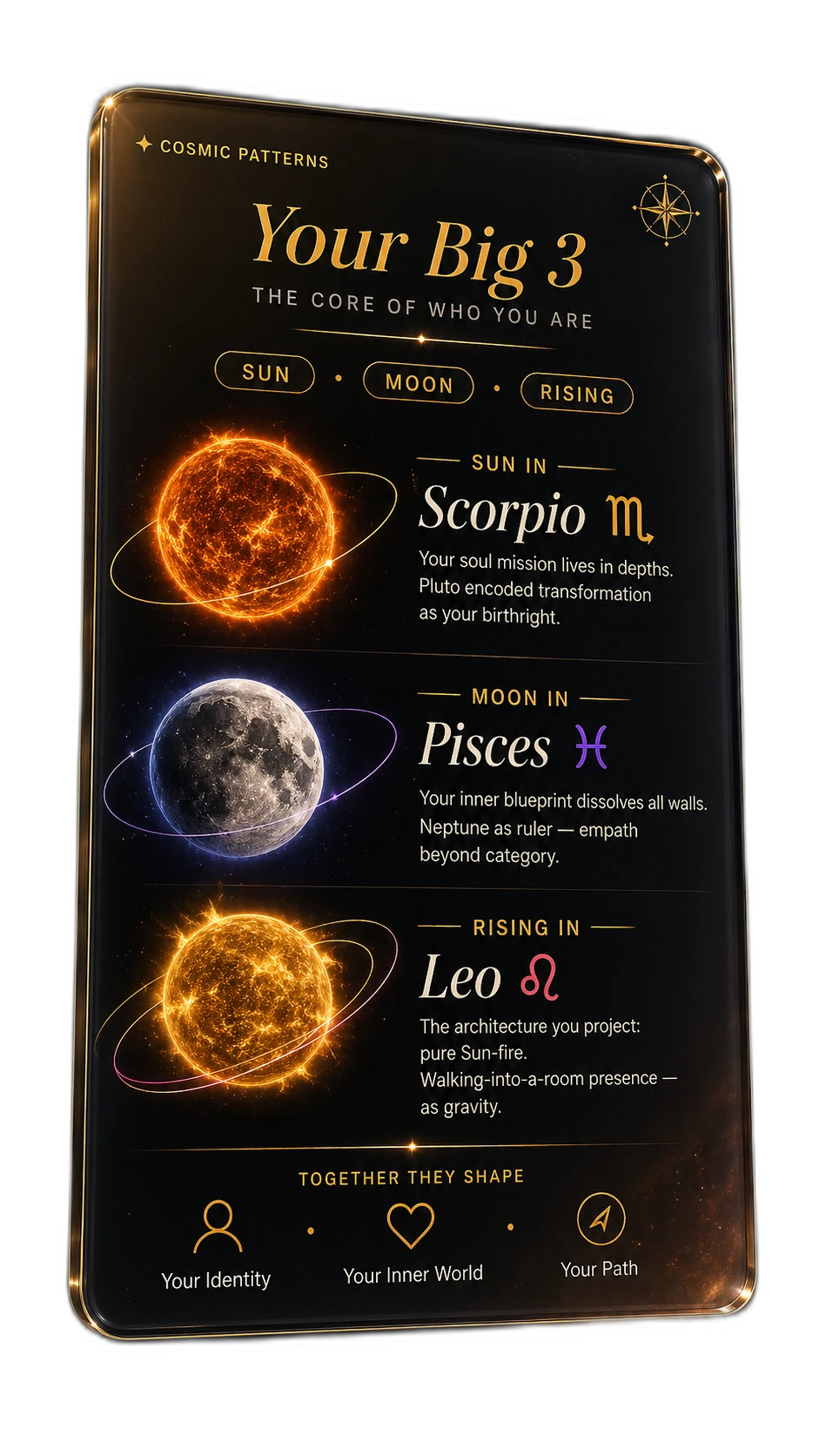
Cosmic Patterns uses whole sign. The free chart calculator draws your wheel that way from date, time and place, with every planet's house number listed beneath it, and the written Birth Chart reads those same houses, $9, down from $19, yours forever. The free Big 3 reading gives you the Rising sign that starts the count. If you want to see what moves when you switch, keep Astro-Seek open beside it and flip the menu. Then come back to one system and read the room. Some part of you has known which room it is for a long time.
For the houses themselves, see the best explanations of the 12 houses; for the tools, the best free birth chart calculators.
You have just read what these tools can do. None of them has read you. Somewhere in all that comparing sits a quieter question, and it is not which app is best. It is what your own sky actually says.
Your complete birth chart reads all ten planets, the aspects your chart supports and, with your birth time, the houses where each one does its work. Not a feature list. A reading of the one chart no comparison can rank: yours. All of the sky, not one page of it.

Your Complete Birth Chart
Read your full birth chart$19$9 · Yours forever · No subscription
frequently asked
Placidus or whole sign: which house system should I use?
Either, as long as you stay in one. Placidus is the default on most calculators and the frame most modern books assume; whole sign is the oldest system, gives each sign one full house and does not move with small birth-time errors. No house system has been proven correct, and they agree on the Ascendant and Midheaven; they differ in how the space between the angles is cut.
Why is my Moon in a different house on two calculators?
Because the two calculators use different house systems. Whole sign asks which sign the Moon is in, counted from your rising sign; Placidus asks how far the Moon had climbed past the horizon at your birth time. A planet near a house boundary can land in different houses under the two systems. Same sky, different cut.
What house system does Cosmic Patterns use?
Whole sign. The free chart calculator on the Birth Chart page draws your wheel with the sign of your Ascendant as the 1st house and each following sign as the next, and the written Birth Chart reads the same houses. The house pages say so as well.
Is whole sign more accurate than Placidus?
No system is more accurate in a provable sense; there is no experiment that settles it, and astrologers do not agree. Whole sign is older and holds still under small time errors; Placidus is more widely used and keeps the Midheaven on the 10th house cusp. Accuracy that can be measured lives in the inputs: exact birth time, resolved birthplace, correct time zone.
Does my birth time matter more in Placidus or in whole sign?
Both need it, because both start from the Ascendant. In whole sign a small error changes nothing until the Ascendant crosses into the next sign, which happens about once every 2 hours. In Placidus every cusp moves with every minute, so a 20-minute error shifts all 12 houses a little and can move a planet across a cusp.
Cosmic Patterns
birth charts, Big 3, and the patterns you keep repeating.