

What birth chart degrees mean and why they make the chart yours
You opened your birth chart, and next to almost every line there is a number. Sun in Pisces, 5.5. Ascendant in Leo, 20.9. A Moon in some sign you had never thought about, with a decimal hanging off it. Nobody explains the number. The report just assumes you already know, so you nod along and quietly wonder whether it is a score, a ranking, or a percentage of something.
It is none of those. It is a position on a circle. And the moment you see what it measures, your chart stops looking like a spreadsheet and starts looking like a map of one specific sky.
why every sign is exactly 30 degrees wide
Start with the shape, because the shape explains the number.
A birth chart is a circle. It is the sky around you at the moment you arrived, flattened onto a page. Everything else follows from that.
- A full circle has 360 degrees. That is geometry, true of any circle anywhere.
- That circle is divided into 12 zodiac signs.
- 360 divided by 12 is exactly 30. Every sign is 30 degrees wide. Not roughly. Exactly.
- So every planet in your chart sits somewhere between 0 and 30 degrees of its sign. There are no exceptions, because this is how the chart is constructed, not how someone chose to interpret it.
- Your chart is calculated from three inputs: your date of birth, your time of birth, and your place of birth.
A degree is a unit of distance, the way centimetres are units of distance on a ruler. It is not a rating, and nothing is being graded. Higher is not better. The degree answers one question: where along the ruler was this planet standing.
So "Sun in Pisces, 5.5 degrees" means that at the exact moment you were born, the Sun had travelled 5.5 degrees into the 30 degree stretch of sky we call Pisces. Early Pisces. Just over the threshold, still fresh in the sign.
what your specific degree is actually telling you
Since each sign is a 30 degree stretch, your degree tells you how far into that stretch a planet had moved when you took your first breath.
- 0 degrees is the very start. The planet has only just crossed the line into that sign.
- Around the middle, near 15, the planet sits in the full body of the sign.
- Close to 30 is the far end. The planet is nearly finished with that sign and about to step into the next one.
Take the second example: Ascendant in Leo at 20.9 degrees. That is late Leo, more than two thirds of the way through the sign, with fewer than 10 degrees left before the Ascendant would have landed in Virgo instead.
Read that again, because it is the whole point. Fewer than 10 degrees stood between "Leo rising" and a completely different rising sign. On a circle that turns all day long, that distance is measured in minutes of clock time.
why the degree is what makes the chart yours
The sky does not pause. Every point in your chart was moving while you were being born, and they move at wildly different speeds.
Look at what that table quietly tells you. Everyone born in the same month shares your Sun sign, and that is millions of people. Everyone born inside a two to three day window shares your Moon sign. But the Ascendant moves through an entire sign in one to two hours, which is why your birth time matters so much, and why two babies born in the same city on the same afternoon can end up with charts that read completely differently.
A zodiac sign is a drawer that millions of people share. A sign plus a degree is an address that only you live at. That is the entire difference between a horoscope column written for one twelfth of the planet and a chart calculated for one moment, in one place, that will never repeat in exactly that arrangement again.
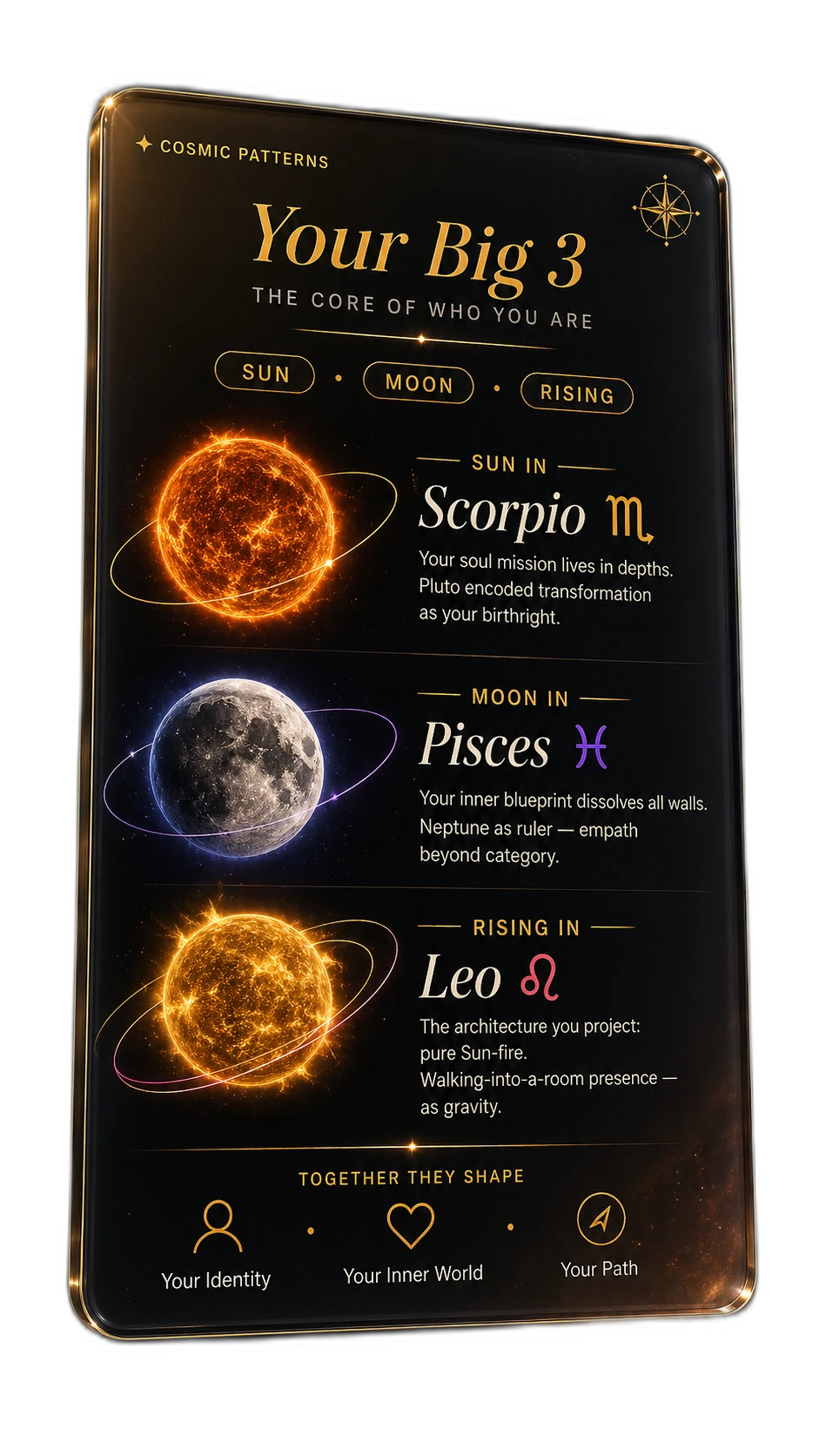
If you have never seen your three headline placements side by side, your free Big 3 gives you your Sun, Moon and Rising with the degree attached to each. And if you want the wider picture of how all the pieces sit together, the full walkthrough lives in how to read your birth chart.
how degrees also measure the space between two planets
Degrees do a second job, and this is the one that turns a list of placements into something that behaves like a person.
The same 360 degree circle also measures the distance between any two planets. When two planets sit at a particular angle to each other, they form an aspect: a conversation between those two parts of you. Two planets at a right angle are having a very different kind of conversation than two planets sitting almost on top of each other, and that is what aspects are about.
Here the degree becomes a volume dial. The closer the angle is to exact, the more intense that conversation runs. An aspect that is nearly perfect tends to feel loud, constant, hard to talk yourself out of. A looser one sits further back, more like a mood than a headline.
One honest caveat, because you will meet very confident numbers online: there is no single agreed table saying an aspect counts up to exactly this many degrees and switches off after that. Astrologers draw that line in different places, and anyone handing you one number as settled law is being tidier than the tradition actually is. What is genuinely agreed is the direction of travel: closer to exact means stronger.
The same degree logic runs through the four angles of your chart as well, since those are points on the same circle, measured with the same ruler.
what to do with this
You do not need to memorise anything. Three small moves are enough to make your own chart readable tonight.
- Find the degree next to your Sun, Moon and Rising. Write the three numbers down. That is your address, not your drawer.
- Ask early, middle or late. Under 10 is early in the sign, around 15 is the middle, over 20 is late. Late placements sit right beside the doorway of the following sign, which is often why someone says their sign never quite fitted them.
- Scan for repeated numbers. If two planets sit within a degree or two of the same number, even in different signs, they are almost certainly in conversation. That is where the interesting parts of a chart usually hide.
Do those three things and the number stops being decoration. It becomes the reason your chart says something specific about you instead of something general about a twelfth of humanity.
When you want the rest of it laid out properly, your full birth chart is $9, down from $19 and covers all 10 planets by sign and degree, your strongest aspects, your elemental balance, and a personalized audio walkthrough so you can hear it rather than study it. If you would rather keep exploring on your own first, start at how to read your birth chart and take it one layer at a time.
Your chart was drawn from one exact moment. The degrees are what make sure nobody else got the same one.
You have just read what these tools can do. None of them has read you. Somewhere in all that comparing sits a quieter question, and it is not which app is best. It is what your own sky actually says.
Your complete birth chart reads all ten planets, the aspects your chart supports and, with your birth time, the houses where each one does its work. Not a feature list. A reading of the one chart no comparison can rank: yours. All of the sky, not one page of it.

Your Complete Birth Chart
Read your full birth chart$19$9 · Yours forever · No subscription
frequently asked
What does 0 degrees mean in a birth chart?
It means the planet had only just entered that sign at the moment you were born. A full circle has 360 degrees and is divided into 12 zodiac signs, so every sign is exactly 30 degrees wide. That makes 0 degrees the very first step into a sign and close to 30 degrees the last step before the next one begins. A planet at 0 degrees is simply at the start of that stretch of sky. It is a position, not a score, so 0 is neither weak nor unlucky.
Why do the degrees in my birth chart matter?
Because the sign alone is shared by millions of people, and the degree is what narrows it down to you. The Sun stays in one sign for about a month, the Moon for two to three days, and the Ascendant changes sign roughly every one to two hours, so the degree records exactly where each point stood at your specific minute of birth. Degrees also measure the distance between two planets, which is how aspects (the conversations between different parts of you) are identified. Without degrees you have a category. With them you have a chart.
Is a high degree better than a low degree?
No. A degree is a measure of distance along a sign, like a centimetre mark on a ruler, not a rating of strength or quality. Because every sign is exactly 30 degrees wide, a planet at 2 degrees is simply near the beginning of that sign and a planet at 27 degrees is near the end. Neither position is better. The only thing a high number tells you is that the planet was close to moving into the following sign at the moment you were born.
Cosmic Patterns
birth charts, Big 3, and the patterns you keep repeating.