
Birth chart aspects explained: what those lines across your chart actually mean
Open your birth chart and look past the outer ring of signs, past the little planet symbols sitting at their degrees, into the empty middle of the wheel. There is a web of coloured lines crossing it: some red, some blue, some thin, some bold, a triangle here, one long line running straight across there.
Almost nobody explains those lines. They look like decoration. They are not. Those lines are your aspects, and they are the part of the chart that makes it specifically yours instead of a general description of your Sun sign.
The whole idea fits into one sentence: your planets do not act alone, they talk to each other, and the angle between them is the tone of voice they use.
What an aspect actually is
A birth chart is a circle, and a circle has 360 degrees. That circle gets divided into 12 signs of 30 degrees each, which is where every zodiac sign you have ever heard of lives. Each planet sits at one specific degree inside one specific sign. If the wheel itself is still unfamiliar, how to read your birth chart walks through the whole layout, and what the degrees mean fills in the numbers.
Once every planet has a position, you can measure the distance between any two of them. That angular distance is called an aspect. Astrology treats a small set of these angles as meaningful, and the five you will meet first are the major aspects: 0, 60, 90, 120 and 180 degrees.
Each planet is a function inside you, one specific job your psyche does. (If you are not yet sure which planet does what, start with the ten planets.) Your Moon is how you need to be cared for. Your Mars is how you go after what you want. When those two sit at one of these angles to each other, they stop being two separate facts about you and become one running conversation, with a texture you probably recognise from your own life.
> Your chart is not ten separate characters standing in ten separate rooms. It is a conversation, and the aspects tell you how each pair speaks: shoulder to shoulder, across a table, or through a wall. None of it is a sentence handed down to you. It is a description of a room you have been living in your whole life, finally written down.
The five major aspects at a glance
Read that table as a map of tones, not a scorecard. There is no column for good and bad.
How each aspect feels from the inside
Conjunction, 0 degrees
Two planets sitting at or near the same degree. They fuse. Neither one gets to act on its own any more: they arrive together, every time, as a single concentrated push.
Because of that, a conjunction has no fixed flavour of its own. Everything depends on which two functions are fused. The same geometry can feel like enormous focus in one chart and like an intensity you have to learn to steer in another. Which two planets are involved is the entire story.
Sextile, 60 degrees
An offer. Sextiles connect two functions in a way that is genuinely cooperative and often quietly creative, and the important word is available. The potential sits there waiting, and it tends to switch on when you actually participate: when you use the talent, take the opening, start the thing.
A sextile is not a conveyor belt that delivers results while you stand still. It is more like a door someone left standing open for you.
Square, 90 degrees
Two functions at right angles, pressing on each other. Squares create pressure, effort and a real demand that something get made, changed or handled. Nothing about a square is passive.
This is also where a great deal of genuine skill in a life comes from. Sustained work against friction builds capacity that ease never builds. The friction is real, and so is what it produces.
Trine, 120 degrees
Two functions in easy agreement. Trines flow. Whatever those two planets do together, they do fluently, often so naturally that you assume everybody can do it and never think to develop it.
One honest caution, because most beginner content skips it: a trine does not guarantee happiness, success, goodness, or protection from difficulty. It describes ease of function, not a good life. Ease can be enjoyed, and it can just as easily be taken for granted.
Opposition, 180 degrees
Two functions facing each other from opposite ends of the wheel, 180 degrees apart, exactly half of the full 360. This is a polarity: both ends are real, both belong to you, and the tension between them is the point.
Oppositions often show up as alternation. You swing to one end for a while, then over to the other. They also carry one specific habit worth knowing about: it is easy to live at one end and keep meeting the other end in other people, especially the people who reliably get under your skin. That is called projection, and noticing it is usually the moment an opposition starts working for you rather than on you.
Squares and oppositions are not a verdict
If you just counted several squares in your chart and felt your stomach drop, read this part twice.
A tension aspect is a workshop, not a verdict. It shows you where two parts of you are in an argument, and arguments between real forces are how things actually get built. It does not predict a hard life, a failed relationship, or a flaw you are stuck carrying.
There is also no need to sweeten it. Squares ask for effort, sometimes for years. Oppositions ask you to hold two true things at once when you would much rather pick one and be done. That is genuinely demanding. It is also the exact place most people find their competence, because you tend to become skilled at whatever you have had to keep working on.
The other half of that honesty: a chart full of trines guarantees nothing either. Ease you never engage with stays potential. Friction you keep showing up for turns into ability.
How close is close enough: the orb question
Two planets almost never sit at exactly 90.00 degrees from each other. So astrologers work with an orb, which is the allowance around the exact angle inside which the aspect still counts.
Here is what is worth knowing early, because plenty of beginner material states it far too confidently: an orb is an interpretive allowance, not a universally agreed boundary. There is no single official orb table every astrologer signs off on. Traditions differ, and some allow wider ranges for major aspects than for minor ones.
What is consistent is the direction. The closer two planets sit to the exact angle, the stronger and more insistent that aspect tends to feel in your actual experience. A nearly exact aspect usually describes something you would recognise instantly if someone named it out loud. A wide one behaves more like background weather.
Applying and separating: which way the conversation is moving
One more layer, and it is part of what separates a real reading from a generic one.
An aspect can be applying, meaning it is still moving toward exactness, or separating, meaning it has already passed through it. An applying aspect points to what is still building in you, still gathering. A separating aspect has already perfected and points to something receding, something already established in you.
Whether an aspect is applying or separating depends on the direction and speed of both planets at your moment of birth, which means it has to be calculated rather than assumed. You cannot eyeball it from the wheel.
What to look for first in your own chart
You do not need to read all of them. A chart with 10 planets can easily hold 20 or more aspects, and trying to absorb every single one at once is how people quietly give up. Start narrow.
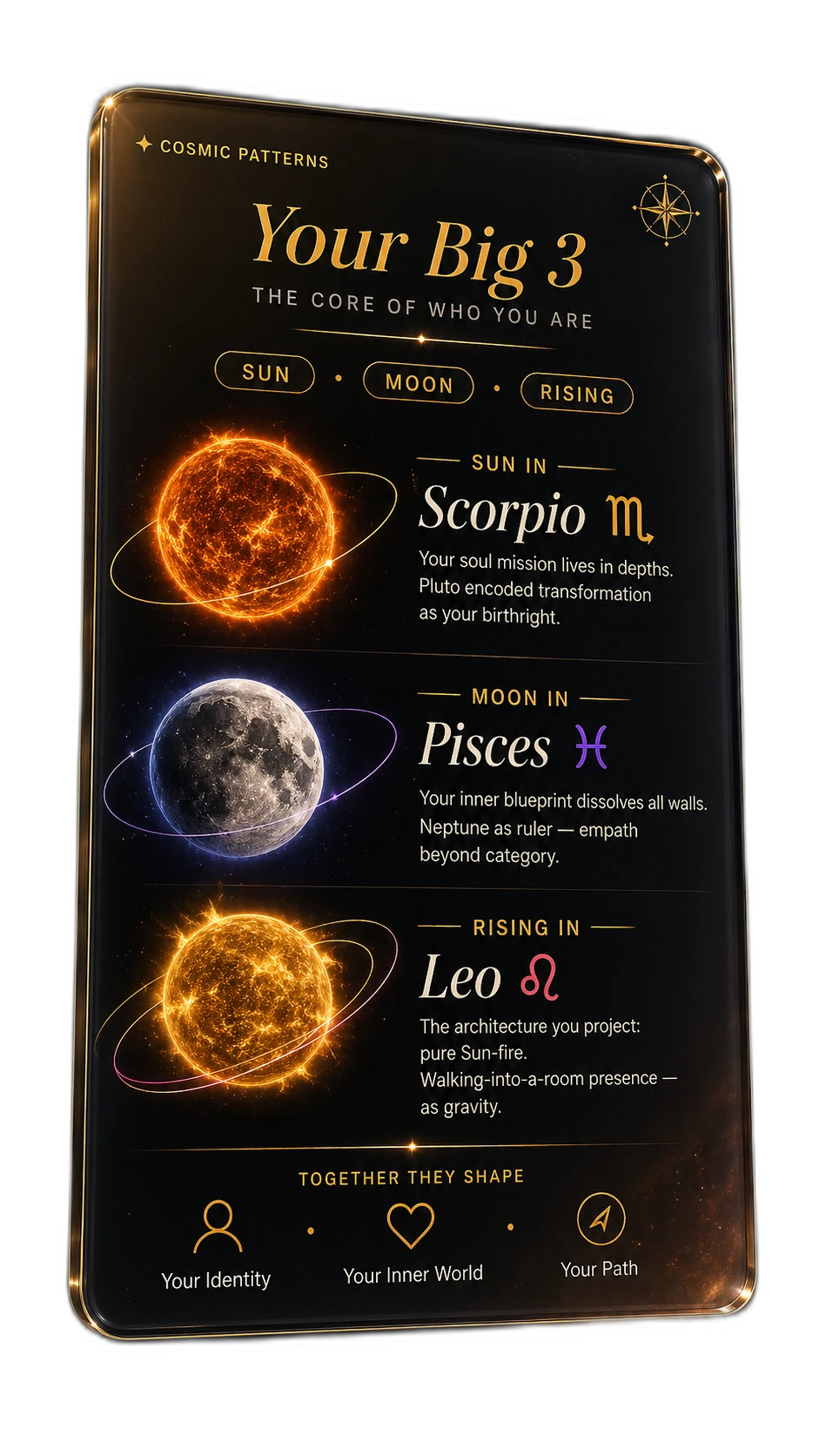
- Anything touching your Sun, Moon or Rising. These three are your core, so any planet in aspect to them colours something you already feel daily. If you have not met yours yet, your free Big 3 is the fastest way in.
- The tightest aspects. Find the two or three pairs closest to exact. Those tend to be the loudest voices in you.
- Every conjunction. Fused functions are usually easy to spot in your own behaviour once you know which two planets are involved.
- One square, deliberately. Pick a single square and ask what it has actually asked you to build. That question is the fastest way to feel the difference between reading a chart and being read by one.
Then keep going in context, because aspects make far more sense once you can see them sitting inside signs and houses. That is exactly what how to read your birth chart takes you through, step by step.
And when you would rather have the whole picture assembled for you than piece it together yourself, your full birth chart is $9, down from $19 and gives you all ten planets by sign and degree, your strongest aspects written out so they actually land, your elemental balance, and a personal audio walkthrough so you can hear your own chart spoken to you. It is the difference between learning the vocabulary and finally hearing the conversation.
You have just read what these tools can do. None of them has read you. Somewhere in all that comparing sits a quieter question, and it is not which app is best. It is what your own sky actually says.
Your complete birth chart reads all ten planets, the aspects your chart supports and, with your birth time, the houses where each one does its work. Not a feature list. A reading of the one chart no comparison can rank: yours. All of the sky, not one page of it.

Your Complete Birth Chart
Read your full birth chart$19$9 · Yours forever · No subscription
frequently asked
Which birth chart aspect is the best one to have?
None of them, and that framing is worth dropping early. Each of the five major aspects describes a different tone of relationship between two planets: the conjunction (0 degrees) concentrates both functions into one combined force, the sextile (60 degrees) offers cooperative potential that opens up when you take part, the square (90 degrees) applies pressure that often builds real skill, the trine (120 degrees) links two functions through natural ease, and the opposition (180 degrees) stretches them across a polarity. A trine is not a promise of happiness, success or protection from difficulty, and a square is not a promise of hardship. What matters far more is which two planets are involved and what you do with the conversation between them.
What does it mean when an aspect has a tight orb?
An orb is the allowance around an exact angle inside which an aspect is still counted, since two planets almost never sit at precisely 90.00 or 120.00 degrees apart. A tight orb means the two planets sit very close to the exact angle, and closer to exactness generally means stronger and more noticeable in lived experience. One caution: there is no universal orb table that all astrologers agree on. An orb is an interpretive allowance rather than a fixed rule, traditions differ, and some allow wider ranges for major aspects than for minor ones. So treat a tight orb as a signal of intensity, not as a number to defend.
Is a square aspect in my birth chart bad?
No. A square, the 90 degree angle between two planets, creates pressure, effort and a demand that something actually get built or handled. It is demanding, and pretending otherwise would be dishonest, but demanding is not the same as bad. Sustained work against friction develops capacity that ease never develops, which is why squares are so often the source of a person's real competence. The useful frame is that a tension aspect is a workshop rather than a verdict: it tells you where two forces in you are negotiating, not what your life is destined to look like.
Cosmic Patterns
birth charts, Big 3, and the patterns you keep repeating.