Planets in astrology: what each of the ten planets means
Here is the first thing to let go of: the ten planets in astrology are not distant rocks beaming influence at you across the solar system. They are names. Ten names for ten kinds of drive that are already running inside you, right now, while you read this sentence.
You know these forces without the labels already. The part of you that wants to matter. The part that needs softness at the end of a hard day. The part that talks, the part that reaches for closeness, the part that pushes back. Astrology named them a long time ago, then noticed something useful: each one shows up a little differently in each person, and your birth chart records exactly which version is yours.
Ten bodies make up the standard set: the Sun and the Moon (technically luminaries rather than planets, though everyone calls them planets, and so will we), plus Mercury, Venus, Mars, Jupiter, Saturn, Uranus, Neptune and Pluto. Learn what each one governs and your chart stops being a wheel of strange symbols. It starts sounding like a description of your actual inner life.
All ten planets at a glance
Keep that table close, because everything else here rests on one fact: the ten forces do not move at the same speed. Speed is what separates the parts of your chart that feel unmistakably like you from the parts you share with millions of people born around the same time.
The five personal planets: the fast ones that feel like you
Five planets move quickly enough to be genuinely personal: the Sun, the Moon, Mercury, Venus and Mars. Two people born a week apart already differ here, which is why these five carry most of what you would call your personality.
The Sun is your organizing center: conscious identity, vitality, will, purpose, and the drive to develop a creative life that is distinctly yours. It takes about a month to cross one of the 12 signs, which is why everyone born in the same few weeks shares a Sun sign. It is not your whole personality. It is your direction of growth, the person you are steadily becoming.
The Moon is instinctive feeling: emotional memory, habitual response, the way you care for people, and the exact conditions under which you feel safe and like you belong. It is the fastest thing in the chart, crossing a sign in only 2 to 3 days. Two babies born on the same day in the same city can have different Moons, and it shows in how they comfort themselves for life.
Mercury runs perception and thought: how you learn, how you use language, which information you select first and what you do with it once you have it. Mercury is the difference between the person who needs the whole picture before speaking and the person who thinks out loud to find out what they mean.
Venus is attraction and value: what you find beautiful, how you seek harmony and fairness, how you build common ground with another person. It governs taste as much as romance. Venus is why one person calls a room warm and another calls it cluttered.
Mars is action: assertion, defense, competition, desire, risk, and the force you use to move against resistance. Mars is not aggression by default. It is simply how you push, and whether you push early or late, loudly or quietly.
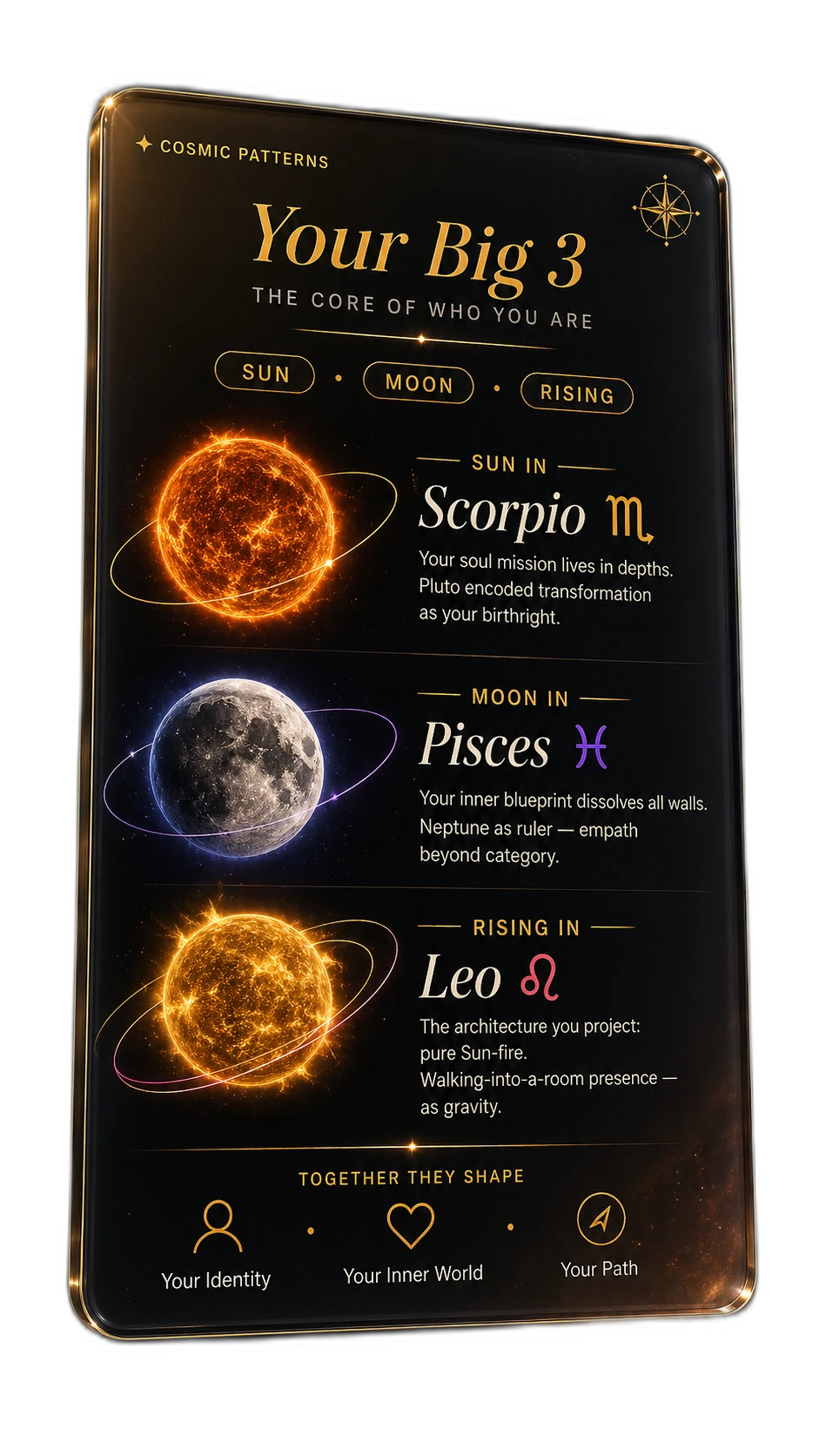
Worth knowing here: the Ascendant, or rising sign, is not a planet at all. It is the sign coming up over the horizon at the moment you were born, and it changes roughly every 1 to 2 hours, which is why an exact birth time matters so much. Your Sun, Moon and rising together are your free Big 3.
The two social planets: how you grow and how you build
Jupiter and Saturn sit in the middle. They are slow enough to describe a whole phase of collective life, fast enough to still feel like yours. Together they shape how you meet the world outside your private inner weather.
Jupiter is expansion: confidence, meaning, education, and the search for a wider horizon. Jupiter is where you say yes, where you believe more is available than you were told. Its one honest cost is excess, because enlargement rarely knows on its own when to stop.
Saturn is the opposite motion, and the necessary one: limits, consolidation, responsibility, time, and disciplined effort. Saturn is where you meet real conditions instead of wished-for ones, and mastery is what gets built there. Saturn is not punishment. It is the part of you that gets good at something by staying long enough to get good at it.
Read as a pair, Jupiter and Saturn describe your whole relationship with growth: where you reach, and where you have to earn it.
The three outer planets: slow, shared, and finally making sense
Uranus, Neptune and Pluto move so slowly that they take years to cross a single sign. That single fact is what makes them click. If a planet sits in one sign for years, then almost everyone born around your time has it in that same sign. This is why these three are read as generational: they describe the mood of an era before they describe you.
Uranus is liberation and disruption: independence, invention, and the mix of excitement and instability that comes with radical change. It is the part that refuses to keep doing something simply because it has always been done that way.
Neptune is imagination and merging: inspiration, compassion, and the softening of the boundary between you and everything else. Its gift is vision. Its risk is distortion, projection and confusion, the moments you lose the outline of what is true.
Pluto is intensity and renewal, and it is far calmer than its reputation suggests. Pluto strips an experience down to essentials, clears out what cannot come along, and rebuilds from what remains. It is the part of you that goes through something completely rather than halfway. Everyone has it. It is not a threat, it is a process of elimination and regeneration, and most people can name a chapter of their life that worked exactly like that.
So do the outer three matter for you personally? Yes, but conditionally. They become personal mainly where they touch one of your five fast planets. That touch is called an aspect, a measured angle between two planets, and it is what turns a generational placement into a private story. That is the subject of aspects.
Who, how, where: the key to reading any placement
Here is the backbone that makes the whole chart readable, and it never changes:
- The planet says WHICH force is speaking. Who.
- The sign says in WHICH STYLE it speaks. How. There are 12 signs, and their differences come from elements and modalities.
- The house says in WHICH AREA OF LIFE it plays out. Where. There are 12 houses, covering everything from money to home to partnership to public life.
Who, how, where. Mars in Libra in the 10th house becomes one clean sentence: your drive (who) works through diplomacy and fairness (how) and shows up most visibly in your career and public role (where). Once you have that grammar you can read a placement you have never seen before, which is the entire method behind how to read your birth chart.
The planets are not ten forces acting on you from a distance. They are ten forces acting from inside, and a birth chart is only the record of how they were arranged the moment you took your first breath. Nothing in it is a verdict. All of it is a description of the equipment you were handed, and what you do with that equipment has always been yours.
Which planets to look at first
Do not try to hold all ten at once. Go in this order:
- Sun, Moon and rising. Identity, emotional needs, and the way you meet the world. This is the fastest and most personal layer, and it is your free Big 3.
- Mercury, Venus and Mars. Thinking, loving, acting. These three explain most of the daily ease and friction in your relationships.
- Jupiter and Saturn. Where you expand, and where you build. This is the layer that usually explains your working life.
- Uranus, Neptune and Pluto, but only where they aspect a personal planet. Otherwise you are reading your generation rather than yourself.
That sequence keeps you from drowning, and it is the same order used in how to read your birth chart. Once you know which planet you are following, planets in the houses shows what it does in each area of life. Take one force at a time and let it sit for a day before moving on.
Which layer do you actually need?
Not everyone needs all ten planets on day one. The two readings answer different questions:
If the ten forces above felt like a lot, start with three. Sun: the self you claim. Moon: the self you protect. Rising: the self people meet before they know your story. Your Big 3 is free.
When you want all of it in one place instead of assembling it article by article, your full birth chart gives you 10 planets by sign and degree, your strongest aspects, your elemental balance, and a personalized audio walkthrough so you can hear how the ten forces actually work together in you. It is $9, down from $19, and it is yours to keep.
You have just read what these tools can do. None of them has read you. Somewhere in all that comparing sits a quieter question, and it is not which app is best. It is what your own sky actually says.
Your complete birth chart reads all ten planets, the aspects your chart supports and, with your birth time, the houses where each one does its work. Not a feature list. A reading of the one chart no comparison can rank: yours. All of the sky, not one page of it.

Your Complete Birth Chart
Read your full birth chart$19$9 · Yours forever · No subscription
frequently asked
Which planet matters most in a birth chart?
There is no single most important planet, but the fast, personal ones carry most of what feels like you. Start with the Sun (identity, purpose, vitality), the Moon (feelings, needs, what makes you feel safe) and the rising sign (how you meet the world). After those, Mercury, Venus and Mars fill in how you think, relate and act. The slow outer planets matter mainly where they connect closely to one of those personal placements.
Why does everyone my age have the same Pluto sign?
Because Pluto moves extremely slowly. It takes years to cross a single sign, so everyone born within that long stretch shares the placement. The same is true of Uranus and Neptune. That is why these three are called generational planets: they describe the era you were born into before they describe your individual temperament. Your Pluto becomes personal where it forms a close angle to one of your fast planets, such as the Sun, Moon, Mercury, Venus or Mars.
Is my Sun sign my whole personality?
No. The Sun takes about a month to cross a sign, so it groups you with everyone born in those few weeks. It describes your organizing center: identity, vitality, will and the life you are growing toward. It says nothing about how you feel in private (the Moon), how you think and speak (Mercury), how you love (Venus) or how you act under pressure (Mars). A full chart places all 10 planets across 12 signs and 12 houses, which is why two people with the same Sun sign can feel completely different.
Cosmic Patterns
birth charts, Big 3, and the patterns you keep repeating.