

Best Astrology Books for Beginners: Five Books That Teach the Chart, Not Just the Signs
The best astrology books for beginners share one quality: they teach you to read a chart rather than to recognise twelve personalities. Steven Forrest's The Inner Sky is the book most working astrologers name first, because it teaches planets, signs and houses as a language. Sue Tompkins' The Contemporary Astrologer's Handbook is the reference you keep beside the chart. Chris Brennan's Hellenistic Astrology explains where the whole system comes from. Demetra George's Astrology and the Authentic Self teaches chart synthesis, the step most books skip. Jessica Lanyadoo's Astrology for Real Relationships applies the chart to the part of life people ask about most. And because no book knows your placements, this comparison ends with where to read yours while you learn.
We compare the books by what they teach, in what order, and what they assume you already know. We link to the authors' own sites rather than to shops.
What a beginner's astrology book has to do
There are 10 planets, 12 signs, 12 houses and a few dozen aspect pairs in a chart. A beginner's book has to do three things with that: teach the planets before the signs, because what Mars does matters more than what Mars in Libra does; say when a birth time is needed, because the Rising sign and the houses depend on it; and show how placements combine, because a chart is a sentence, not a list of words. Most books that fail beginners fail on the third point. They explain every piece and never show how the pieces read together.
Steven Forrest, The Inner Sky: the language of the chart
What it teaches: Steven Forrest's classic teaches planets, signs and houses as parts of speech and then reads them together, with the psychological, choice-centred stance his school is known for. It is the book astrologers most often hand a beginner.
Best for: Learning the chart as a language, from the first page, without keyword tables.
Assumes: Nothing. It is written for the person who has just drawn their chart for the first time.
Sue Tompkins, The Contemporary Astrologer's Handbook: the reference you keep open
What it teaches: Sue Tompkins wrote the handbook many students keep beside the chart: planets, signs, houses and aspects, each explained with the precision of a teacher who has taught them for decades.
Best for: Looking up what a placement or an aspect means while you learn, in prose that respects you.
Assumes: That you have a chart in front of you and want to work through it.
Chris Brennan, Hellenistic Astrology: where the system comes from
What it teaches: Chris Brennan's book reconstructs the astrology of the Hellenistic period, the source of the houses, the dignities and most of the techniques still in use, and is the long-form companion to The Astrology Podcast.
Best for: The beginner who keeps asking why: why the houses mean what they mean, why Mars rules Aries, why astrologers disagree about house systems.
Assumes: Patience. It is a big book, and a second book rather than a first.
Demetra George, Astrology and the Authentic Self: how the pieces combine
What it teaches: Demetra George's book teaches chart synthesis: how to move from a list of placements to a reading of the whole, using traditional techniques in a modern frame. It is the book for the step most beginners get stuck on.
Best for: Someone who knows what their placements mean and cannot yet see how they fit together.
Assumes: The basics. Read it after Forrest or Tompkins.
Jessica Lanyadoo, Astrology for Real Relationships: the chart applied
What it teaches: Jessica Lanyadoo's book takes the chart into relationships, the subject most people come to astrology for, with the honesty her practice is known for: what the chart can show about how you love, and what it cannot decide for you.
Best for: Readers who learn best when the lesson is about something they care about now.
Assumes: Little. It teaches the relevant placements as it goes.
Where to read your own chart while you learn
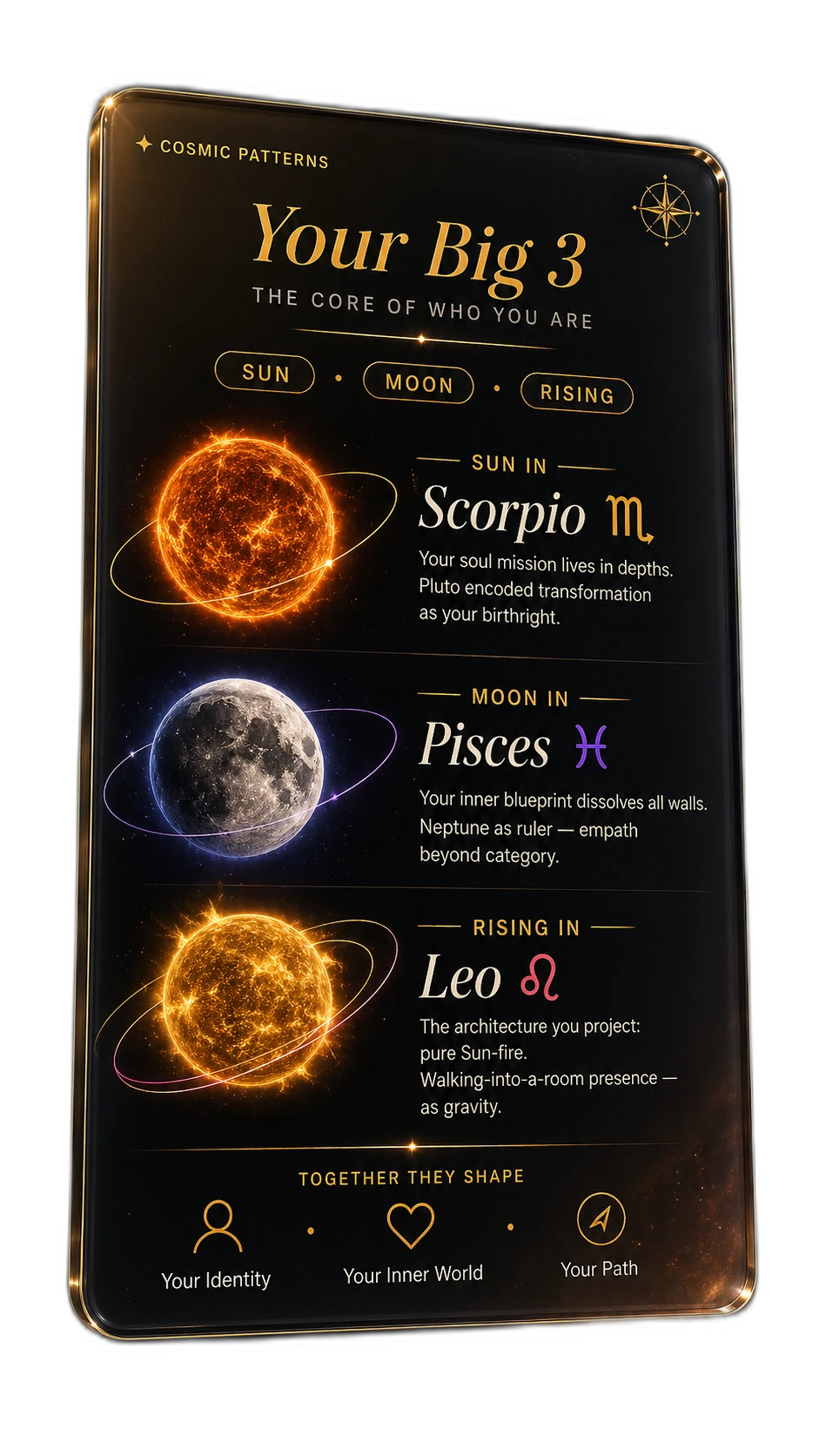
What it offers: No book knows your placements. Cosmic Patterns gives every sign, every planet in a sign and the Moon, Venus and Saturn in every house its own page, each with a fact block and a reading, so what you read in a book has a page for your own chart. The free Big 3 reading tells you your Sun, Moon and Rising; the Birth Chart reads all of your placements together, $9, down from $19, yours forever.
Best for: Reading the lesson against your own chart the same day.
Trade-off: It is a reading, not a textbook. Learn the language from the books; read your own sentence here.
Quick Comparison
How to read an astrology book so it sticks
- Draw your chart first. A book read without your chart beside it is a book about other people.
- Read the planets chapter twice. Everything else is planets in context.
- Look up your own placements as you meet them. One page per placement, read the day you learn what the placement means.
- Skip the sign chapters that are not yours on the first pass. You will come back for the people you love.
- Do the synthesis chapter with a pencil. Write your own reading in ten lines. That is the moment the book pays off.
Which one should you read first?
The Inner Sky, then Tompkins beside your chart, then Brennan when the why keeps you up at night, then George when the pieces will not combine, then Lanyadoo when someone else's chart enters the picture.
And while you read, let your own chart keep up: the free Big 3 gives you your three main placements, their pages give you the reading, and the Birth Chart gives you the whole sentence. Somewhere in the first chapter you will meet a placement you already knew was yours; that recognition is the whole reason to keep reading.
For the sites that teach the system online, see the best astrology websites to learn your birth chart; for the houses in particular, the best explanations of the 12 houses.
You have just read what these tools can do. None of them has read you. Somewhere in all that comparing sits a quieter question, and it is not which app is best. It is what your own sky actually says.
Your complete birth chart reads all ten planets, the aspects your chart supports and, with your birth time, the houses where each one does its work. Not a feature list. A reading of the one chart no comparison can rank: yours. All of the sky, not one page of it.

Your Complete Birth Chart
Read your full birth chart$19$9 · Yours forever · No subscription
frequently asked
What is the best astrology book for a complete beginner?
Steven Forrest's The Inner Sky. It teaches planets, signs and houses as a language and shows how they read together, without keyword tables, and it assumes you have never read a chart before. Sue Tompkins' handbook is the reference to keep beside it.
In what order should I read astrology books?
The Inner Sky first, for the language. Tompkins' handbook beside your chart as you learn placements. Brennan's Hellenistic Astrology when you want to know where the system comes from. Demetra George when your placements will not combine into a reading. Lanyadoo when another person's chart enters the picture.
Do astrology books tell me my own chart?
No. A book explains what placements mean in general; it cannot know yours. Draw your chart at a free calculator first, or read your Sun, Moon and Rising free at Cosmic Patterns, then look each placement up as you meet it in the book.
Which astrology book explains the houses best?
For the origins and the reasoning, Chris Brennan's Hellenistic Astrology. For clear working definitions of each house and each placement in it, Sue Tompkins' handbook. For how the houses combine into a reading, Demetra George's book.
Is there an astrology book about relationships for beginners?
Jessica Lanyadoo's Astrology for Real Relationships. It teaches the relevant placements as it goes and is honest about what a chart can and cannot decide about how two people fit. For reading two actual charts together, that is what synastry does.
Cosmic Patterns
birth charts, Big 3, and the patterns you keep repeating.